
Grantmakers In Health (GIH) is pleased to release our 2026 Policy Priorities Agenda. Now more than ever, philanthropic organizations must act decisively and strategically to improve the conditions in communities that impact health and to protect communities from harm. We hope these priorities will inspire the field of health philanthropy and encourage greater collaboration and commitment to common policy goals. GIH looks forward to working with funders and others to advance this agenda.
Grantmakers In Health’s strategic plan elevates leadership and influence as one of four strategic pillars for our work. GIH seeks to take a more active role in defining the key issues that will advance better health for all, including by supporting health philanthropy to create lasting impact by influencing advocacy, policy, and funding in targeted areas.
To deliver on this, GIH has partnered with Leavitt Partners, a leading health care policy consultancy, to develop a set of policy, advocacy, and legal strategy resources that aim to inform funders about the important health policy trends in the White House and Congress.
Grantmakers In Health (GIH) is grateful to the 30 co-signatories who joined us in submitting a comment letter responding to a proposed Centers for Medicare and Medicaid Services (CMS) Interim Final Rule requiring adult Medicaid beneficiaries to work or perform community service for 80 hours per month or risk losing their Medicaid benefits.
If implemented, the Interim Final Rule would create procedural barriers to coverage for eligible individuals and families, while imposing significant administrative burdens across the Medicaid ecosystem, including for beneficiaries, community-based organizations (CBOs), and health care providers.
GIH Health Policy Update Newsletter
An Exclusive Resource for GIH Funding Partners
GIH’s Health Policy Update newsletter, published twice a month, is an essential resource for helping our Funding Partners to better understand the changing federal health policy landscape.
Policy and Advocacy Resources
Summary of Medicaid Community Engagement Interim Final Rule
Make Our Children Healthy Again Strategy Report
2026 Federal Health Policy Timeline
This timeline previews expected regulatory and legislative health policy events in 2026.
Funding Partners interested in state legislative sessions should visit NCSL’s State Legislative Session Calendar.
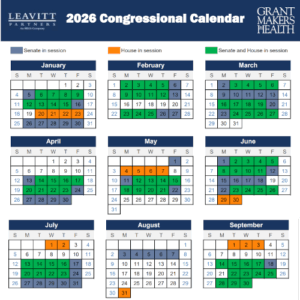
2026 Congressional Calendar
When each house of congress will be in session in 2026.
Overview of the 119th Congress
A detailed overview of the U.S. House of Representatives and Senate, including leadership in both houses and key committee and subcommittee members.
Congressional Staff and Member Outreach
A detailed overview of how congressional offices, committees, and leadership are staffed. In addition, it provides recommended best practices for meeting with Members of Congress and their staff.
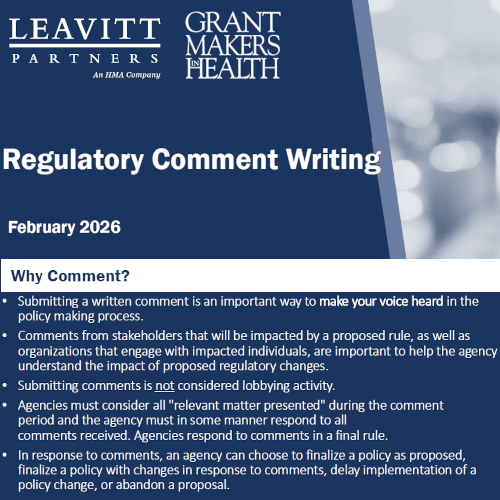
Regulatory Comment Writing
This resource provides an overview of how to write and submit a regulatory comment to the federal register.
Upcoming Policy & Advocacy Events
Legal Strategy Resources
Health-Related Executive Orders and Presidential Memoranda
This Grantmakers In Health policy resource summarizes health-related executive orders and presidential memoranda issued since 2015, highlighting implications for health funders. It tracks directives on behavioral health, Medicaid, prescription drugs, federal grantmaking, DEI, gender-affirming care, child welfare, vaccines, and related litigation affecting implementation.
August 2026 Executive Order on Childhood Vaccines: Overview, Implications, and Stakeholder Reactions
This Grantmakers In Health policy resource provides an overview of the August 2026 executive order on childhood vaccines, including the restructuring of the federal immunization schedule, the directive to split the MMR vaccine, implications for insurance coverage, family costs, and state exemption laws, and reactions from stakeholders.
Select Legal Challenges Relevant to Health Funders in 2026
This resource highlights key court cases that could affect health funders, their communities, and their partners. It focuses on legal challenges to changes in federal programs and policies implemented by the current Administration. The brief also highlights significant cases related to health funders’ priorities. Understanding these cases can help funders anticipate changes in federal policy, assess potential implications, and identify opportunities to support or protect health programs and services.
Recently Featured

What’s Coming Up in 2019 for GIH and Health Philanthropy?
In 2019, there are several trends we will be following. These trends show that, in general, funders are grappling with the changing environments of service delivery, health in communities, and organizational effectiveness.
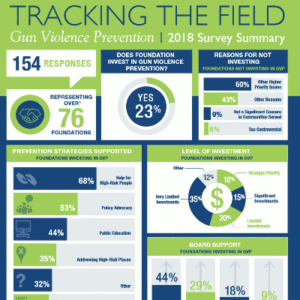
Gun Violence Prevention Infographic (2018)
Gun violence is a public health crisis in the United States, with approximately 120,000 Americans injured or killed by guns each year. GIH surveyed Funding Partners in June 2018 to explore investments in gun violence prevention and found that health funders who support gun violence prevention efforts are investing in a wide range of prevention strategies, including support for high-risk populations and policy advocacy. The survey results have been compiled into a one-page summary infographic.
Cone Health Foundation is Taking the Long View: Public Policy Advocacy
To date, Cone Health Foundation has made grant investments of $86 million, spread over 1,500 grants in four priority areas (access to care, adolescent pregnancy prevention, HIV, and mental health and substance use disorders).

Riding Wild Horses: Philanthropic Strategy in An Era of Unpredictable Health Policy
In 2015, Montana passed bipartisan legislation to expand Medicaid for low-income adults. The new coverage went into effect in January 2016. Within a year, Montana’s uninsured rate dropped from 15 to 7.4 percent and more than 30,000 thousand newly-insured people had already obtained preventive services.
Violence Is Preventable
Mass shootings command public attention, but for too many Americans violence is a threat that must be confronted every day. Violent crime, although low relative to historical rates, has risen in recent years and disproportionally affects poor, racially segregated, urban neighborhoods (U.S. Department of Justice 2017; U.S. Department of Housing and Urban Development 2016).

Three Ways Foundations Can Navigate Changing Political Tides
In today’s turbulent climate, when shifting political winds and policy changes go hand-in-hand with ever-expanding health care needs across the country, how can health funders be strategically effective?