

Grantmakers In Health (GIH) is pleased to release our 2026 Policy Priorities Agenda. Now more than ever, philanthropic organizations must act decisively and strategically to improve the conditions in communities that impact health and to protect communities from harm. We hope these priorities will inspire the field of health philanthropy and encourage greater collaboration and commitment to common policy goals. GIH looks forward to working with funders and others to advance this agenda.
Grantmakers In Health’s strategic plan elevates leadership and influence as one of four strategic pillars for our work. GIH seeks to take a more active role in defining the key issues that will advance better health for all, including by supporting health philanthropy to create lasting impact by influencing advocacy, policy, and funding in targeted areas.
To deliver on this, GIH has partnered with Leavitt Partners, a leading health care policy consultancy, to develop a set of policy, advocacy, and legal strategy resources that aim to inform funders about the important health policy trends in the White House and Congress.
Grantmakers In Health (GIH) is grateful to the 30 co-signatories who joined us in submitting a comment letter responding to a proposed Centers for Medicare and Medicaid Services (CMS) Interim Final Rule requiring adult Medicaid beneficiaries to work or perform community service for 80 hours per month or risk losing their Medicaid benefits.
If implemented, the Interim Final Rule would create procedural barriers to coverage for eligible individuals and families, while imposing significant administrative burdens across the Medicaid ecosystem, including for beneficiaries, community-based organizations (CBOs), and health care providers.
GIH Health Policy Update Newsletter
An Exclusive Resource for GIH Funding Partners
GIH’s Health Policy Update newsletter, published twice a month, is an essential resource for helping our Funding Partners to better understand the changing federal health policy landscape.
Policy and Advocacy Resources
Summary of Medicaid Community Engagement Interim Final Rule
Make Our Children Healthy Again Strategy Report
2026 Federal Health Policy Timeline
This timeline previews expected regulatory and legislative health policy events in 2026.
Funding Partners interested in state legislative sessions should visit NCSL’s State Legislative Session Calendar.
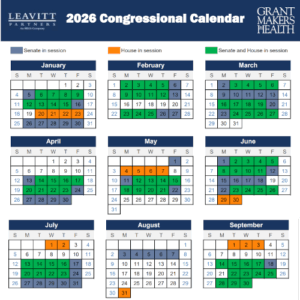
2026 Congressional Calendar
When each house of congress will be in session in 2026.
Overview of the 119th Congress
A detailed overview of the U.S. House of Representatives and Senate, including leadership in both houses and key committee and subcommittee members.
Congressional Staff and Member Outreach
A detailed overview of how congressional offices, committees, and leadership are staffed. In addition, it provides recommended best practices for meeting with Members of Congress and their staff.
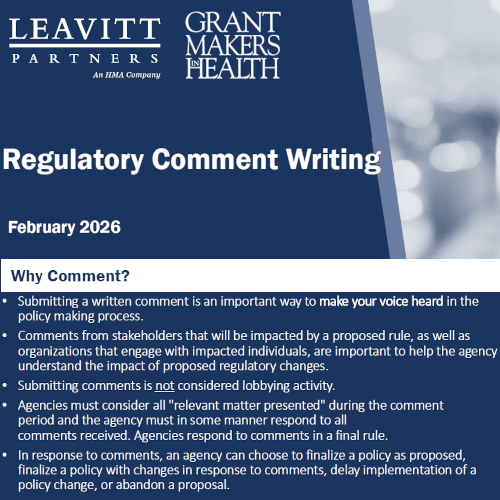
Regulatory Comment Writing
This resource provides an overview of how to write and submit a regulatory comment to the federal register.
Upcoming Policy & Advocacy Events
Legal Strategy Resources
Health-Related Executive Orders and Presidential Memoranda
This Grantmakers In Health policy resource summarizes health-related executive orders and presidential memoranda issued since 2015, highlighting implications for health funders. It tracks directives on behavioral health, Medicaid, prescription drugs, federal grantmaking, DEI, gender-affirming care, child welfare, vaccines, and related litigation affecting implementation.
August 2026 Executive Order on Childhood Vaccines: Overview, Implications, and Stakeholder Reactions
This Grantmakers In Health policy resource provides an overview of the August 2026 executive order on childhood vaccines, including the restructuring of the federal immunization schedule, the directive to split the MMR vaccine, implications for insurance coverage, family costs, and state exemption laws, and reactions from stakeholders.
Select Legal Challenges Relevant to Health Funders in 2026
This resource highlights key court cases that could affect health funders, their communities, and their partners. It focuses on legal challenges to changes in federal programs and policies implemented by the current Administration. The brief also highlights significant cases related to health funders’ priorities. Understanding these cases can help funders anticipate changes in federal policy, assess potential implications, and identify opportunities to support or protect health programs and services.
Recently Featured
Public Policy Engagement During an Election Year
Political elections create both challenges and opportunities for foundations seeking to inform and influence the public policy process. Philanthropic organizations have broad latitude to conduct or sponsor a variety of policyrelated activities, and this flexibility includes the ability to promote civic engagement and encourage informed participation in democratic elections.
Grant Agreements and Lobbying
Have you read your grant agreement or grant award
letter recently? Not just scanned it to make sure the
reporting dates have been updated, but read every
paragraph or clause to make sure the agreement says what you
think it says…and what you want it to say? If not, it is time to
do it now.
Cultivating the Next Generation of Philanthropic Leadership
Fellows from the inaugural Terrance Keenan Institute for Emerging Leaders in Health Philanthropy share their thoughts on how the field of philanthropy can help cultivate the next generation of leaders.
2011 Terrance Keenan Award Acceptance Speech
Read the acceptance speech of Drew Altman, head of The Henry J. Kaiser Family Foundation, upon receiving the 2011 Terrance Keenan Leadership Award in Health Philanthropy. He shares his thoughts on what foundations should be, concerns about the field, the theory of change, and his experience transforming Kaiser into what it is today.
Building Capacity for Health Advocacy at the State and Local Level
This paper was prepared in conjunction with a strategy session convened by GIH and sponsored by the Missouri Foundation for Health and The California Endowment last fall. It examines philanthropy’s role in advocacy, the various sectors that constitute the field of health advocacy, capacities required to effectively engage in advocacy efforts, ways health funders have facilitated advocacy capacity development, and key issues for future action.

Giving Voice: The Power of Grassroots Advocacy in Shaping Public Policy
Within advocacy work, there exists a wide spectrum of strategies that can be employed to change or shape public policy. Yet, too often, nonprofit health organizations tend to limit themselves to a narrow range of strategies that typically includes education, policy/data analysis, and limited legislative advocacy. While these strategies are important to public policy work, they may not be enough to influence policymakers in today’s increasingly special interest and ideological-driven political system.