
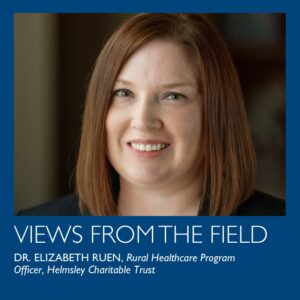

Dr. Elizabeth Ruen, Rural Healthcare Program Officer, Helmsley Charitable Trust
Sometimes innovation in philanthropy is associated with breakthrough technologies or new medical discoveries. But some of the most impactful investments fund something less visible: the coordination of people, protocols, and institutions already in place so they work together seamlessly to save lives.
The Leona M. and Harry B. Helmsley Charitable Trust has worked to advance health equity by improving access to timely, high-quality care in rural communities. As part of this broader investment, Helmsley has supported the American Heart Association’s Mission: Lifeline cardiac and stroke programs to transform care across multiple states, demonstrating how philanthropy can catalyze large-scale systems change and improve patient outcomes.
These improvements resulted from the methodical and often understated work of coordination, communication, and collaboration, an effort to connect the many components of acute care across a state into a single, integrated system of care.
For philanthropic organizations, this work underscores an important lesson: meaningful improvements in health outcomes often depend less on new interventions and more on strengthening how existing systems function. These are complex, cross-sector efforts that require sustained investment and coordination, roles that philanthropy is uniquely positioned to play.
An example of these efforts is Helmsley’s funding of the implementation of Mission: Lifeline Stroke in seven states. This robust system of care begins the moment a patient experiences symptoms and extends through hospital discharge and rehabilitation. It brings together EMS and first responders, hospitals, rehabilitation providers, communications and regulatory agencies, and state and local government.
Stroke systems of care save lives everywhere, but they are especially important in rural states, where patients often travel long distances to reach care, and every delay carries greater risk. In an acute stroke, time is brain: every minute saved improves survival and recovery.
Stroke is the fourth leading cause of death in the United States, and survival rates are lower in rural areas (Palaniappan et al, 2026). A 2020 study published in Stroke looked at nearly 800,000 stroke patients and found that while the overall in-hospital mortality rate was 6 percent, the risk of death was 16 percent higher for patients in rural areas and 21 percent higher for patients in remote rural areas (Hammond et al, 2020).
For funders focused on rural health, these challenges are especially acute. While philanthropy cannot change the distance a rural patient must travel, it can play a critical role in ensuring that systems are designed to overcome those barriers, improving the quality, speed, and coordination of care when patients arrive.
That’s why Helmsley has supported the establishment of statewide systems of care designed to make treatment as efficient as possible, with no time wasted. In rural states, coordinated systems of care are one of the most effective ways to maximize a patient’s chances for the best possible recovery.
Since 2017, Helmsley has invested $36 million to bring the American Heart Association’s Mission: Lifeline Stroke program to Hawaii, Iowa, Minnesota, Montana, Nebraska, North Dakota, and South Dakota, with measurable improvements in system coordination and patient outcomes across states. In these states, funding supported statewide coordination, data sharing, provider training, and the alignment of stakeholders who do not typically operate within a single system. This included direct investments in the hospitals and EMS providers operating in rural communities to participate in data collection, attend educational opportunities, and obtain certifications.
For rural communities, where structural barriers may limit access to timely, high-quality care, these investments have had a significant and lasting impact. By improving coordination across providers and settings, Helmsley’s support has helped reduce disparities in care delivery, strengthen local capacity, and ensure that more patients receive the right care at the right time regardless of geography. By funding the infrastructure required for participation, philanthropy helped create durable systems that continue to function beyond the life of a grant.
A system of care can touch every stage of the patient journey, and for stroke, that system of care begins with the first signs of symptoms. Public education campaigns led by the American Heart Association have helped communities recognize stroke warning signs and act quickly, using the acronym B.E. F.A.S.T.: Balance loss, Eyesight changes, Face drooping or twisting, Arm weakness, Speech difficulty, and Time to call 911.
A coordinated EMS network identifies stroke patients quickly and transports them to the most appropriate facility. EMS teams may also activate hospital stroke teams while en route, ensuring that specialists are ready when the patient arrives and reducing time before treatment.
Within hospitals, stroke care teams receive standardized training and follow shared evidence-based protocols for treatment. These consistent practices improve outcomes while enabling seamless transfers between hospitals and smoother transitions to rehabilitation care when needed.
The outcomes have proven the difference that investments in systems of care can make.
In North Dakota, for example, among acute ischemic stroke patients who received a clot-busting drug called tissue plasminogen activator (tPA), 66.7 percent had a “door-to-needle” time of 60 minutes or less. After the American Heart Association’s Mission: Lifeline Stroke program expanded to the state in 2017, that figure rose to 84.7 percent by 2020.
We saw similar gains in Iowa. There, the percentage of patients at Critical Access Hospitals who received a CT scan within 25 minutes of arrival increased from 62.5 percent in 2021 to 72.1 percent in 2024.
The final stage of the stroke journey—rehabilitation—is equally important for recovery. Mission: Lifeline Stroke helps ensure that rehabilitation providers follow the same evidence-based practices used throughout the broader system of care.
Historically, however, most post-acute stroke care standards were designed for large hospitals and inpatient facilities in urban areas. Smaller rural hospitals and skilled nursing facilities often lacked a certification framework designed with their realities in mind.
In 2024, the American Heart Association launched its first certification for post-acute stroke care, developed with Helmsley’s support and with a specific focus on rehabilitation facilities in rural communities.
For the first time, smaller hospitals and skilled nursing facilities had access to a nationally recognized standard designed for their setting.
The response from providers has been overwhelmingly positive. Following successful beta testing in Montana and implementation in Iowa, the certification has since become a standard component of the Mission: Lifeline Stroke program.
Thanks to the deliberate work of thousands of EMS professionals, clinicians, and health system leaders across multiple states, stroke patients today are receiving faster, more coordinated care, and many are returning home with better chances for recovery.
This approach offers several lessons for philanthropy. First, investments in systems, while less visible than new technologies, can yield significant and measurable improvements in outcomes. Second, rural communities benefit from strategies tailored to their unique contexts rather than adaptations of urban models. Finally, long-term commitment is essential; building and sustaining coordinated systems of care takes time, trust, and continued support.
For philanthropic organizations, this work offers a clear call to action. Advancing health outcomes, particularly in rural communities, will require more than funding individual programs or technologies. It will require sustained investment in the systems that connect care, the partnerships that sustain it, and the infrastructure that allows it to function effectively.
Innovation in health care does not always come from advances in medicine or technology. Sometimes, it comes from ensuring that what already exists works better together.
References
Hammond, Gmerice, Alina A. Luke, Lauren Elson, Amytis Towfighi, and Karen E. Joynt Maddox. “Urban-Rural Inequities in Acute Stroke Care and In-Hospital Mortality.” Stroke. 51, 7 (June 17, 2020)
Palaniappan, Latha P., Norrina B. Allen, Zaid I. Almarzooq, Cheryl A.M. Anderson, et al. “2026 Heart Disease and Stroke Statistics: A Report of US and Global Data from the American Heart Association.” Circulation. 153, 9 (January 21, 2026)