
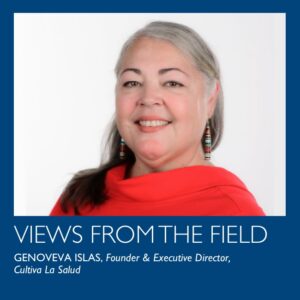

Genoveva Islas, Founder & Executive Director, Cultiva La Salud
A native of Fresno, I was raised in California’s Central Valley where I have now worked for a few decades. As a first-generation college student, my lived experience is very common for the children of farmworkers. My extended Mexican family was big, poor, uninsured, and suffered many losses from violence and preventable illnesses.
My story is not unique; the poverty experienced in our region places us as one of the most economically depressed regions in the U.S. The health inequity experienced here is well-documented. To understand how this happens in a region of agricultural wealth, you must appreciate the conspiring forces that generate disparity.
Fresno County is the agricultural powerhouse of California and arguably the nation. We produce an abundance of food products at a speed and scale that very few regions in America can rival. Agribusiness is a multimillion-dollar industry. Its influence is omnipresent in everything from education to politics.
Agribusiness, like any other business, is about profit at the end of the day. Protecting profit drives employers to enlist vulnerable workers who accept low wages and are less likely to complain. Protecting profit drives the use of unsustainable agricultural practices that lead to higher crop yields at the cost of water and air contamination. Protecting profit is what drives healthy food grown in our region to be sold elsewhere to those willing to pay more.
We are living in a system that is doing exactly what it is designed to do—grow food for profit, not to keep us healthy and thriving.
Investing in Community Prosperity for Better Health
In regions like the Central Valley, single siloed efforts are not enough to make a difference. We need interventions that create multiplicative benefits and create building blocks for change in the long term. That’s the focus of the work of Cultiva La Salud – to “cultivate health” through a food systems approach. At our core, we are about increasing access to healthy food in disadvantaged neighborhoods, but we are also about creating economic opportunities for disadvantaged community groups by positioning them to be successful small food business owners. Our work is about investing resources to create assets that can then be leveraged to address other needs in local communities.
Many efforts aimed at increasing access to healthy foods often do so by inviting well-intentioned groups into neighborhoods to address food insecurity. This is not the best approach, because in our experience, those outside groups often reinvest back into the neighborhoods where they live instead of ours. We need resources to stay in our community.
Cultiva La Salud began its work by appreciating that there are assets in our community that can be supported and improved. Street food vendors are small food business owners who live in the neighborhoods where they sell their food. There is no need to convince them to go into certain neighborhoods or invest back into the neighborhood, because they are already doing that. Our approach is to support them in selling healthier options.
Our team starts with outreach to street food vendors to build relationships with them. Our goal is to meet these vendors where they are, without judgment, and offer them support in their preferred language at no cost. We aren’t the government, and we aren’t reporting them to anyone. We are providing them with resources and an opportunity to establish a legitimate small food business.
The team supports them in knowing the ordinances and requirements to operate as small food businesses in Fresno. We offer free food handling classes, conducted in-person and in Spanish that, upon successful completion, allow us to work with them to obtain a license from the city and a permit from the Fresno County Environmental Health Department. We also help them write out their recipes and outline their food preparation procedures, which is a huge help for vendors who have limited education, literacy, and English fluency. Once these steps are completed and vendors have approved vending carts, they are ready to operate.
Street food vendors often sell food that is fried and processed with little nutritional value, because they are inexpensive to purchase and are shelf stable. The minute you cut produce for a salad and place it in a clamshell container to sell, you must demonstrate that you have a food handler certificate and that you prepared that item in a certified commercial kitchen that complies with all standards of sanitation. Restaurants can easily comply with these standards, but street food vendors must find a workaround.
Partnering with a community kitchen is an effective solution. They provide the much-needed infrastructure for street food vendors to sell healthy food options. In the absence of community kitchens, vendors are left to their own devices to prepare and sell food covertly, which could ultimately lead to negative interactions with code enforcement, fines, and even criminal charges. After working with vendors to obtain their certifications, licenses, and permits, we refer them to operating kitchens and other groups that will help them with their business planning, tax filing, and insurance needs. We want street food vendors to be successful and well-positioned to share in the economic prosperity that the food system can offer.
When the vendors are ready, we provide them with access to nutrition and healthy cooking classes. We partner with the California Association of Family Farmers (CAFF) to make connections with local farmers and to maximize sourcing of locally-grown food. We teach them about seasonality and showcase recipes that use locally grown items. Vendors also influence farmers on what they need for their recipes, creating an ecosystem that supports vendors in offering healthier options and centers local small ethnic farmers. This is how we win in increasing access to healthy foods and reshaping our food system.
As we look to the future, our next goal is to build a new community kitchen—Cocina La Salud. While our partnerships are vital, a community kitchen is still needed as infrastructure to fully support street food vendors in selling healthier options. This kitchen will open new doors for those who may dream of becoming food truck operators or restaurateurs. Many vendors are also hoping to maximize catering opportunities in the kitchen. Last year, we purchased a building near downtown Fresno and hope to be ready for operation in 2027.
We continue to see new opportunities for these vendors to grow and serve the community. Some examples include providing medically tailored meals to vulnerable community members, or food processing services for small farmers. The opportunities to maximize the kitchen space to support community needs and build a healthier food system are endless, and that’s the beauty of adding resources in disadvantaged communities—it allows people to be creative and dream.
Building an advantage from a disadvantage is no easy feat. It’s a work in progress for us, but we know that investing in community works. It is possible to change the trajectory of our food systems and ensure that future generations have more prosperous futures.
What This Work Needs to Thrive
Work like this does not fail because the community lacks commitment; it stalls because funding structures force organizations to operate from scarcity. When grants are small, short, and conditional, leaders spend more time managing survival than building systems. That is a choice funders make, and it can be made differently. Here are some recommendations for how funders might want to approach their support for organizations like Cultiva La Salud:
- Fund bigger up front. Cultiva La Salud did not stumble into a building purchase and a community kitchen vision. That came from years of trust-building, systems thinking, and relationships that are simply not fundable in $25,000 increments. We’ve only recently been able to purchase a building because we cobbled together funding for the down payment and because we’ve built a solid history with our bank, who gave us a loan for the building. With larger investments up-front we would have been further down the road of success. Significant up-front investment lets leaders plan, hire, and act with confidence. When organizations receive meaningful funding at the start, they can make decisions from a position of strength, not desperation.
- Trust the people doing the work. Trust-based philanthropy is not just a values statement. It is a practical strategy. When funders require exhaustive reporting on narrow deliverables, they are asking us to prove the legitimacy of our work, which the funder has already chosen to fund. That overhead is a tax on capacity. Flexible, general operating support allows leaders to respond to what the community needs in real time. Grantees like Cultiva La Salud are not managing a program, we are navigating a system, and systems do not move in straight lines. Reporting structures should reflect that reality. It has been a monumental relief and morale boost when we’ve been able to join Zoom meetings with funders and have a debrief instead of completing lengthy reports. More of that would be welcomed.
- Understand what infrastructure actually costs. The cost of the kitchen has exponentially increased only because of the change in federal administrations during kitchen development. The tariffs now in play have added millions to the project’s costs. Failing to create portfolios that allow these type of infrastructure investments in community only furthers the chasms of opportunity for disadvantaged communities and fledgling entrepreneurs. Cocina La Salud is not a nice-to-have thing. It is load-bearing infrastructure for an entire ecosystem of vendors, farmers, and food access pathways. Physical assets, commercial kitchen space, and community-owned facilities do not fit neatly into program budgets. Funders operating at a national level should recognize that capital investment in community-owned infrastructure is one of the highest-leverage uses of philanthropic dollars in low-income regions. The building Cultiva La Salud purchased near downtown Fresno is an anchor for wealth that will stay in the community for decades.
- Work to understand the communities you are supporting. My best experiences with funders have been with those who have done site visits to my community, and those who have sat with the community members we serve and listened to their stories. Small nonprofits like Cultiva La Salud benefit from funders who are thought partners and offer opportunities to connect with others doing similar work in similar places. When you understand the realities of our communities, you are in a better position to offer strategic technical assistance to advance our work on the ground. The Central Valley produces a significant share of the nation’s food supply. The people who grow, process, and sell that food live in some of the most economically distressed zip codes in California. This reality is the result of a system designed to extract value from a region while concentrating wealth elsewhere. We need to work in the reverse. National funders focused on food systems, economic mobility, or health equity should understand that the Central Valley requires investments that create economic mobility, build power and instill capacity for continued success. Our region is a test case for what structural change can look like when community-rooted organizations are properly resourced. The work of Cultiva La Salud is not a local story, it is a national model.