
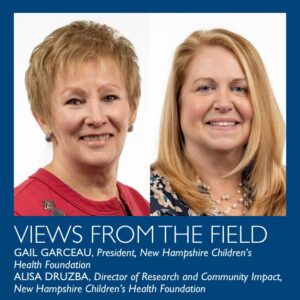

Gail Garceau, President, New Hampshire Children’s Health Foundation
Alisa Druzba, Director of Research and Community Impact, New Hampshire Children’s Health Foundation
For nearly three decades, we at the New Hampshire Children’s Health Foundation have operated with a clear and compassionate mission: to improve the health and well-being of vulnerable children from birth to five years old and their families throughout New Hampshire.
As a relatively small philanthropy with net assets of $31 million, we have long relied on a steady practice of responsive grantmaking. Through this approach, we supported nonprofit organizations working on the front lines—addressing issues such as food insecurity, children’s oral health, access to health and dental insurance, childhood trauma, and opportunities for healthy eating and active living.
These investments have been impactful, often catalytic, and deeply valued by our community partners. Yet after 28 years, we have made a deliberate and strategic decision to evolve our approach—shifting our focus “upstream” to address poverty as a root cause of the challenges we have long sought to mitigate.
Looking Beneath the Surface
This transition was sparked by our development and launch of the Children’s Health Dashboard, a tool designed to help us, other grantmakers and stakeholders in the field, policymakers, and members of the public understand the conditions that shape children’s health in New Hampshire. What makes the dashboard different is that it looks beyond surface-level statistics. By examining 16 interconnected conditions, it illustrates how external factors—such as neighborhood safety and socioeconomic status—affect children’s well-being.
The dashboard gave us a much clearer picture of what shapes children’s lives. It led to an important realization: the common factor underlying poor health outcomes is poverty. For nearly three decades, we had been addressing the symptoms—not the root cause.
The pattern became increasingly clear; the same needs continue to resurface, often with greater complexity. The issues our funded partners work tirelessly to address—poor health outcomes, educational disparities, and family instability—are inextricably linked to economic hardship. Even in a state often perceived as prosperous, significant pockets of child poverty persist, particularly in rural communities and among families with limited access to opportunity.
Despite the dedication of our funded partners and the effectiveness of individual programs, the underlying conditions driving these challenges remained largely unchanged. This realization prompted a period of reflection and inquiry for us as an organization.
Being Willing to Take the Risk
The decision to shift upstream was not made lightly. It required us to grapple with fundamental questions about identity, impact, and risk. What does it mean to move away from a well-established grantmaking model? How do we maintain trust with longstanding partners while pursuing a new strategic direction? And how can we meaningfully influence structural issues such as poverty, which are shaped by policy, systems, and deeply entrenched inequities?
Change carries risk and acknowledging that internally pushed us to conduct the strongest research and information‑gathering we could. That preparation allowed us to introduce the concept of this strategic shift first at the committee level and then at the full board level, building understanding and buy‑in at each step.
Over the course of more than a year, we intentionally built education and information‑gathering into each board meeting so that, by the time we reached the board retreat—where we hoped a decision could be made—our members had all the data, context, and learning needed to make a thoughtful and deliberate choice. And that is exactly what they did.
To answer our own questions, we conducted an extensive series of interviews with key informants, focus groups with parents and caregivers, and a survey of other funders to deepen our understanding of the causes and impacts of the difficulties that families with young children face. We have now embarked on our second round of interviews, again intentionally including those with lived experience to narrow the scope of our strategy.
Our approach is still taking shape, but we anticipate it will include supporting policy and advocacy initiatives, investing in cross-sector collaborations, and strengthening the capacity of organizations working to create systemic change.
We hope to focus our resources, relationships, and voice on advancing economic stability for families with children. Rather than funding individual programs across a wide array of issue areas, we are working to concentrate our efforts on strategies that address the root causes of poverty.
Importantly, this shift does not represent a departure from our mission—it is a deepening of it. By targeting the conditions that give rise to poor health outcomes, we aim to create more durable and equitable impact.
Systems Thinking
Research consistently shows that children who grow up in economically stable households experience better health, educational attainment, and long-term well-being. Addressing poverty is not ancillary to children’s health—it is central to it.
Our transition also reflects a broader shift within philanthropy toward systems thinking and upstream investment. Increasingly, funders are recognizing the limitations of siloed, programmatic funding and exploring ways to influence the policies and structures that shape community outcomes. For us, this means leveraging our credibility and sharing power to bring together stakeholders across sectors, including government, health care, education, community-based organizations, and other funders.
We are intentionally incorporating the principles of trust-based philanthropy into our work, and by incorporating the voices of those on the front lines in the field and those with lived experience in our research and focus groups, we can sense a power dynamic shift.
At the same time, we are committed to honoring our legacy and the relationships we have built over nearly three decades. We have approached this transition with transparency and care, engaging our funded partners in open dialogue about why we are shifting and what it may mean. While some organizations will no longer receive funding, we continue to value their work and seek to support the broader ecosystem in new ways, including through knowledge sharing and partnership development.
We also recognize the challenges ahead. Upstream work often requires a longer time horizon and carries greater uncertainty than traditional grantmaking. Measuring impact can be more complex, and progress may be incremental.
For a small foundation, the scale and depth of tackling poverty can feel daunting. Yet we are guided by the belief that even modest resources, when strategically deployed, can contribute to meaningful change. One of our hallmarks has been our ability to use our resources as a catalyst to leverage far greater impact.
Ultimately, our decision reflects both clarity and conviction. We acknowledge that while alleviating symptoms is necessary, it is not sufficient. By turning our attention to root causes, we are positioning ourselves, and we hope others, to play a more transformative role in the lives of New Hampshire’s children and families.
As philanthropy continues to grapple with questions of impact and equity, we hope our journey offers a useful example of what it means to evolve in pursuit of deeper change. Small but mighty, we are embracing the complexity of this work—and reaffirming our commitment to a future where all children have the opportunity to thrive.