


Akeiisa Coleman, Assistant Vice President, Medicaid, Expanding Coverage and Access
Faith Leonard, Senior Program Associate, Medicare, Expanding Coverage and Access
Gretchen Jacobson, Vice President and Senior Scholar, Medicare, Expanding Coverage and Access
Andrea C. Landes, Senior Vice President, Grants Management
The Commonwealth Fund
In July, we recognize Disability Pride Month, marking the anniversary of the landmark Americans with Disabilities Act (ADA) and celebrating the contributions and diverse identities of people with disabilities. While the ADA prohibits discrimination on the basis of disability and establishes protections and requirements for employers, state, and local governments, and other areas of public life, many people with disabilities still face barriers.
At the Commonwealth Fund, we recently reviewed the barriers disabled people continue to face in the health care sector, what research may be needed to identify the extent of these challenges and possible solutions, and where there may be opportunities for the Fund to support this work. We spoke with other foundations with a disability focus, researchers, organizations representing people with disabilities, and disability policy experts. We also reviewed recent grants and program strategies to see how our work was already touching some of these issues or incorporating a focus on individuals with disabilities. Below are some of the challenges we identified, our approach to addressing research gaps, and lessons learned for other funders exploring work to improve health and health care for people with disabilities.
Challenges and Issues
Staff from the Fund led a landscape review and interviews with experts, being mindful that issues raised were not ignored and were aligned across the Fund, beyond our own immediate scope of work and priorities. We gathered data on sources of health insurance coverage for people with disabilities, affirming that Medicare and Medicaid were the primary sources of coverage for this group, while also showing the distribution across ages and the importance of commercial insurance for part of the population.
Coverage for People with Disabilities
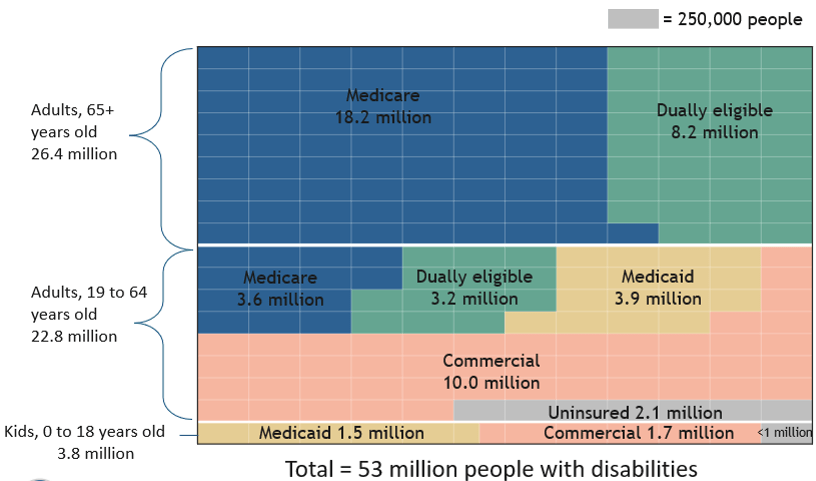

Data: SHADAC analysis of the American Community Survey (ACS) Public Use Microdata Sample (PUMS) files: “Medicaid enrollees who qualify for benefits based on disability in 2020” CMS
The following coverage challenges emerged in our conversations:
- Services that help people with disabilities remain in their homes are not universally accessible or affordable. Medicaid Home and Community-Based Services (HCBS) have waiting lists and wide variations across states, since state Medicaid programs are not required to cover the benefit. The Medicare home health benefit is not designed as long-term care, and the services included in the benefit are often difficult for people on Medicare to access. Gaps in both programs can lead to high out-of-pocket spending and the inability to get needed care.
- Individuals covered by both Medicaid and Medicare (dual eligibles) often have difficulty navigating which program is the primary payor on certain benefits, as well as a cumbersome appeals processes, which can result in care delays.
- The two-year waiting period for most people receiving Social Security Disability Insurance to become eligible for Medicare coverage can be stressful and lead to unmet health needs.
- Concerns persist about the quality of care provided through Medicaid-managed long-term services and supports (LTSS), and the provision of these services is not transparent.
- Medigap policies (supplemental plans for traditional Medicare) may not be available for people with disabilities, as most states allow underwriting of health conditions outside of specific periods of time and do not require policies to be offered to Medicare beneficiaries under age 65.
- The needs of younger people with disabilities are often deprioritized by both the Medicaid and Medicare programs since they make up a minority of the programs’ beneficiaries, leading to a focus on able-bodied beneficiaries’ needs over those with disabilities. For example, long-term care needs are frequently discussed as short-term needs at the end of life, rather than a potentially decades-long need throughout one’s life.
One of the largest program areas at the Commonwealth Fund focuses on improving care delivery. The following are specific issues regarding care delivery that arose in discussions:
- For health outcomes and quality of care measures, different measures may be needed for people with disabilities. For example, maintaining health status and improving quality of life may be more meaningful than measuring improvements in functioning.
- There are concerns that value-based payment arrangements may have unintended effects on disabled people. Financial incentives that reward providers for improvements in functional or cognitive health may not align with the needs of this population, and providers could be disincentivized to treat patients with disabilities.
- Workforce shortages can make it difficult for people with disabilities to find a provider or receive enough services to support living independently in the community. Additionally, providers may not have the training, comfort, or appropriate billing units to treat people with disabilities and co-occurring conditions, which can impede access to care and lead to discrimination.
- Access to care in rural areas is a particular challenge for people with disabilities, from accessible care settings to providers with knowledge of their disability.
Other issues that emerged included technology, data collection, and decision making. Technology can both help and hinder access and quality of care. Adaptive technologies and telehealth can improve access to care and functioning, but AI tools and automation could make it harder for people, including those with disabilities, to have care needs met.
Better data collection is needed to understand the intersections of disability, race and ethnicity, and preferred language. People with certain disabilities are also living longer, and there is a lack of research to understand how care needs may change with age. Additionally, the caregivers that some disabled people rely on are also aging and it is sometimes unclear how to transition roles as the caregivers themselves begin needing long-term care. Autonomy and decision making for people with disabilities is nuanced and would benefit from strengthening person-centered planning and improving the flow of information to caregivers.
Addressing What We Learned
As program staff examined the landscape and where the Fund could help address gaps, our grants management team reviewed recent grants to assess how many included a focus on people with disabilities. They found that 11 percent of grants in our 2024 and 2025 fiscal years had a disability focus or component, with funding spread across almost every program area.
We then shared this, along with the findings of our interviews and research, at a staff meeting. Program teams were encouraged to consider how people with disabilities fit within existing priorities for their work. For instance, when discussing the demographic data researchers are considering, teams considered whether it was feasible to include disability status and to what extent our internally-led research includes analyses by disability status.
Given the number of coverage issues that surfaced, the Expanding Coverage and Access team agreed that additional research and policy development around long-term care was needed, from the Medicare home health benefit to Medicaid HCBS and supports for caregivers. We also agreed that while there has been a great deal of work on dual-eligibles, there is a gap in understanding the unique needs of those younger than 65. Additionally, we recognized that policy discussions benefit from the voices and lived experience of people with disabilities, and we sought to highlight and support the work of researchers with disabilities. As a result, we have made several grants to fill in some of these knowledge gaps and identify promising practices.
Additionally, investments were made so The Commonwealth Fund itself becomes more accessible. Staff were trained in disability standards and given new language to facilitate accessible in-person and virtual meetings. In 2024, capital improvements began to our 20th century home-turned-office, Harkness House, to address its construction as a single-family home long before accessibility standards were updated. This project will take years to complete, but the investment ensures our workspace is accessible and welcoming to people with disabilities in every role they play at the Fund.
Recommendations for Funders
Disability Pride Month is both a celebration of the contributions and leadership of people with disabilities and a reminder of the work that remains to improve health care for these communities. Our review reinforced that many barriers are deeply embedded across coverage, care delivery, workforce capacity, technology, and data systems, requiring sustained attention and meaningful engagement with disability communities.
For health funders ready to take this on, our experience suggests four places to start:
- Begin with what you already fund. Examine your existing portfolio for grants that touch on disability, whether or not they are framed that way. A structured landscape review, including conversations with disability-focused funders, researchers, and advocacy organizations, can surface gaps and opportunities within your current priorities without requiring a new initiative.
- Be intentional about data. Ask whether disability status is captured in the research you support and encourage grantees to disaggregate findings by disability where feasible. Intersections with race, ethnicity, age, and language deserve particular attention.
- Follow the lead of people with disabilities. Meaningful inclusion means supporting researchers, policymakers, and advocates with lived experience of disability and ensuring their voices shape the questions being asked. For more resources, we recommend the Disability & Philanthropy Forum.
- Look inward. Physical accessibility, meeting standards, and organizational culture are part of your mission, not separate from it.
At The Commonwealth Fund, this process highlighted opportunities to deepen our own work and reaffirmed that inclusion of people with disabilities is essential to building a better health system for all.