
Miriam Tardif-Douglin, Associate Director, Program Evaluation, North Carolina Healthcare Foundation
Most pregnancy-related deaths in North Carolina are preventable. Yet mental health conditions, including overdose and suicide, remain the leading cause of pregnancy-related death. For health care leaders, that reality demands a closer look at how we identify, treat, and support pregnant and postpartum patients with opioid use disorder.
As of 2023, there were 17 maternal deaths per 100,000 live births in the US compared to between 3.6 and 7.3 maternal deaths in Germany, the Netherlands, and France (UNICEF 2025). Within the US, North Carolina performed poorly from 2019 to 2023, reporting 53 pregnancy-related deaths per 100,000 births. This is higher than every state except Mississippi, Tennessee, and Alabama (DeClercq 2025).
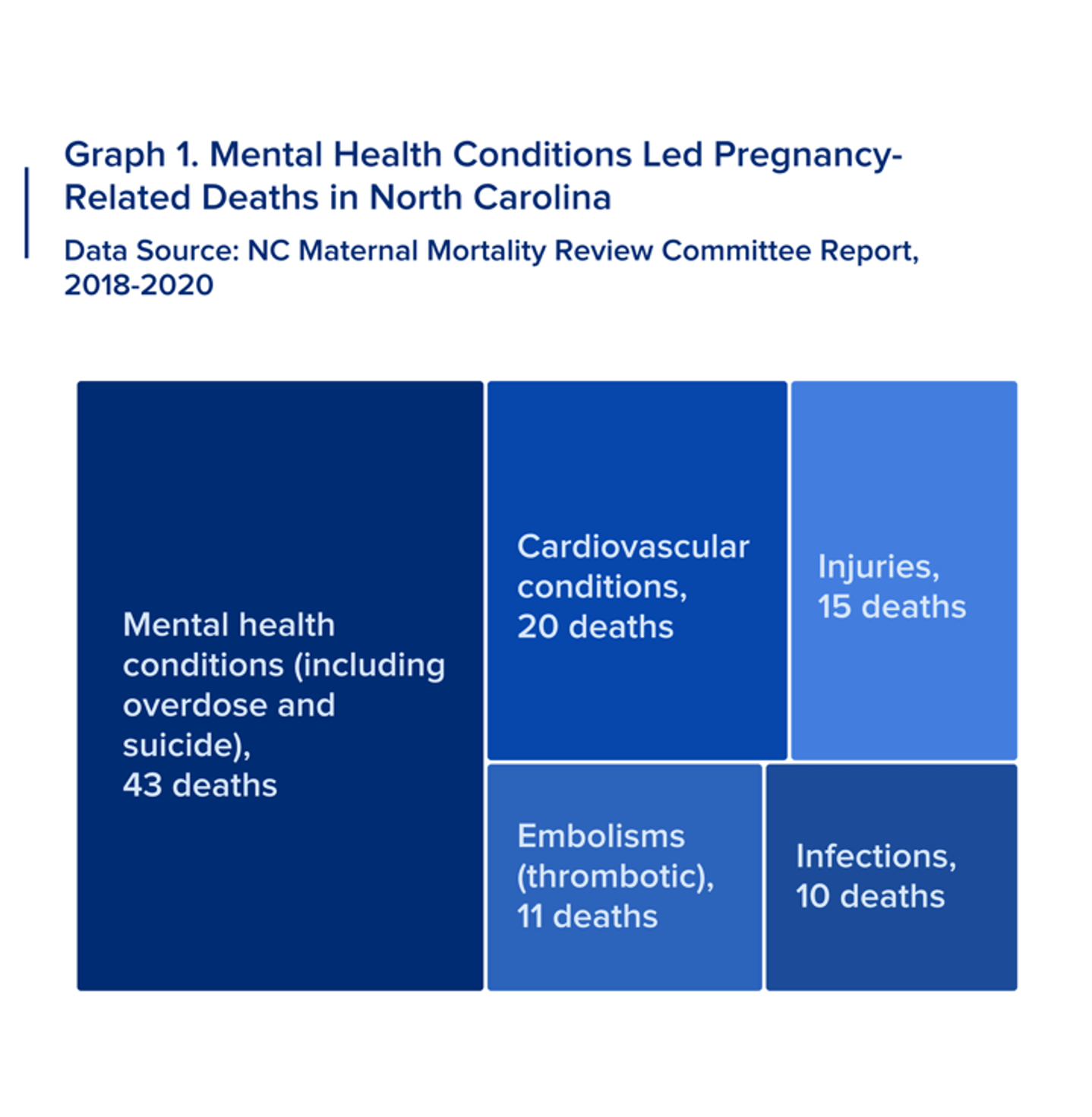
Poor access to mental health care and substance use treatment is one culprit. In the 2018-2019 NC Maternal Mortality review, 18 of the state’s 20 substance use disorder (SUD)-related maternal mortality cases involved opioids, primarily fentanyl (NC DHHS 2024). In the latest report, mental health conditions, including overdose and suicide, were the leading cause of pregnancy-related death (see Graph 1) (NC DHHS 2025). A particularly crucial and sobering finding was that 87 percent of the pregnancy-related deaths were ruled preventable (NC DHHS 2025).
There is effective treatment to prevent maternal deaths from opioid overdose, but historically, it has not reached enough patients. The Centers for Disease Control and Prevention (CDC) and the American College of Obstetricians and Gynecologists (ACOG) state that
perinatal patients (pregnant or 12-months postpartum) with opioid use disorder (OUD) should be treated like anyone else with that diagnosis. Both the CDC and ACOG state perinatal patients should be offered the latest evidence-based care—medications for opioid use disorder (MOUD) (ACOG 2017). MOUD includes medications such as methadone, buprenorphine, and naltrexone (NIDA 2005).
Multiple peer-reviewed studies show MOUD is not only safe but beneficial to the mother and baby (Krans 2021 and Ordean 2023).
Nationwide, the challenge is no longer whether evidence-based treatment exists—it is now ensuring patients can access it consistently across care settings:
- OUD treatment centers do not universally accept pregnant women, and maternity care is not uniformly equipped with the latest in OUD treatment (CMS n.d.).
- The perinatal patients themselves may hesitate to seek care for OUD, if it is even offered, fearing loss of custody (Admass 2025).
- A significant concern for individual health care providers addressing the complex needs of a perinatal patient with OUD is ensuring they do no harm (Admass 2025).
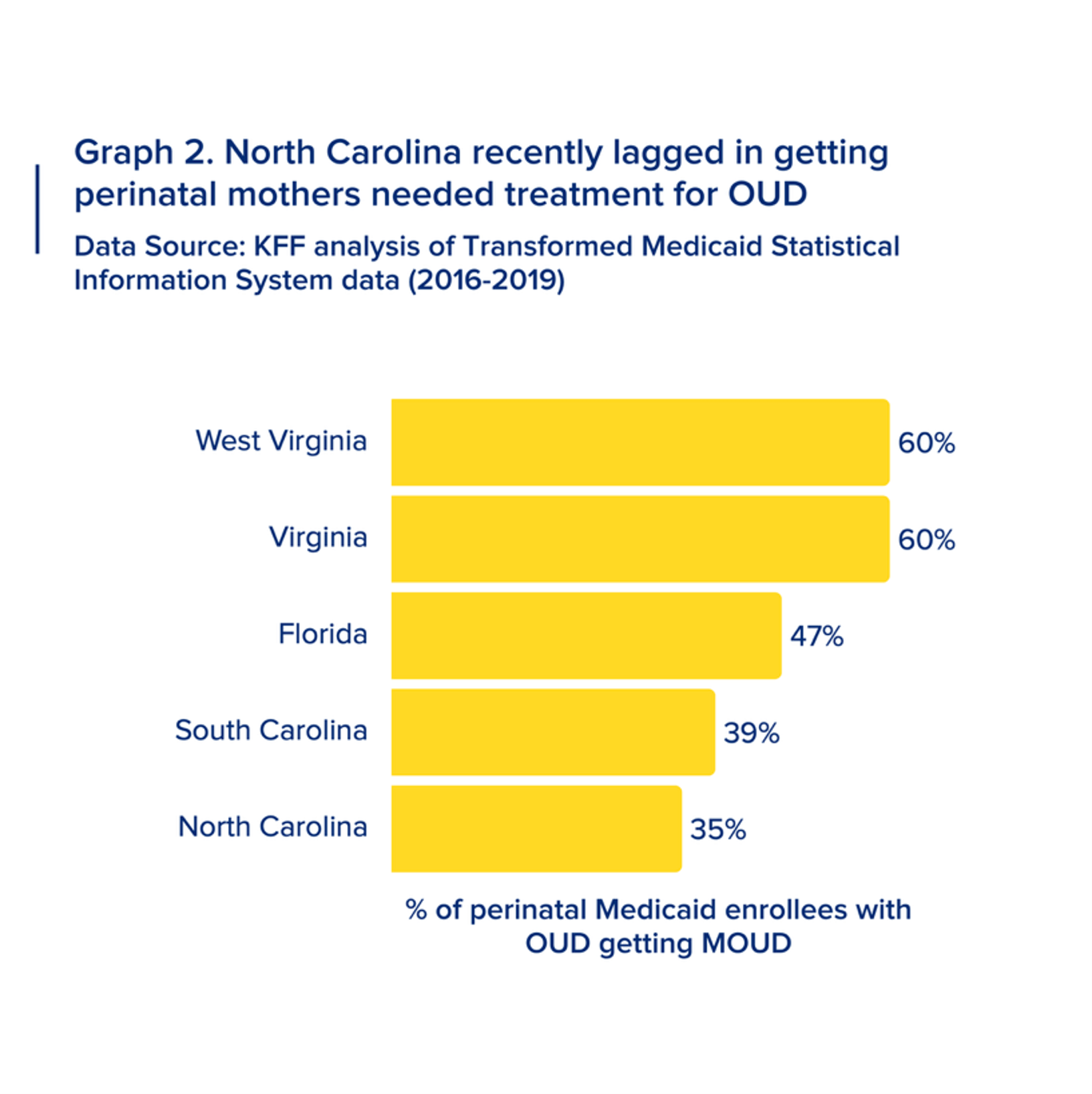
The nationwide challenges keeping perinatal mothers from needed OUD treatment were on display in North Carolina as recently as 2019. Data from 2016-2019 show North Carolina had particularly low rates of providing MOUD for Medicaid-covered perinatal patients (see Graph 2) (Roberts 2023).
Fortunately, the rates of emergency department visits for opioid overdose in North Carolina and nationally have dropped considerably since 2023, reaching an all-time low in 2026 (NC DHHS 2026). This drop is related to many factors, including implementation of interventions such as making naloxone widely available, better management of prescribing practices, needle exchange programs, and recovery support programs. Recent gains do not justify slackening the pace; existing efforts must be maintained and additional ones added. As a state, we must ensure that improvements in access to effective OUD treatment reach all perinatal mothers who need it.
What the North Carolina Healthcare Foundation (NCHF) is Doing
Previously
For the past seven years, NCHF has helped hospitals use accessible interventions with the best evidence to mitigate the impact of the opioid epidemic. Funding for this work comes from the North Carolina Division of Public Health Injury and Violence Prevention Branch.
One intervention is peer support specialists, who use their own experience to help discharged emergency department (ED) patients with OUD follow through with treatment in the community (Zuccarini 2022). Peers can counterbalance the stigma patients may otherwise face from treatment staff who have not experienced OUD themselves. In 2018, NCHF led a pilot of ED-based peer support specialists at six hospitals, which generated more than 460 referrals for MOUD in the community.
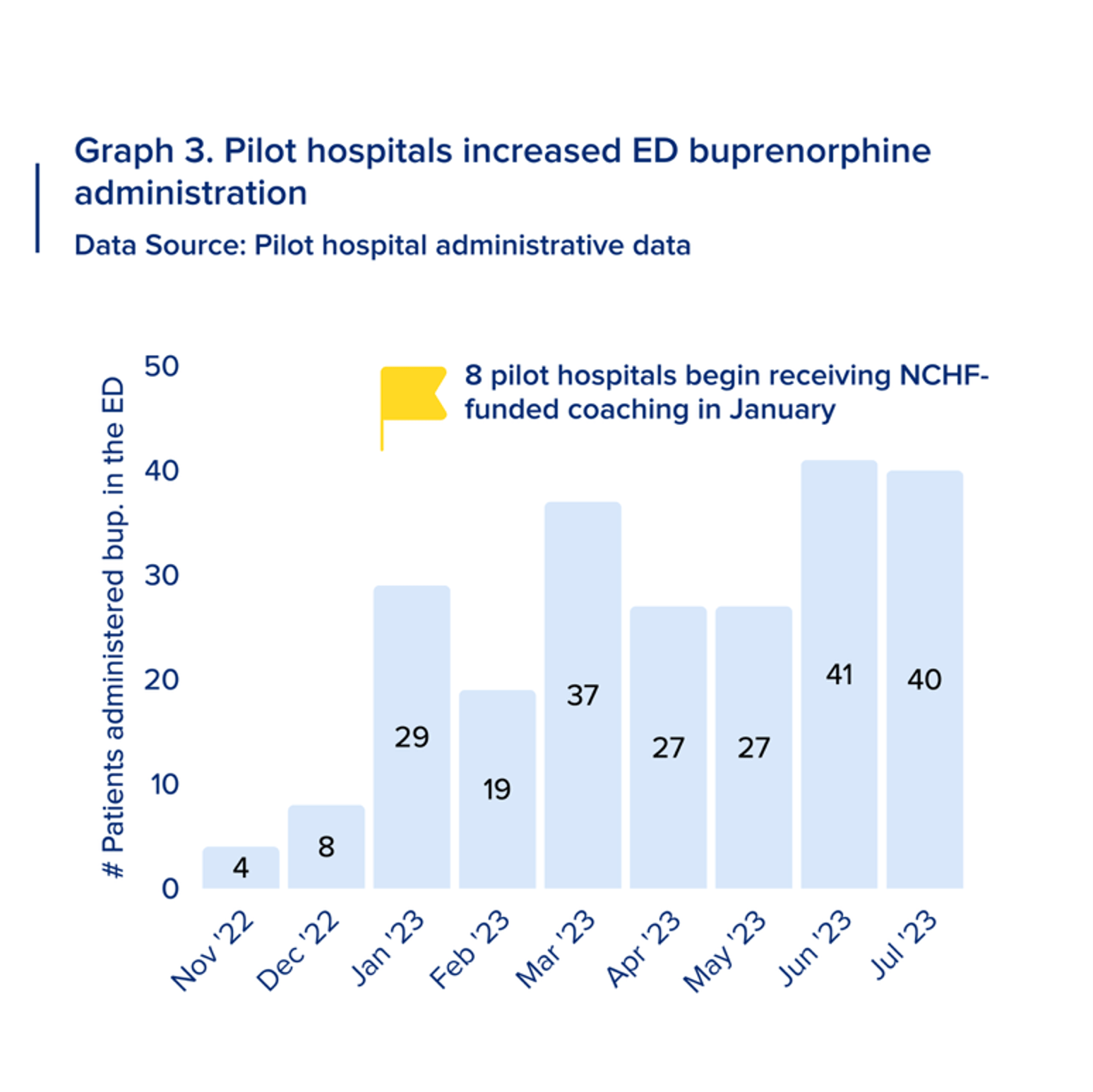
Another intervention is delivery of buprenorphine in the ED. By reducing cravings and withdrawal symptoms among other benefits, buprenorphine supports recovery from OUD and reduces mortality (Ling 2015 and Hickman 2018). In 2022, NCHF led eight hospitals in a pilot focused on delivery of buprenorphine treatment for ED patients with OUD (see Graph 3). At one hospital in a subsequent NCHF-led learning collaborative, use of ED buprenorphine and referrals to community treatment rose by 147% from 2022 to 2024.
Currently
Both the peer support specialist and ED buprenorphine pilots included pregnant patients, but the perinatal population was not the focus. NCHF is currently working with the NC Division of Public Health (DPH) to help hospitals—particularly rural hospitals—close gaps in evidence-based treatment for perinatal women with OUD. One highlight of this work was the nearly 100 participants at the 2026 Maternal Care Quality and Safety Forum on April 1 who heard from an expert panel entitled Best Practices in Caring for Birthing Persons with Substance Use Disorders. Additionally, NCHF conducted a focus group and statewide survey with clinicians and other providers who care for perinatal patients with SUD, including opioid use disorder. The survey informed a patient survey and focus group, identification of targeted professional development opportunities for clinicians, and a repository of evidence-based clinical practices.
As of June 2026, NCHF has begun planning to adapt and implement the Perinatal Substance Exposure Education (PSEED) training for inpatient hospital settings. PSEED is an evidence-informed training that equips interprofessional teams with the knowledge and tools to deliver trauma-informed, stigma-reducing care for perinatal mothers impacted by substance use.
Applying These Lessons in Your Community
Working with hospitals to remove barriers to evidence-based OUD treatment, particularly for the most vulnerable patients, is vital. With clinicians and hospital administrators who all want to do best by their patients, it is also feasible. At NCHF, we have learned about what it takes to spread effective OUD treatment. There are several roadblocks to anticipate and insights to apply when partnering with local hospitals and conducting grantmaking.
Roadblocks NCHF encountered
Considering challenges NCHF faced, it is worth anticipating the burden of data collection and the timeline of policy change. To demonstrate how patients were better off due to pilot funding, we requested data from our hospital partners. Some data proved too burdensome; we learned to avoid requesting data beyond what is most readily available and meaningful to the public.
As the nonprofit arm of the state hospital association, we advocate for policy changes that can sustain successful, evidence-based, yet time-limited pilots. We learned that successfully advocating to change state policy on OUD treatment takes more time. In the shorter term, follow the lead of your state department of injury and violence prevention to understand how you can maximize the uptake of policies already enacted.
Developing funding partnerships with hospitals
NCHF had multiple tailwinds due to how we partnered with hospitals. First, we learned from statewide trends. Second, we engaged subject matter experts (SMEs). We needed to understand the population needs hospitals were responding to and the tools they were working with. In other words, to partner with hospitals it is important to learn what the data says about the trends driving morbidity and avoidable mortality. At the same time, your state hospital association can share the knowledge and training barriers preventing uptake of the newest, evidence-based clinical practice. This can guide a more targeted, evidence-informed approach to developing new programs.
Once you have a network of hospitals with a clinical practice to improve based on statewide needs evident in the data, identify a clinical SME for one-on-one coaching or group training. Clinical SMEs can speak the language of doctors and nurses in a way that grantmakers typically cannot, but they rely on the funding and networks that a grantmaker with the right partnerships can provide.
Lessons from this work to apply in grantmaking
There are two more realities we encountered that are worth considering in grantmaking: policy change doesn’t automatically mean practice change, and some organizations are more risk tolerant than others. We learned that just because policy may newly permit a beneficial clinical practice doesn’t mean the practice will be taken up by busy practitioners. This is particularly so if the practice is considered complex and if practitioners haven’t seen the benefits themselves. Grantmaking can close this gap by working with early adopters.
Practitioners are keen to see how other facilities fare in piloting new approaches that may seem unorthodox but are well grounded in evidence. However, those facilities that are early adopters may need grant funding and expert coaching to justify the risk. Specifically, learning collaboratives among early-adopter hospitals can provide a valuable source of support in addition to yielding information for other, non-early adopting hospitals.
Our role at NCHF is to uplift the innovations around health care happening in North Carolina. There is still a long way to go, but our success enhancing OUD treatment and narrowing in on perinatal mothers gives us confidence we are on the right track.
References:
Admass, Biruk A., et al. “Barriers to opioid replacement therapy in pregnant women with opioid use disorder: a systematic review” Substance Abuse Treatment, Prevention, and Policy. 20, 1 (October 1, 2025).
Centers for Medicare & Medicaid Services. “Maternal Opioid Misuse (MOM) Model”
“Committee Opinion No. 117: Opioid Use and Opioid Use Disorder in Pregnancy: Committee Opinion” American College of Obstetricians and Gynecologists. 130, 2 (August 2017): e81-e94.
Declercq, Eugene and Zephyrin, Laurie C. “Maternal Mortality in the United States, 2025” Advancing Equity (Issue Brief), The Commonwealth Fund, July 29, 2025.
Hickman, Matthew, et al. “The impact of buprenorphine and methadone on mortality: a primary care cohort study in the United Kingdom.” Addiction. 113, 8 (April 19, 2018): 1461-1476.
Krans, Elizabeth E. et al. “Outcomes associated with the use of medications for opioid use disorder during pregnancy” Addiction. 116, 12 (May 25, 2021): 3504-3514.
Ling, Walter, Mooney, Larissa, and Torrington, Matthew. “Buprenorphine for opioid addiction.” Pain Management. 2, 4 (January 5, 2015: 345-350.
“Maternal Mortality in North Carolina: 2018-2020” Raleigh, NC: NC Department of Health and Human Services Division of Public Health, August 2025.
National Institute on Drug Abuse. “Medications for Opioid Use Disorder.” March 2025.
NC Department of Health and Human Services Division of Public Health Injury & Violence Prevention Branch. “North Carolina Overdose Epidemic Data.” 2026
“North Carolina 2018-2019 Maternal Mortality Review Report” Raleigh, NC: NC Department of Health and Human Services Division of Public Health, February 2024.
Ordean, Alice and Tubman-Broeren, Meara. “Safety and Efficacy of Buprenorphine-Naloxone in Pregnancy: A Systematic Review of the Literature” Pathophysiology. 30, 1 (February 11, 2023): 27-36.
Roberts, Tatyana. “Opioid Use Disorder and Treatment Among Pregnant and Postpartum Medicaid Enrollees.” Washington, DC: Kaiser Family Foundation, September 19, 2023.
UNICEF. “Maternal Mortality” April 2025.
Zuccarini, Michelle M. and Stiller, Cate. “The Effect of Peer Support on Treatment Engagement for Opioid Use Disorder” Journal of the American Psychiatric Nurses Association. 30, 3 (October 17, 2022): 709-715.