

EITC Pooled Fund: Lessons on Ideas, Innovation and Impact
Since 2011, Economic Opportunity Funders (EOF) has been working to increase public support for state EITCs through the EITC Pooled Fund (The Fund). We provide a table around which multiple funders can align support to work on an area of mutual interest, and a mechanism by which funders can quickly and collaboratively deploy funding to help meet the needs of the field.
Boosting Philanthropic Investment in Healthy Food in Tribal Communities
Tribal communities in America receive only about a half percent of all philanthropic giving, and the total dollar amount of grantmaking in these communities by large philanthropic foundations actually declined by 29 percent ($35 million) from 2006 to 2014 according to a report by First Nations Development Institute. Additionally, only a small portion of those grant dollars go to Native-controlled organizations.
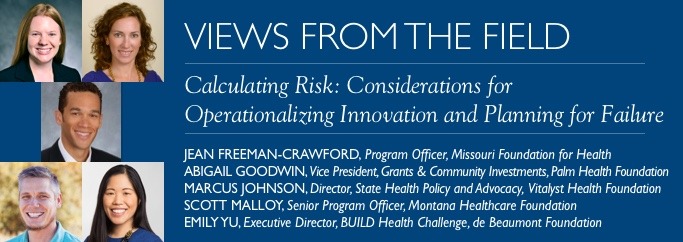
Calculating Risk: Considerations for Operationalizing Innovation and Planning for Failure May 2019
Philanthropy’s greatest freedom is, perhaps, the freedom to fail. This insight, stated in Terrance Keenan’s monograph (2000), “The Promise at Hand: Prospects for Foundation Leadership in the 1990s,” sparked robust dialogue during the 2018 Terrance Keenan Institute (TKI) for Emerging Leaders in Health Philanthropy.
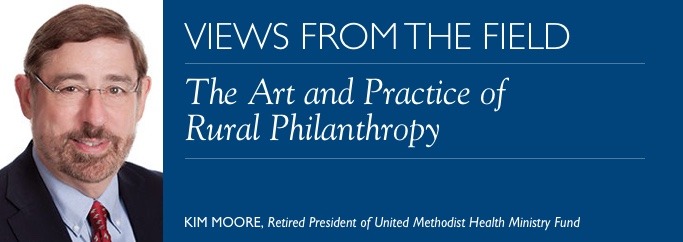
The Art and Practice of Rural Philanthropy
Newly formed conversion foundations and community foundations, often with rural areas in their grantmaking territories, have identified the absence of significant regional and national philanthropic attention to rural America.
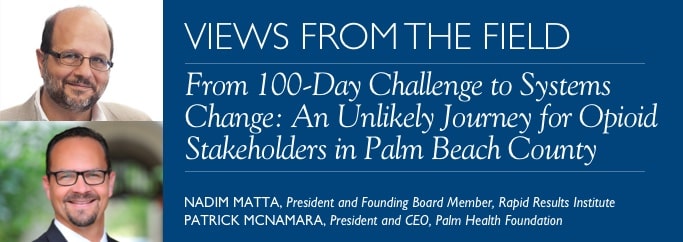
From 100-Day Challenge to Systems Change: An Unlikely Journey for Opioid Stakeholders in Palm Beach County
Palm Beach County, Florida became an epicenter for the nation’s deadly opioid crisis, with the number of opioid-related deaths hitting epidemic proportions in 2016.
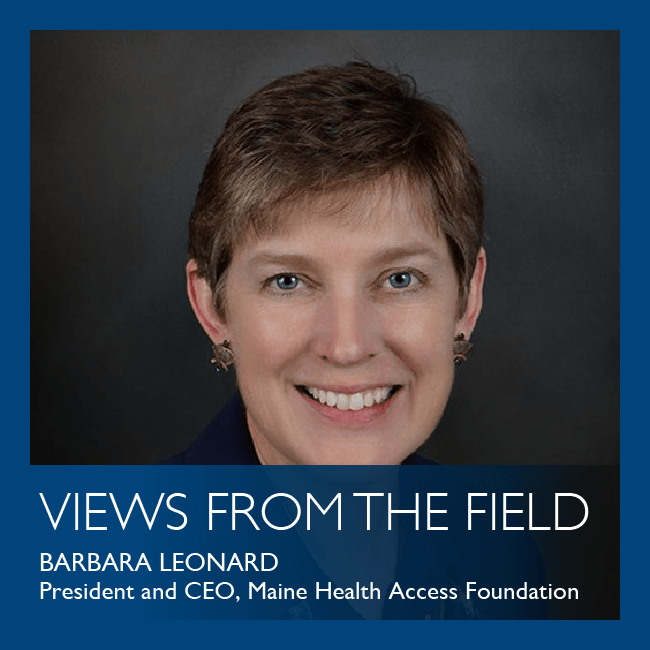
Building the Will, and the Way, to Advance Equity at the Maine Health Access Foundation
In 2016, the Maine Health Access Foundation (MeHAF) Board approved an extension of its strategic plan, as a bridge between the founding CEO and a new leader. Two issues were added to MeHAF’s work: equity, and the opiate epidemic. We had ideas about how to tackle the latter. We did not know where to start with the former.
Supporting Health Care and Community-Based Organization Partnerships to Address Social Determinants of Health
Increasingly, health systems, providers, and payers recognize the significant influence that social factors such as housing, food insecurity, employment status, and transportation have on well-being and health care spending.
A Grantmaker Affinity Group Informs the Field, Inspires Innovation, and Ignites Action
Early and often, health funders are asked to fund oral health. It has become clear, however, that equally, if not more essential, are investments to eliminate the systemic inequities that concentrate disease in specific populations.
What It Takes for a Foundation to Achieve Success: Essential Ingredients and Lessons Learned
Create healthy outcomes through lasting systems change for children in the state of Connecticut. This was the charge to the Children’s Fund of Connecticut when it was created 25 years ago as a public charitable foundation.
Promoting Nurturing Care for Our Youngest Children
Early childhood matters. Mounting evidence over the last several decades has demonstrated the importance of the early years to long term health, behavior, and learning.