

Address: P.O. Box 23, Hadley, MA 01035
Web: www.rxfoundation.org (Linkedin)
Email: rx@rxfoundation.org
The Rx Foundation was established in 2002 by Serena M. Hatch with the vision of “a prescription for better health care” and a commitment to improving health care delivery in hospitals, clinics, and communities across the United States. Over the last decade, the foundation made a strategic pivot to building capacity and infrastructure for policy advocacy, community organizing, and civic engagement; empowering communities to champion change that improves health care, and health and wellbeing more broadly. The experience has been an extraordinary one for the foundation, inspiring an evolution of their mission, which now centers collaborative initiatives that promote health justice, healing, and wellness in communities throughout the United States. The Rx Foundation engages diverse partners committed to a future in which all communities build their connections, capacity, and power to address the root causes of poor health.
The 2026 Rx grant portfolio includes partners in at least 15 states, as well as regional and national organizations. Rx-supported nonprofits are led by and work with communities historically excluded from resources and decisionmaking, including Black, Indigenous, and other communities of color; immigrants; people with disabilities; low-income communities; and people living in areas with limited access to care. Many Rx-funded partners work across issue areas because housing, economic security, reproductive freedom, disability justice, environmental conditions, and civic participation all shape health. The Rx Foundation mission and approach to grantmaking reflect the view that no single stakeholder, system, or community can bring about health justice alone. The foundation believes that enduring gains will only come through meaningful partnership, particularly with those most affected by injustice.
Program Information:
Through grants and programmatic work, the Rx Foundation aims to strengthen the leaders, organizations, networks, and connective tissue needed for long-term change. The foundation’s largest grantmaking area is Building Capacity for Health Advocacy, launched in 2019, which makes three- to five-year funding commitments to organizations that are hubs for building advocacy, organizing, and civic engagement capacity and infrastructure. The Healthy Communities grant cohort grew out of a rapid response Vaccine Equity initiative in 2021 and provides general operating support to community-led organizations and trusted messengers responding to immediate health needs in historically and currently marginalized communities.
The Rx Foundation pairs multi-year and flexible funding with support beyond the grant, including technical assistance, coaching, peer learning, convening, communications support, and connection across the Rx network. It recognizes that durable change requires investment in staff, organizing, communications, data, coalition work, leadership development, and the time needed to build trust.
Financial Information:
Total Assets: $60 million (CY25)
Amount Dedicated to Health-Related Grants: $3,145,000 (CY25)
Special Initiatives and/or Representative Health and Human Services Grants
Yellowhammer Fund (Building Capacity for Health Advocacy grantee)—Organizing and building capacity in partnership with allied organizations in communities across Alabama, Mississippi, and the Florida panhandle around a holistic vision of reproductive justice. ($150,000 per year for five years)
El Centro (Healthy Communities grantee)—Supports trusted, community-led health outreach and power-building among immigrant and Latino communities in Kansas, linking immediate health information and resources with deeper relationships, leadership, and community advocacy ($195,000 since 2021; $60,000 in 2026)
Signals from the Field—This foundation-led learning and resource initiative returns insights from nearly 700 grant applications to the field and challenges philanthropy to invest in the resources, relationships, and capacity organizations need.
Power is a Social Determinant of Health Webinar Series (Special Initiative)—This ongoing virtual learning series established in 2022 brings together grant partners, funders, health care leaders, researchers, and allies to explore community power, civic engagement, narrative, and systems change.
Rx Foundation and GIH
For more than a decade, Grantmakers in Health has been an important peer community for shared learning and relationship-building for the Rx team. GIH staff and other leaders in the health funding community were important resources in the Rx Foundation’s learning journey as it explored the links among health, democracy, and community power. Rx has collaborated in multiple ways with other foundations in the GIH network and regularly participates in the annual conference and policy forum, as well as virtual learnings. The 2026 annual conference reinforced that Rx is part of a growing movement within health philanthropy to understand healthy democracy as essential to healthy communities.
Strategic Changes in Grantmaking Direction

“Over the past decade, Rx has evolved both what we fund and how we fund. We began by asking what a small national health foundation could do to support health advocacy, and that question led us to move resources toward building capacity for community organizing, civic engagement, and the connective tissue that makes it possible for communities to build power for long-term change.
“We have also shifted toward longer-term, more flexible grant support and a ‘beyond the check’ approach that includes peer learning, technical assistance, communications support, and relationship-building. This strategic pivot is not an emergency response, it is a theory of change with a longer time horizon than traditional philanthropy and a belief that communities must build grassroots leadership, capacity, and relationships to act publicly and advance changes in policies and practices that impact the conditions of their lives.”
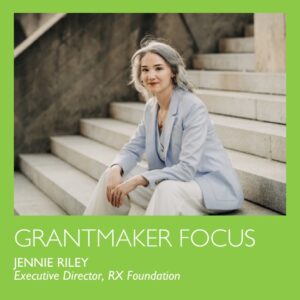
–Jennie Riley, Executive Director