

Mitchell Balk, President, Mt. Sinai Health Foundation
Shelby Kaemmerer, Program Officer, Mt. Sinai Health Foundation
Kimberly Boller, Executive Director, Grandparents for Vaccines
The State of Vaccines
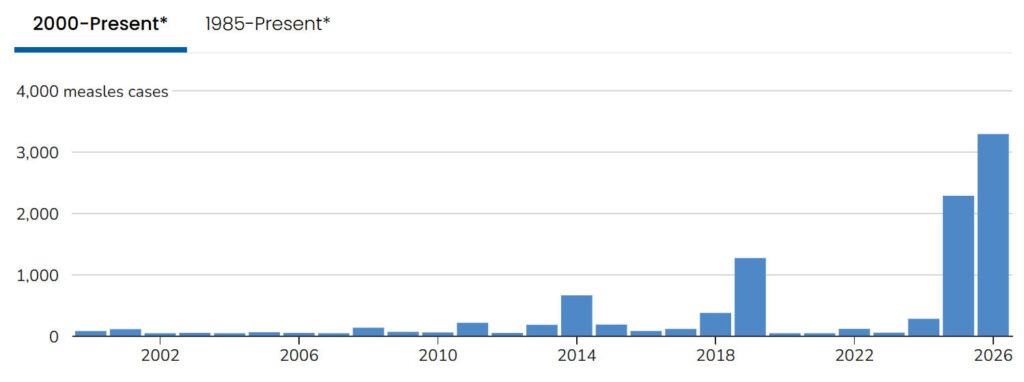
In July 2026, the United States reached a grim milestone when the number of confirmed cases of measles exceeded the total for all of 2025 (Devi 2026). On August 10, 2026, the White House issued an executive order directing changes to the federal childhood vaccine schedule and categories, and calls for availability of separate measles, mumps, and rubella vaccines. The science has not changed, but the new framework could significantly slow down the delivery of protective immunizations from these serious diseases. As it deviates from recommended clinical practice and formulation availability in the United States, the order has added to public confusion for parents and clinicians about what vaccines are available and recommended. If parents seek separate vaccines that are not currently available, the confusion may create additional burdens on the health system.
Decline in vaccine coverage and increased cases of vaccine-preventable diseases relate directly to today’s information environment. Misinformation about vaccines is growing, and Covid-19 exacerbated the decline in trust of public health.
Yearly measles cases
as of September 10, 2026
Declining vaccination rates could become catastrophic. The rates of coverage are below community immunity levels in many jurisdictions. In addition, the costs of dealing with reemerging diseases are astronomical—on average $104,000 per US measles case in 2025 (Wells et al. 2026). Declining vaccination rates also worsen health inequities by deepening disease burden in marginalized communities. So, what can philanthropy do to help restore trust?
This article describes how Mt. Sinai Health Foundation chose to fund Grandparents for Vaccines, what the Foundation has learned so far from this effort, and why the Foundation wants to encourage others to fund efforts that encourage vaccine uptake before we lose decades of progress on vaccine preventable diseases.
Investing in Vaccine Access
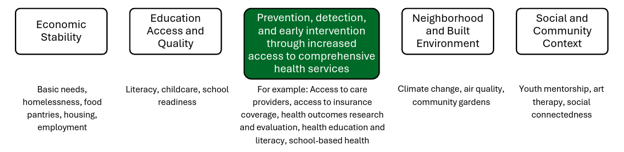
Mt. Sinai is a hospital conversion foundation in Cleveland, Ohio, focused on prevention, detection, and early intervention through increased access to health services. We focus our grantmaking in Cuyahoga County with some statewide giving related to health policy.
Like many health funders, Mt. Sinai has spent years reckoning with what our “slice” of the social determinants of health framework should be. We know that we cannot have an impact across every domain of social drivers. To do so would spread our assets too thin and prevent effective evaluation of our impact. Therefore, in 2025, we released new guidance that emphasized access to care as our priority. The following graphic was included in a community brief that illustrates Mt. Sinai’s grantmaking priority based on the Healthy People 2030 social determinants of health domains.
Because of our focus on prevention, we are committed to promoting vaccine access and education. But in the wake of misinformation campaigns, from grassroots to the federal government, we knew that the usual methods would not be enough to maximize the impact of vaccines on our community’s children. Parents have doubts. They have fears. Often these fears overshadow the real worst-case scenario—children contracting preventable, life-threatening diseases.
That’s because the success of vaccines did not only erase disease—it erased memory. Parents of young children today did not live through the national polio crisis. Their classmates were unlikely to have had measles and mumps. Perhaps they remember chickenpox as an uncomfortable but ultimately non-deadly experience of their childhood. But our grandparents remember. Mt. Sinai chose to invest in Grandparents for Vaccines to take a new, storytelling-driven approach to building the case for vaccines.
A Surprising Solution
In early 2025, retired Cleveland pediatrician and grandfather Arthur Lavin, MD asked a simple question: could grandparents’ love for their grandchildren and memories of life before vaccines help cut through fear about childhood immunization? After testing the idea with leaders in storytelling and public health, Grandparents for Vaccines launched on Grandparents Day, September 7, 2025.
The organization’s premise is that grandparents are trusted messengers who can share firsthand stories about the consequences of vaccine-preventable diseases while encouraging informed conversations about childhood vaccination. Its long-term goals are to strengthen confidence in vaccines and increase childhood vaccination rates. The approach draws on lessons from philanthropy-supported social movements, including Mothers Against Drunk Driving, ACT UP, and Everytown for Gun Safety. Research shows that these movements, with personal storytelling as a central strategy, help shift public attitudes, influence behavior, and improve health outcomes (Winsten 2017; Nagarkar et al. 2026).
Grandparents for Vaccines works with more than 80 volunteer leaders in 32 states and a growing community of 6,000 members. Volunteers communicate through traditional and social media, organize events, and share stories about the devastating effects of vaccine-preventable diseases. Grandparents record videos, submit written stories, write opinion pieces, appear in media, and host storytelling events. Below is an example of one of the stories we’ve collected:
“My sister had measles encephalitis when she was six years old. She slipped into a coma and when she woke up six months later she was profoundly brain damaged. She is 66 years old and has been on a feeding tube for decades. She has been in a nursing home her whole life and hasn’t known her family since she went into a coma…Our mother chose for us to get the polio vaccine [rather than the measles vaccine] first because you couldn’t get the vaccines together. We got the measles soon after. My mother never got over the choice she made, and it profoundly changed our family.”
-Charlotte, a Grandparents for Vaccines volunteer from Missouri
Early Lessons
To mark its first anniversary, volunteers launched the inaugural “Before the Bell Rings!” back-to-school vaccine education campaign. Across the country, grandparents amplified “get ready, get vaccinated” messages as families prepared for the school year. At the same time, support from Mt. Sinai has enabled the organization to diversify its Board of Directors, clarify its strategy, and strengthen the leadership and operational capacity needed for growth.
Several early lessons have emerged:
- Grandparents’ lived experience creates opportunities for dialogue and opens doors that many organizations cannot easily replicate.
- Volunteer energy requires organizational investment. A rapidly growing national network depends on training, communications, and leadership that enable volunteers to act locally while advancing a shared strategy.
- Storytelling grows through partnerships. Collaborations with community groups, libraries, schools, professional organizations, and health departments extend the reach of grandparents’ stories, connect them with families at key decision points, and create opportunities to learn what resonates across different communities.
Mt. Sinai has learned our own lessons, too. We have long operated as a fiscal agent for various strategic initiatives–most notably the Lead Safe Cleveland Coalition. But Grandparents for Vaccines represented a new challenge for the Foundation. How do we support an emerging organization still in the process of professionalizing while simultaneously growing its national footprint? Our small finance team, which consists of one Finance Officer, quickly realized the demand that would come from managing individual donations and foundation grants while also tracking spending and sharing financial reports. Additionally, Mt. Sinai and Grandparents for Vaccines are working collaboratively to find the balance between Mt. Sinai’s providing support without overshadowing Grandparents for Vaccines’ expert leadership and independent Board of Directors. Our partnership is only six months old, and we’re still discovering the right ways to work together.
Scaling and Sustainability
Like many organizations working in immunization today, Grandparents for Vaccines faces a challenging environment in which securing growth capital remains difficult.
The organization is pursuing a diversified sustainability strategy that combines philanthropy, individual giving, strategic partnerships, and volunteer leadership to expand its reach over time. As with many prevention-focused initiatives, demonstrating the relationship between storytelling, increased vaccine confidence, and health decisions will require ongoing evaluation. Our approach is to focus on communities with lower vaccination coverage, where trusted local voices may have the greatest opportunity to influence conversations.
Scaling and sustaining this work will depend on multi-year investment that supports both organizational capacity and continued innovation. Consistent, year-over-year funding will enable Grandparents for Vaccines to strengthen its evidence base, deepen partnerships, and extend its reach to families across diverse American communities and policy contexts.
The Role of Philanthropy
Mt. Sinai is a local funder. We are focused on honoring the legacy of Mt. Sinai Medical Center, which served Cleveland for over one hundred years. Even when we contribute dollars to statewide policy efforts, we ask grantees to demonstrate a direct impact in our local community. So why did we invest in a national organization?
First, it was the right thing to do for our mission. Vaccines sit at the intersection of primary prevention and sound health policy, two of our highest priorities. Second, the organization’s leader is home-grown–a Harvard-trained, Cleveland-based pediatrician. This was, in part, an investment in a trusted local leader. So, for Mt. Sinai, the political moment and the partner were right. And finally, our Board has consistently been supportive of Mt. Sinai’s ability to be flexible in order to meet the moment. Vaccine policy is a federal issue, and it requires a national response. This is not unprecedented in Mt. Sinai’s history. We have previously supported, with funding and direct advocacy, federal policy change around long-term elder care, expansion of managed care organizations, and funding of the Maternal, Infant, and Early Childhood Home Visiting program.
We hope this serves as an example for local- and regional-based philanthropic peers to look to their own communities for leaders thinking on a national scale. A local investment could lead to a larger impact if you align strong partnerships with strategic investment.
References
Centers for Disease Control and Prevention. “Measles Data and Research.” Accessed August 4, 2026.
Nagarkar, A., G. Martin, K. Sadaniantz, S. Iyengar, H.C. Wisniewski, M.K. Denu, G. Chiriboga, S.N. Forrester, J.J. Allison, and L.C. Kovell. “Storytelling for Health Promotion: A Scoping Review.” American Journal of Health Promotion. 40, no. 2 (2026): 187-209. doi:10.1177/08901171251365366.
Shastri Devi. “There are already more US measles cases this year than in all of 2025.” Associated Press. July 24, 2026.
Wells, C.R., A. Pandey, Y. Ye, C. Bawden, R. Giglio, C. Wong, V. Wang, C. Cipriano, L. Ayaz, G. Röst, S.M. Moghadas, M.C. Fitzpatrick, B.H. Singer, and A.P. Galvani. “The Health and Economic Repercussions of Declining MMR Coverage in the United States.” Proceedings of the National Academy of Sciences. 123, no. 17 (2026): e2605971123. doi:10.1073/pnas.2605971123.
Winsten, Jay A. “Developing Media Messages That Save Lives.” Stanford Social Innovation Review, 2017. doi:10.48558/CWM2-TQ88.