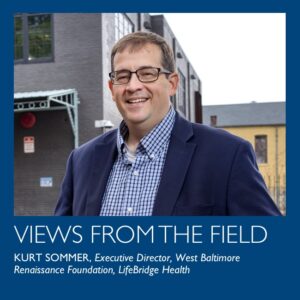

Kurt Sommer, Executive Director, West Baltimore Renaissance Foundation, LifeBridge Health
For far too long, residents of west Baltimore have faced continuous uphill battles to access basic amenities, services, jobs, and quality of life. Racism, redlining, eminent domain, disinvestment, school closures, poverty, violent crime, chronic health conditions, failed affordable housing, and the outmigration of businesses and residents have left behind vacant housing and dilapidated commercial corridors. These challenges result in a 17-year difference in life expectancy between residents of west Baltimore neighborhoods compared to other parts of the city and prosperous suburbs. Despite these dynamics, resilient residents and community leaders continue organizing and engaging to access resources and build better pathways forward, seeking to restore their historic neighborhoods and parks while ensuring residents, especially youth, have an opportunity for success.
A Health System Expands Into West Baltimore
LifeBridge Health, a growing community health system serving greater Baltimore, acquired what is now Grace Medical Center in 2019 to preserve health services and the 100-year-old facility serving the west Baltimore community. Through an agreement with the Maryland Health Services Cost Review Commission which oversees hospital budgets, capital funds were committed to rebuilding the hospital, building a community center, and investing in strategies that influence health in west Baltimore.
A new nonprofit, the West Baltimore Renaissance Foundation (WBRF), was created to build and manage the community center and fund initiatives that focus on social and upstream factors that influence health.
Over the past seven years, working closely with nonprofit and neighborhood leaders, LifeBridge Health and WBRF have been working to address clinical and social determinants of health challenges in west Baltimore. Grace Medical Center was completely renovated as a free-standing emergency department and outpatient health facility affiliated with nearby Sinai Hospital. Over $60 million was invested to preserve and enhance health services, maintaining emergency, behavioral, and clinical services, including significant outreach strategies to the greater west Baltimore community. Working with community partners, Grace staff builds new relationships and trust by bringing health services to residents where they are, including in senior residences and through faith-based strategies.
Improving Health by Tackling the Social Determinants
Built in phases, with the final stage expected to start this fall, The Factory: A West Baltimore Opportunity Center is now open in the Franklin Square neighborhood hosting nonprofit organizations that focus on direct and systems-oriented strategies for the community. A former warehouse and gelato production facility, the $14 million catalytic redevelopment of the 33,000 square foot facility overcame numerous regulatory, physical, financial, and utility challenges that are emblematic of the barriers inhibiting investment in the surrounding communities. The building is home to nonprofit tenants and community-facing LifeBridge Health entities. The Factory offers a wide range of services in the building including entrepreneurship, technology training, youth programming, mental health services, food access, health care job training, violence intervention strategies, and convening.
Tenants benefit from below-market rents and have access to significant amenities including a conference room, classroom, and computer lab, as well as a large event space. The building is also used by other nonprofit and community organizations hosting trainings, resource fairs, conferences, celebrations, dinners, and other outreach strategies. Two additional strategies are expected to come online in 2027, including the redevelopment of a 3,000 square foot commercial kitchen to grow food access strategies as well as space to host a job training program in the construction field. The Factory is intended to be a sustainable, long-term approach to empowering community and improving health in west Baltimore.
In addition to The Factory, over the past six years, WBRF has worked to address social determinants of health needs through grantmaking. Funds were made available for a limited term to be managed by WBRF to support programming by other nonprofits serving the community. Over 300 grants totaling more than $27 million have been made to support workforce development, youth programming, food access, and population health strategies such as legal and financial services, housing, homeownership readiness, health education, and mental health engagement in west Baltimore.
Funds are overseen by a board that includes health care, community, and public agency representation, and focuses on proven organizations that are based in or have established partnerships in west Baltimore to ensure services are provided by accessible and community trusted entities. Outcomes from the grants, given to over 120 organizations to date, include 2,247 job placements, 16,728 youth programming opportunities, 8.8 million pounds of food provided, and 24,505 residents accessing critical services and supports.
Additional awards focus on community-building strategies, strategic capital projects, capacity building programming for nonprofit staff, entrepreneurs and community leaders, as well as a community managed investment fund. Joining with Kaiser Permanente and Bon Secours Community Works, WBRF provided seed funding for the Anchor Group Impact Fund managed directly by community and church leaders around Grace Medical Center. The Fund, a strategy developed by the community to be able to directly control and invest in needs and strategies they wanted to move forward, has supported a wide range of programming focused on youth, seniors, food access, and more. Local leaders are seeking to build on the seed funding to continue their work.
Partnerships Key to Success
As WBRF begins to pivot from its grantmaking role to take on new strategies and programming at The Factory, there is much more work ahead to continue the progress being made. Given the depth of challenges in the area, partnerships are fundamental to success and aligning limited resources for larger impact. WBRF works closely with local peer institutions such as Bon Secours Community Works, which manages affordable housing, an urban farm, and community programming, as well as with University of Maryland Baltimore, which has created a Community Engagement Center hosting programming. The institutions, along with neighborhood leaders, are part of and support Southwest Partnership, a professionally staffed community development entity focused on seven neighborhoods. Southwest Partnership manages a range of housing and commercial redevelopment strategies, leveraging private and public capital funding while supporting organizing, engagement, and other approaches to improve conditions and quality of life.
Partnerships have also been key to service delivery. Residents face challenges that are deeper than the services of any one organization. For example, in response to opioid addiction and overdose challenges facing senior affordable housing, WBRF created an integrated strategy led by LeadingAge Maryland along with Civic Works, Grace Medical Center, and New Hope Treatment Center to train affordable housing residents and staff in harm reduction, connect seniors to public benefits and services, provide programming, increase food access, and engage residents around health and addiction services. Engagement started slowly, but over time, relationships and trust have been established and outcomes have been positive, including very strong participation and engagement rates.
Focusing on People- and Place-Based Strategies
Another key to successful improving health requires strategies that support both people and places. Community conditions are a fundamental driving factor, and influence an individual’s health particularly when violence, abandoned housing, and access to employment centers and grocery stores are issues. WBRF has invested in community development partners, nonprofit housing providers, and strategic projects. Similarly, on the people-based side, supporting organizations that have the capacity to work with individuals where they are, including youth programming and sector focused workforce organizations with barrier removal strategies, has been critical. Access to free legal services has also been important to help overcome a variety of housing issues as well as expungement needs. Through this work, WBRF sought organizations based in the community and measured impact and data tracking to the local zip codes to ensure connectivity.
Looking Ahead
This work was highlighted at a site visit during the Grantmakers In Health Annual Conference, which offered an opportunity for other funders to see the work of WBRF and its partners and get a sense of the agenda that remains. It demonstrated that community health is strengthened not by one organization acting alone, but through a network of committed partners working together over the long term.
We believe that community and individual health requires investing in neighborhoods, strengthening trusted community organizations, being intentional and focused geographically, and recognizing that empowering residents is fundamental.
Thanks to the work of many, progress can be seen in west Baltimore through improving conditions, new investments, and sharply declining homicides as well as deaths from overdoses. However, the challenges faced remain deep. While some neighborhoods are seeing signs of resurgence, others are still seeking signs of hope. Continuing this progress in west Baltimore will take a deeper commitment of public and private partners as well as public policy changes. The dynamics faced are built by decades of decisionmaking that failed to focus on the primary basic element of success – the residents. There is indeed much work ahead, and LifeBridge Health and WBRF are proud to work alongside and support the community as we collectively work for improved neighborhood and individual health.