

Diana L. Stilwell, Strategy Lead, Eyes on Health
Elizabeth Gould, Program Officer, de Beaumont Foundation
Nalini Padmanabhan, Communications Director, de Beaumont Foundation
Our information environment is transforming—including the places and people who help us make decisions about our health. Those health information ecosystems are fragmented; filled with information from a wide range of expertise and sources; and platform algorithms exert tremendous and unseen control over what messages are seen, shared, and amplified. These changes have many of our traditional health information sources racing to learn new skills to ensure they remain trusted and relevant.
Our organizations are focusing on the people and institutions that play key roles in health information ecosystems. We are helping them to adapt and to continue supporting the public in meeting their health goals. This article presents insights from our recent conversations with researchers, practitioners, funders, and many others working in this area, including examples of how philanthropy is supporting work to create and sustain robust and resilient health information ecosystems.
Insight 1: Health information ecosystems are complex
The public faces challenges in finding and using information to meet their health goals that go beyond the need to sort rumors from accurate content. Our information environment is shaped by policies, practices, resource flows, relationships, power dynamics, and mental models—all of which interact and influence one another in complex ways.
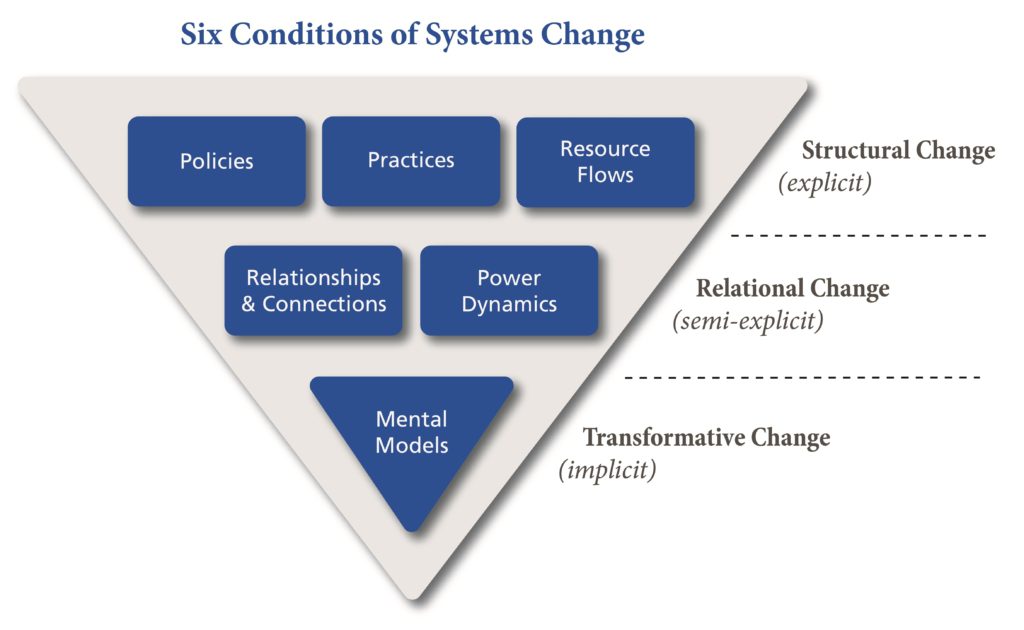
Our understanding of the social determinants of health has helped us recognize that health disparities are more than the result of individual decisions and behaviors. Applying a similar systems perspective to our health information ecosystems helps us identify the conditions that underlie these challenges and recognize the leverage points where shifts can lead to positive change (Kania, Kramer, Senge 2018; Fraser 2024).
Solutions that focus on individual behaviors, such as media literacy training for the public or communication skill-building for practitioners, can then be seen as key parts of a complex whole; and their outcomes, successes, and informative failures can also be better understood through this broader lens.
Implications for funder strategy:
Funders can support work across the conditions that lead to systems change. For example, practices are shifting as health communicators and other professionals adapt their approaches (see below). Access to information is a key resource within communities, and support for local media outlets (for example, Press Forward Locals) is ensuring that more people can find and use the information they need to make decisions that affect their health and wellbeing.
Efforts to address the policies and power dynamics that shape our information environment—transformed by platform algorithms and AI—will require close collaboration among funders, platform leaders, researchers, governments, and many other stakeholders (Duco 2024).
And there is increasing support for work to shift mindsets. Initiatives such as the Pro-Democracy Narrative Playbook have rigorously developed narrative strategies to evoke shared values that can shift what we think and how we act. Investment in the infrastructure and tools needed to implement these strategies in health and adjacent contexts will be needed. The long-term work to shift norms will also require changes in how nonprofits communicate, including exploring new messengers and embedding new communications skills and strategies throughout organizations, beyond the communications team (DiResta & Kleinfeld 2026).
Insight 2: Traditional institutions and communicators need support to adapt
Institutions and experts are no longer the gatekeepers who create and distribute information to a trusting public. Traditional top-down models of communication that reached wide audiences through a few shared channels have been replaced by new structures. Our information “diets” are individually tailored by algorithms. Artificial intelligence (AI) has a central and rapidly expanding role in consumer health information.
Today, credibility depends less on expertise and more on mastery of new skills that may not come easily to traditional information sources such as publishers and health systems. The new trusted sources are casual, authentic, relatable, and engage actively with their audiences. Many experts honed a different set of communications skills, which may not meet their goals as well as they once did. Their expertise matters as much as ever—but it needs help to reach its intended audience.
Implications for funder strategy:
Initiatives that strengthen professional practice, strengthen health communication, and deepen community listening will help expert sources stay relevant and trusted. For example, the Public Health Communications Collaborative provides tools, training, and support to build communications capacity among public health professionals. The Infodemiology Training Program (ITP) equips practitioners with skills to identify and respond to trending health narratives. Other tools in development include an AI-enabled platform called VeriSci that is helping a range of content creators reach diverse audiences with different communication needs, and Arclet, designed to help public health communicators easily find, localize, deploy, and measure the impact of their messaging.
Renee DiResta and Rachel Kleinfeld (2026) recently offered recommendations for how institutions— including funders—can respond effectively to the dramatic and irreversible shifts in our information environment; for example, by viewing new kinds of communicators as partners. Funding influencers directly or through fellowship or cohort models is an evolving strategy that requires willingness to experiment, learn, and accept a different degree of control over messaging.
Insight 3: A new field is emerging and needs structure
We’ve talked with dozens of individuals and organizations who make up this emerging field, working through diverse perspectives and expertise to understand and adapt to our transformed information environment. Through most of 2025, we hosted an online community of researchers and practitioners working on different aspects of health information ecosystems. Most members belong to professional organizations in their fields (sociology, medicine, etc.)—but say much of their work on issues related to the health of information ecosystems happens in silos. They have few spaces for collaboration and shared learning with others who share their interest in health, and even fewer with others working on identical issues in climate, education, or democracy.
Similar spaces for relationships and connections have also formed through the work of Your Local Epidemiologist, Unbiased Science, the “Why Should I Trust You?” podcast, and others. Often with limited resources, these projects are building trust, finding shared values, and forming new relationships that can foster innovation and shared solutions, including a unique partnership between Yale public health researchers and Make America Healthy Again advocates.
Implications for funder strategy:
Emerging fields need both project support and resources and infrastructure to enable cross-sector learning, foster shared understanding of problems and priority solutions, and collaborate on agendas for action.
Work to build connection and relationship among professional stakeholders is supported by a few groups that represent broad coalitions, such as the Coalition for Trust in Health and Science, or specific practitioner communities, such as the Public Health Communications Collaborative, the Society for Health Communication, and similar organizations. Support to expand these ‘containers for collaboration’ will help the field align around shared priorities for research, solutions, and policy change.
Funders need the clarity and prioritization that will emerge from these discussions among field actors to inform strategy and grantmaking decisions in this area and ensure efficient use of resources. Investment in convenings that focus on shared agenda-setting and action plans will move toward that clarity. And while support for podcasts and online communities may not fit neatly into traditional grantmaking strategies, these efforts are making clear progress in adapting to a changed environment for health communications.
Insight #4: Measuring progress will look different
The structures and systems that make up health information ecosystems are complex and transforming rapidly. In this dynamic context, we need to think differently about how we measure the impact of our work and investments. Success in efforts to reduce tobacco use took decades but is clearly seen in lower rates of smoking and policy changes such as advertising restrictions. Experts who study systems change have wryly noted, “Over the course of a generation, measuring progress can be a breeze” (Bridgespan Group 2024).
Responding and adapting to our transforming information environment has been described as “generational work.” We need baseline information coupled with flexible, adaptive measurement strategies that envision both long-term success and short-term positive movement.
Implications for funder strategy:
In this emerging field, it will be important to co-create a baseline “state of the field” analysis with periodic reassessments that monitor the health of the field as it matures. Important early measures of progress will include the number of actors who identify with the work and the creation of shared priorities and agendas. A strong field is a prerequisite for systems change. Progress on measures that assess the field’s health and growth will be essential for positive long-term outcomes.
Given the complexity of change needed, we also need to track changes in the system and adapt strategies and measures of success accordingly. Regular assessment of conditions such as public trust in institutions, adoption of practices that show adaptation and resilience, and the presence of infrastructure to support collaboration are all positive signs of systems change.
Future shifts may create new opportunities or risks, requiring new shifts in strategy and measurement. Progress will not be linear, and change may come in unexpected ways. Being prepared to respond and adopt new approaches as conditions change – while keeping the long-term vision clearly in mind—will allow funders to adjust quickly and maintain momentum, just as many have done recently in response to rapidly shifting federal priorities and investment.
Building Toward Resilience
The biggest challenges in today’s health information ecosystems are systemic, not the result of individual failure or bad choices on the part of the public, practitioners, or policymakers—all of whom are operating in a complex, dynamic system that is rapidly transforming.
Recognizing the complex nature of systems, supporting positive adaptation, creating infrastructure for this emerging field, and creating adaptive, flexible ways to measure progress and impact are all important strategies for organizations working to ensure our health information ecosystems support healthy individuals, stronger communities, and a more resilient society.
(For additional background, see Session Spotlight: Protecting the Public’s Health: Strategies for Building a Healthier Information Ecosystem from the 2025 GIH Annual Conference on Health Philanthropy.)
References
National Academies of Sciences, Engineering, and Medicine. 2025. Understanding and Addressing Misinformation About Science. Washington, DC: The National Academies Press.
DiResta, Renee, and Rachel Kleinfeld. For Expertise to Matter, Nonpartisan Institutions Need New Communications Strategies. Carnegie Endowment for International Peace, 2025.
DiResta, Renee, and Rachel Kleinfeld. Why Social Media is Now the Place to Build Trust. The Chronicle of Philanthropy, February 3, 2026.
Fraser, Michael. Strategic Skills for Public Health Practice: Systems and Strategic Thinking. APHA Press, 2024.
Duco. Trust and Safety Market Report. March 13, 2024.
Kania, John, Mark Kramer, and Peter Senge. The Water of Systems Change. FSG, 2018.
Farnham, Lija, Emma Nothman, Kevin Crouch, and Bradley Seeman. What Philanthropists Can Learn from Field Catalysts About Measuring Progress on Systems Change. The Bridgespan Group, 2024.