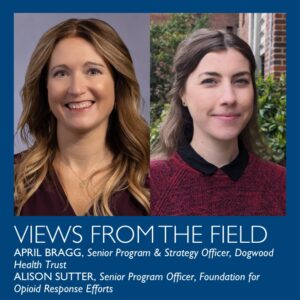

April Bragg, Senior Program & Strategy Officer, Dogwood Health Trust
Alison Sutter, Senior Program Officer, Foundation for Opioid Response Efforts
Recent changes in the federal policy landscape have created new questions for communities working to address substance use disorder (SUD), mental health needs, and housing instability. In this evolving environment, philanthropy, in collaboration with community-based organizations and local governments, has an important role to play in supporting evidence-based responses to overdose and mental health emergencies that improve access to care, strengthen community wellbeing, and uplift public health while avoiding unnecessary criminal legal outcomes.
As an issue-based and place-based funder, respectively, the Foundation for Opioid Response Efforts (FORE) and Dogwood Health Trust have worked extensively to reduce opioid overdose mortality by partnering with organizations, collaboratives, and local and state governments to support the implementation of community-based harm reduction and recovery models of SUD care. Post-Overdose Response Teams (PORT) leverage the community reach of paramedics and peer recovery support specialists (PRSS) to engage and support individuals who have recently experienced an overdose. They are an effective, replicable model for improving both individual and community health and safety, and lessons learned from PORT can inform other rapid-response models that address mental health emergencies and broader public safety challenges.
Emergency medical services (EMS) are on the front lines of the overdose crisis, with nearly 650,000 cases of nonfatal overdoses recorded by the National Emergency Medical Services Information System in 2023 (NEMSIS 2024). Because many overdose survivors decline transport to hospitals for medical care, often due to the risk of stigma and punitive treatment, first responders have a unique opportunity to connect individuals with community-based services they might not otherwise access. PORT teams connect people who have experienced an overdose with recovery support, harm reduction services, overdose prevention education, and evidence-based treatment such as medication for opioid use disorder (MOUD). Teams can be coordinated by county agencies or community-based organizations working in collaboration with county agencies and have been shown to decrease the risk of subsequent overdose for outreach participants (Carroll 2023).
Examples from the Field
Launching and Expanding PORT in Western North Carolina
Based in Asheville, North Carolina, Dogwood Health Trust works to dramatically improve the health and wellbeing of all people and communities in Western North Carolina (WNC). Since its inception in 2019, Dogwood has invested more than $50 million to address SUD across the 18 westernmost counties of North Carolina and the Qualla Boundary.
As a place-based funder, Dogwood’s work to address SUD has been shaped by relationships with local partners, collaboration with the North Carolina Department of Health and Human Services (NC DHHS) and North Carolina Department of Justice, community listening sessions, and regional and local data reporting including Community Health Assessments. In recent years, those assessments have consistently ranked SUD and behavioral health as priority concerns across communities Dogwood serves.
Dogwood’s first PORT partnership launched in 2021 in one of the region’s more populated counties, with the county EMS team leading the partnership with multiple Federally Qualified Health Centers (FQHCs), harm reduction organizations and recovery partners. The PORT offered 24/7 direct care to citizens experiencing illicit drug overdoses, including emergency care and patient advocacy in real time. The PORT included community paramedics, PRSS, and clinicians who worked closely to provide in-person wrap-around services.
Building on the success of this partnership, Dogwood provided additional funding to support the PORT team to initiate MOUD in the field, connect individuals with ongoing care, and address barriers such as housing, transportation, food, and financial support. Throughout the program, no patients enrolled experienced a fatal overdose, only 4 percent of patients experienced a second overdose, and more than half remained engaged in MOUD after six months (MAHEC 2024). The pilot’s success led to a replication toolkit and county funding through national opioid settlement funds, demonstrating how philanthropy and public-private partnerships can spark lasting local solutions for opioid use disorder.
Building Capacity for PORT in Frederick County, Maryland
The Foundation for Opioid Response Efforts (FORE) is a national grantmaking foundation that is committed to convening and supporting partners advancing patient-centered, evidence-based solutions to the opioid and overdose crisis in the United States. Since its founding in 2018, FORE has awarded 156 grants totaling $56.7 million nationwide. In recognition that community-based organizations often best understand community needs, FORE launched its first round of CBO Capacity-Building funding in 2023 and has since awarded more than $7M to 47 local organizations delivering prevention, treatment, harm reduction, and recovery services where they are needed most.
In its first cohort of CBO grantees, FORE supported the Frederick County, Maryland Community Outreach and Support Team (COAST), a PORT. COAST was launched by the Frederick County Health Department and Division of Fire and Rescue Services (DFRS) when paramedics identified that they were responding to repeated overdose calls from community members and recognized a need to combine supportive services with emergency response. FORE’s grant supported the costs associated with training all Frederick County paramedics in overdose response, stigma reduction, and community-based resources, positioning 600 paramedics to engage in compassionate overdose response and partner more effectively with COAST. In pre/post self-assessments, first responders reported that after the training they felt more knowledgeable and confident in supporting people who use drugs. With grant funding, COAST pursued new partnerships with local treatment and healthcare providers to build community support for the program and expand their referral network. Because of these efforts, the COAST program has been highlighted by county officials as a leader in developing the community-wide partnerships contributing to declining overdose rates in Frederick County (Barakat 2026).
Flexible philanthropic support has also enabled Frederick County’s COAST to respond to community-identified needs contributing to overdose risk. As across many rural communities, COAST participants and staff emphasized that transportation is a significant barrier to healthcare access. FORE’s grant funding has provided DRFS with adaptable resources to explore the development of a transportation program within the framework of a local government agency. They have also braided FORE funding with government and in-kind support to launch a mobile medical unit to reach locations disproportionately impacted by overdose and underserved by fixed-site healthcare services.
Considerations for Funders Supporting Post-Overdose Response Teams:
Does the proposed PORT program…
- Document strong wrap around partnerships with community-based harm reduction, treatment, recovery, and social service providers?
- Have a plan for addressing negative stigma regarding substance use?
- Link with organizations providing MOUD, including methadone and buprenorphine?
- Include individuals with lived experience and have those individuals had a voice in planning for the work?
- Have strong data collection methodology in place to inform program evolution and sustainability planning?
Does your grantmaking strategy…
- Involve feedback from a diverse range of community members to develop a shared vision for community health and safety?
- Allow for flexibility to respond to evolving local needs, emerging challenges, and the complexities of multi-sector collaboration?
- Provide sufficient support for evaluation and dissemination of findings to demonstrate the impact of community-based responses to overdose?
- Create opportunities for shared learning within and between communities, to encourage the scaling and replication of evidence-based models of SUD care?
Learnings From and For Grantmakers
- Overdose reversal is not the end of the story – to be effective in improving health and safety outcomes, PORT programs must be part of a community-wide continuum of care.
A key learning from this work is that close and intentional collaboration with the local recovery system is essential to PORT success, as addressing the social drivers of health is critical to improving public safety and reducing overdose mortality. Collaborations can include mutual referral relationships with CBOs, trusted relationships with law enforcement, and multi-agency collaboratives that provide a continuum of support for individuals at all stages of recovery. PORT programs are most effective when they operate within a multi-dimensional recovery ecosystem where individuals can receive a continuum of support tailored to their readiness. A 2023 study showed that post overdose response programs in municipalities with more social services had lower fatal overdose rates (Kimmel 2023). There is substantial evidence that unemployment, economic downturns, and poverty increase risk of opioid-related harms including overdose (Dean 2019; Hollingsworth 2017; Case 2017). Employment is associated with reduction of substance use and successful engagement in SUD treatment, and experiencing homelessness increases the risk of overdose and of medication treatment cessation (Sahker 2019; Fine 2022). Funders considering support of PORT teams should explore whether these crucial elements for success are in place in the community, and if support for community development is needed as an initial step to lay the foundation for successful PORT implementation.
- Health funders can amplify the impact of PORT programs by fostering and supporting cross-sector collaboration.
Philanthropies can serve as conveners to connect the government agencies that house emergency response departments with the community voices that are critical in developing effective programming and the policymakers and government leaders who can turn promising practices into sustained programs. For example, Dogwood worked closely with NC DHHS to review the state’s Opioid and Substance Use Action Plan and connected multiple community partners to design a post-overdose response initiative in one of the hardest hit counties in the region. Similarly, FORE’s funding in Frederick County, MD has facilitated COAST’s participation in coalition meetings like the Maryland Association of Counties Conference to encourage the use of opioid settlement funds for evidence-based strategies like PORT programs.
- Grant funding can create opportunities for community-driven innovation within local government health and public safety services.
Philanthropic support can complement government funding, pilot promising interventions, and respond to emerging public health and safety needs to ensure that programs run by local government agencies are meeting the needs of community members. Funders can supplement the work of local health and EMS departments by embedding innovative programming within traditional care models, supporting policy change that will support PORT programs (e.g. MOUD field induction, certification and standardization of effective models, sustainable funding), and coordinating efforts to leverage additional capital, such as opioid settlement dollars, in combining funding sources to sustain PORT programs. Funders should also direct resources to center individuals with lived experience in program design to ensure new initiatives are responsive to community priorities.
It is a timely moment for funders to assess how they can directly support the development, scaling, and sustainability of evidence-backed models like PORT that reduce overdose mortality while protecting and improving community health and safety. Furthermore, it is important that philanthropic leaders strategize to develop unified messaging around public safety and consider how this policy moment can be leveraged to center the role of community workers such as paramedics and peers in public safety efforts.
References:
Barakat, Marwa. “Overdose deaths in Frederick County have decreased each year since 2022.” The Frederick News-Post. February 3, 2026.
Carroll, Jennifer J. “Post-Overdose Response Teams.” National Association of Counties. July 17, 2023.
Case, Anne, and Angus Deaton. “Mortality and morbidity in the 21st century.” Brookings Papers on Economic Activity. Volume 2017 (2017): 397-476. doi:10.1353/eca.2017.0005
Dean, Adam and Simeon Kimmel. “Free trade and opioid overdose death in the United States.” SSM – Population Health. Volume 8 (May 23, 2019).
Fine, Danielle R., et al. “Drug Overdose Mortality Among People Experiencing Homelessness, 2003 to 2018.” JAMA Network Open. Volume 5, No. 1 (January 7, 2022).
Hollingsworth, Alex, et al. “Macroeconomic conditions and opioid abuse.” Journal of Health Economics. Volume 56 (December 2017): 222-223.
Kimmel, Simeon, D., et al. “Characteristics of post-overdose outreach programs and municipal-level opioid overdose in Massachusetts.” International Journal of Drug Policy. Volume 120, 2023.
Mountain Area Health Education Center (MAHEC), Buncombe Bridge to Care (BB2C) Condensed Report.2024.
National Emergency Medical Services Information System (NEMSIS). “Drug Overdose Surveillance Dashboard.” 2024.
Sahker, Ethan, et al. “Employment recovery capital in the treatment of substance use disorders: Six-month follow-up observations.” Drug and Alcohol Dependence. Volume 205 (December 2019).