
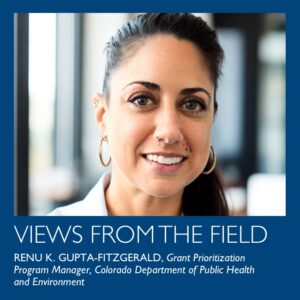

Renu K. Gupta-Fitzgerald, Grant Prioritization Program Manager, Colorado Department of Public Health and Environment
Public funding for youth well-being isn’t lacking in effort or investment. But when dollars move through disconnected systems, even the best intentions can fail to translate into meaningful outcomes. What if the challenge isn’t how much we fund, but how those investments work together? Colorado is testing a different approach: aligning funding, data, and strategy across agencies so that public dollars can operate as a more coordinated system rather than a collection of parallel but sometimes siloed efforts.
Colorado House Bill 23-1223 established the Grant Prioritization Task Force within the Colorado Department of Public Health and Environment, bringing together multiple state agencies “to achieve maximum impact in reducing youth violence, suicide, and delinquency risk factors.” The legislation directed the Task Force to establish shared goals, objectives, and guidelines to help agencies prioritize, align, and, where appropriate, coordinate resources to achieve maximum impact in communities with the greatest need. It also called for the development of streamlined grantmaking processes including a common application and coordinated data and reporting approaches to track progress and outcomes. For community-based organizations, navigating these various systems can be complex and time-consuming, even when their work directly aligns with state priorities. Through the work of the Task Force, our state grant funding can become both more accessible to community-based organizations and more effective in driving measurable improvements in youth outcomes.
This isn’t about creating another program; it’s about changing how funding decisions get made. The Task Force is focused on something more foundational: building shared infrastructure across agencies and supporting funding decisions that are more coordinated, data-informed, and responsive to community needs. This approach reflects a broader shift from funding individual programs to designing systems that produce shared outcomes.
Building Alignment Across Systems
The Grant Prioritization Task Force brings together representatives from six state agencies, alongside community-based organizations. This structure is intentional. Youth outcomes are shaped by multiple systems—public health, education, behavioral health, public safety, and more—and aligning those systems requires shared ownership.
One of the core strategies emerging from the Task Force is the creation of agency-level working groups that serve as a bridge between individual agencies and the broader Task Force. These groups support the implementation of shared guidelines while also bringing feedback from program teams into the process.
This creates a two-way conversation, rather than a top-down directive. It allows the state to maintain a unified vision while still adapting to the implementation realities across different agencies, funding sources, and communities.
The result is not uniformity, but alignment, where agencies move toward shared goals while retaining the flexibility to respond to the communities they serve.
A Shared Language for Decisionmaking
A major barrier to coordination across systems is the lack of a shared understanding of need. To address this, the Task Force will begin applying a common data framework that considers multiple indicators—such as education, housing, economic stability, and safety—to identify where youth are most impacted by risk factors and where investment can have the greatest impact.
More importantly, this framework will provide a shared language and understanding by turning data into something actionable that can directly shape where and how funding is disbursed, with common language and understanding. Agencies that previously relied on different data sources and metrics are beginning to align around the same indicators and outcomes.
This shift will enable more coordinated decisionmaking: funding strategies, reporting expectations, and evaluation frameworks can all be anchored in a shared understanding of what matters most for youth well-being.
Reducing Barriers to Funding Access
While alignment at the agency level is critical, the Task Force is equally focused on improving access for community-based organizations.
Historically, organizations seeking state funding have had to navigate multiple application systems, each with different requirements and expectations. This has created a disproportionate burden, particularly for smaller or newer organizations that may not have dedicated grant-writing capacity, despite being deeply embedded and trusted in their community.
Consistent with the statute, the Task Force is working on the following:
- Developing a common application to reduce redundant data entry and streamline the process across agencies.
- Exploring a centralized grant clearinghouse so applicants can easily find opportunities and resources in one place.
- Providing technical assistance, including workshops, office hours, and one-on-one support.
- Establishing shared expectations through standardized language, reporting, and guidance.
These efforts are designed to shift the system from one that rewards familiarity with bureaucracy to one that prioritizes community impact. For community partners, and for us as funders, this changes the focus from navigating systems to demonstrating impact. An important benefit is the focus on strengthening community capacity alongside funding.
As one example, technical assistance is being reframed not as an add-on, but as a core function of responsive and accessible grantmaking. Supporting organizations in building their capacity so they can apply for and secure competitive funding—not just navigate the process —is part of the funder’s responsibility, not a separate service.
Centering Community Voice
A critical component of the Task Force’s work is ensuring that community perspectives inform decisionmaking.
Community-based appointees bring lived experience and on-the-ground insight into how state processes are experienced, and where they may fall short. This includes feedback not only from successful grantees, but also from non-recipient organizations or partners who choose not to apply due to perceived barriers.
This perspective helps the state better understand both the benefits and unintended consequences of its funding practices. It also ensures that strategies for improvement are grounded in real-world conditions across Colorado’s diverse communities.
From urban centers to rural and frontier regions, community input is essential to designing systems that are both effective and responsive.
Early Signals of Change
While the work is still in progress, early signals suggest that this coordinated approach is beginning to shift how agencies and communities interact.
There is increased alignment across agencies in how funding priorities and expectations are defined. Community organizations report greater clarity in understanding application processes and expectations. And there is growing emphasis on using both quantitative and qualitative data to inform decisions.
Perhaps most importantly, the conversation is shifting from how to navigate systems to how to improve outcomes.
Lessons for the Field
Colorado’s experience points to a simple reality: alignment doesn’t happen by accident—it has to be designed. For funders and policymakers looking to move from fragmented investments to measurable outcomes, several lessons stand out:
- Alignment is built, not declared. Shared goals are a starting point, but without coordinated systems, processes, and data, funding will continue to operate in parallel. Real alignment requires infrastructure that connects how decisions are made across agencies.
- Start with shared definitions. Before funding can be aligned, language must be aligned. Terms like “need,” “rural,” or “evidence-based” often vary in meaning across agencies, creating hidden barriers to coordination. Establishing a common language is one of the most practical and immediate steps toward alignment.
- Reduce friction to increase impact. Complex applications and reporting requirements don’t just slow systems down, they shape who is able to participate. Right-sizing expectations based on grant size and scope expands access and allows organizations to focus on delivering results, not navigating processes.
- Make data usable, not just available. Data only drives impact when it informs decisions. Shared frameworks help translate complex information into actionable insights, so funding can be directed where it is needed most.
At the same time, it’s critical to remember that every data point represents a person: a youth who can get to school safely every day, a family on the edge of missing their rent payment, a parent deciding which bills to pay late because groceries can’t wait. Grounding data in lived experience ensures that alignment efforts remain focused on real outcomes for real communities. - Measure what actually changes. Counting how many people are served is not the same as understanding impact. Aligning around shared outcomes shifts the focus from reach to results, answering “what is different for youth and communities because of the investment?”
- Design with communities, not for them. Community and youth voices should shape system design from the beginning, not be added as feedback after the fact. Embedding lived experience into decisionmaking leads to more responsive, effective, and trusted funding strategies.
- Invest beyond the award. Funding alone is not always enough to ensure success. Providing technical assistance, clear guidance, and capacity-building support helps organizations compete for, manage, and sustain funding, which strengthens impact over time.
Looking Ahead
As the Task Force continues its work, the focus is on implementation and translating alignment into tangible improvements for both state agencies and community partners. A key component of this work is building continuous feedback loops, ensuring that input from community partners and program teams directly informs how systems evolve over time, with room to grow and pivot.
Emerging approaches include piloting a two-phase application model combining a shared core application with program-specific addenda, to balance consistency across agencies with the flexibility needed for different funding streams.
Success will not be defined by the creation of new tools alone, but by how those tools are experienced. When community organizations can easily find opportunities, navigate a streamlined application, and feel that their feedback has shaped the process, the system will have moved beyond the status quo.
Colorado’s model shows that when grant funding is aligned, it becomes more than spending; it transforms coordinated strategy into measurable impact. Behind every data point is a real person, and what changes in each life depends on our alignment.