
A New Path for Philanthropy: Supporting Oral Health Through Community Partnerships
Good nutrition is essential to good oral as well as overall health. A community-based organization in central Washington state called APOYO shares this belief with Arcora Foundation. Beyond food and nutrition services, the organization has long supported immigrant and Latinx families with culturally relevant outreach, advocacy, and resource navigation. But during the summer of 2025, their ability to support communities was in jeopardy.
Welcoming and Belonging: Drivers for Equity and Growth
More than a decade ago, leadership at REACH Healthcare Foundation began exploring how a community would function if it truly embraced welcoming and belonging for immigrant and refugee populations. The mid-sized Midwest philanthropic foundation sought to invest in a plan to reveal, then address, the systemic barriers impacting Kansas City’s efforts of inclusion for all members of the community.
Healing Takes Practice: Reaching People Is Only the Beginning
Violence is increasingly understood as a public health problem. That shift has changed the way communities respond—moving the conversation beyond policing and criminal justice and toward prevention, intervention, and the conditions that put people at risk. But treating violence as a health problem also requires us to reckon with trauma.
We Didn’t Stop: Leading with Purpose When the System Stepped Back
The notice came the way these things now tend to come: abruptly, in writing, and without a transition plan. In April 2025, Public Health AmeriCorps programs were terminated nationally alongside about 900 other AmeriCorps programs. Funding halted. AmeriCorps service members who had built their careers and households around a year of community health service were left waiting for answers no one could give them. Organizations across the country scrambled.
GIH Health Policy Update Newsletter
An Exclusive Resource for Funding Partners
The Health Policy Update is a newsletter produced in collaboration with Leavitt Partners and Trust for America’s Health. Drawing on GIH’s policy priorities outlined in our policy agenda and our strategic objective of increasing our policy and advocacy presence, the Health Policy Update provides GIH Funding Partners with a range of federal health policy news.
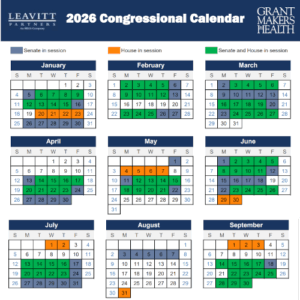
2026 Congressional Calendar
Developed in collaboration with Leavitt Partners, this calendar tracks when each house of congress will be in session in 2026.
Grantmakers In Health’s Partnership with Sustainable Agriculture and Food Systems Funders Highlighted in Inside Philanthropy Article
Due to cuts to the Supplemental Nutrition Assistance Program (SNAP) in H.R.1, along with the program’s suspension during the longest government shutdown in American history, Grantmakers in Health (GIH) is partnering with Sustainable Agriculture and Food Systems Funders (SAFSF) on a funder working group to coordinate philanthropy’s response. This partnership, along with SAFSF’s broader work, was highlighted in a November 13, 2025 Inside Philanthropy article. In the piece, Clare Fox, SAFSF’s…

Roles for Philanthropy as Medicaid Changes Take Effect
For those of us who have worked toward health equity, who have spent the past few years building toward incremental gains and pushing for larger change, the events of this year can feel like one big backslide. At times, it’s overwhelming. Yet this is not the time to get bogged down by the size of the challenge or by analysis paralysis. From where I sit, I see five roles that philanthropy can play in the rollout of changes to Medicaid.

Acting with Urgency: Stupski Foundation Accelerates Its Spend-Down Grantmaking
In this interview, Grantmakers In Health’s Maya Schane spoke with Dan Tuttle and Sulma Gandhi of the Stupski Foundation about the foundation’s spend-down strategy and acceleration of grantmaking in 2025 in response to federal policy changes.

Practicing What We Preach: Three Tips for Putting Equity at the Heart of a Successful Application Process
Every step of the grant application process
— from initial outreach to final award notification — provides opportunities for funders to either reinforce inequities or dismantle them. The grant application process is often the first barrier that organizations encounter when seeking funding. If designed without an intentional focus on equity, the application process can advantage well-resourced organizations, while disadvantaging equally or better qualified organizations that have fewer resources.

Protecting Children’s Access to Health Care in Schools: The Impact of Medicaid Cuts on School Health Services
“Due to the remote area we serve, our students have little to no access to medical services otherthan those provided in schools.”—Superintendent from a rural school district in Michigan. Schools are essential places for children to access health services. An estimated 40 percent ofschool-aged children have at least one chronic health condition (National Survey of Children’sHealth, 2019). Among low-income children with special health careneeds, approximately 87percent do not receive necessary care, primarily due to financial costs and limited access (Childand Adolescent Health Measurement Initiative, 2022). Providing health care at school, where children spend most of their days, is crucial to addressing these concerns.