
Molly Baldwin, Founder and CEO, Roca, Inc.
Jennifer Clammer, Executive Director, Roca Impact Institute
Allie Maynard, Strategy Advisor
Violence is increasingly understood as a public health problem. That shift has changed the way communities respond—moving the conversation beyond policing and criminal justice and toward prevention, intervention, and the conditions that put people at risk.
But treating violence as a health problem also requires us to reckon with trauma.
Roca has spent nearly four decades working with young people at the highest risk of shooting someone, being shot, or becoming incarcerated, and who are often the least ready to seek help. Many have experienced violence as both victims and perpetrators, along with other forms of trauma and exploitation like trafficking and abuse.
For some, that trauma is ongoing; violence and instability remain part of their lives. But even when the immediate danger has passed, trauma can have lasting effects on the brain systems involved in detecting threat and regulating emotion and behavior. Those effects can make the very capacities behavior change requires—like controlling an impulse and choosing a different response—harder to access under stress (Ressler et al. 2022).
That raises a practical question: Who is going to help? The country already faces a dire shortage of behavioral health clinicians.
Health funders largely recognize that reaching people at greatest risk often requires going beyond traditional systems of care. Community violence intervention workers, youth workers, case managers, credible messengers, and other frontline practitioners can reach people who may never walk into a clinic or ask for help.
Roca knows something about how difficult achieving that reach can be.
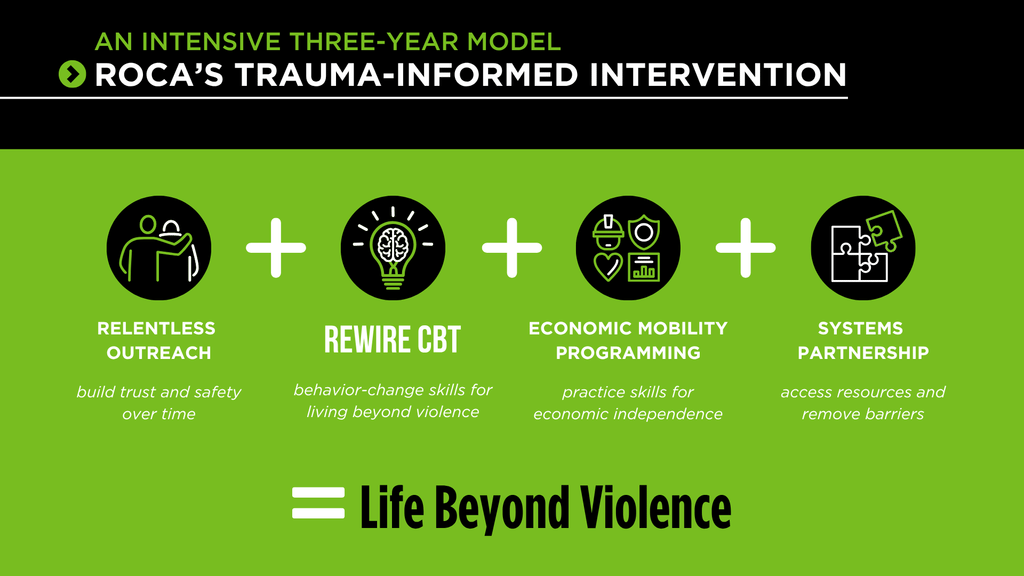
In FY 2026, Roca staff made more than 134,000 outreach attempts to reach 1,399 young people. More than three-quarters had prior or current involvement with the criminal justice system; over time, 89 percent engaged in Roca’s cognitive behavioral intervention (Roca 2026).
That experience has taught us that reaching someone is only the first challenge. The harder question is what it takes to help them change.
A trusted relationship creates an opportunity for change. It does not, by itself, give someone a different response in a moment of stress or perceived threat.
That takes practice.
Knowing what to do is not the same as being able to do it
In 2014, Roca partnered with Massachusetts General Hospital to adapt the core principles of Cognitive Behavioral Therapy (CBT), a behavioral health intervention for addressing trauma and reducing violence and crime, into Rewire CBT, a simple, nonclinical practice that frontline workers could use with young people unlikely to seek help in a traditional clinical setting. Rewire CBT helps young people understand the connection between what they think, feel, and do—and helps them learn how to create an 8- to 12-second pause between impulse and action.
Eight seconds is not much. But in the space between a perceived threat and a response, it can be enough to interrupt a reaction that could lead to violence—and create the possibility of a safer response.
Learning how to pause, however, isn’t the same as being able to pause when someone threatens you.
So young people learn new skills. Then they practice them—over and over again. They practice when the stakes are low, so the skills are more available when the stakes are high. They try a different response. Sometimes it works. Sometimes it doesn’t. Either way, there is another opportunity to look at what happened, understand the connection between thought, feeling, and action, and try again.
That repetition isn’t incidental to the intervention—it is how the intervention works. Rewire’s seven CBT skills are embedded in everyday interactions, creating repeated opportunities to strengthen new patterns of thinking and responding.
One young man’s breakthrough came on a Roca-supervised worksite. After arriving late, Jordan became angry when his supervisor held him accountable—a situation that once would have ended with him walking off the job. Instead, his supervisor prompted him to think about what he valued: staying free, building a career, creating a different future. He paused, went back to work, and later recognized that he had responded differently instead of reacting automatically.
Roca sees evidence of change well before it shows up in traditional measures like reduced arrest or incarceration. Among young people engaged with Roca for at least 18 months and practicing Rewire CBT, 95 percent improved on behavioral health indicators, including 86 percent who improved emotional regulation.[i]
Those figures do not tell us that Rewire alone produced those outcomes. Roca’s direct-service model combines CBT with relentless outreach, sustained relationships, employment, education, and other supports. But they do demonstrate what is possible with a population often considered extraordinarily difficult to engage.
Getting there, however, requires more than teaching young people what to do differently. They have to be able to do it when the stakes are highest.
That gap—between knowing and doing—is where practice becomes essential.
Increasingly, we have realized that this is true for the people responsible for helping them change, too.
What if practitioners need to learn the same way?
Rewire CBT was designed to be simple, practical, and nonclinical. It did not require a therapist or a clinical setting. That has made it highly transferable to other frontline practitioners working with people traditional behavioral health systems struggle to reach.
Since 2020, the Roca Impact Institute has worked to equip frontline practitioners with Rewire CBT skills they can use within the work they already do. Increasingly, that work has extended to the community violence intervention (CVI) field, equipping practitioners who are already reaching young people at the center of violence with a practical behavioral health tool to help them build skills to address trauma and change over time.
Roca has now trained more than 3,000 frontline staff across 81 community-based and juvenile justice institutions, reaching more than 80,000 additional young people, as well as more than 11,000 police and corrections officers.
But taking Rewire outside Roca has revealed another version of the same challenge.
We can teach a practitioner a CBT skill in a training. We can explain it, demonstrate it, and give them a chance to try it. But none of that tells us whether they will be able to use it well while sitting across from a young person who is furious, grieving, frightened, or considering retaliation.
Under a conventional training model, that real interaction may be the first meaningful test. The stakes are high, and the supervisor who could provide useful feedback may never see it happen.
If young people need opportunities to practice, get it wrong, reflect, and try again, practitioners do too.
From training to readiness
This insight is beginning to change the way Roca thinks about scale.
The question is no longer simply how to train more practitioners in Rewire CBT. It is how to ensure they are ready to use what they have learned when it matters.
Roca is now exploring how technology, including AI-powered simulation, can create more frequent opportunities for practitioners to rehearse difficult interactions, receive feedback, and try again before the stakes are real. Technology may make frequent practice possible at a scale conventional training cannot.
But the technology is not the point. Readiness is.
Completing a training tells us that someone received information. It does not tell us whether they can use it. Scale, then, is not simply a question of how far an intervention can travel. It is a question of what survives the journey.
Roca does not yet have all the answers. The next phase will test whether practitioner skill improves, whether workers continue to practice, whether quality holds in partner organizations—and ultimately whether greater practitioner readiness contributes to better outcomes for young people.
What this means for health philanthropy
For health philanthropy, this presents an opportunity to think differently about what it takes to bring effective behavioral health approaches to more people.
A grant that trains 500 practitioners can readily report that 500 people were trained. It is harder to fund—and measure—the practice, feedback, coaching, supervision, and reinforcement required to know whether they can actually use what they learned.
But that may be where some of the most important work happens.
Funders can invest in the infrastructure between training and competency. They can support ongoing practice and coaching rather than treating training as a one-time event. They can support the time, tools, and evaluation needed to understand whether skills are demonstrated, retained, and used in practice. Philanthropy can also help build the evidence connecting those investments to the outcome that ultimately matters: what changes for the people those practitioners serve.
“Roca’s work reminds us that building the capacity to respond differently to trauma takes deep commitment—both from young people themselves and from the staff who work alongside them every day. Meaningful change doesn’t happen through a single intervention or training; it takes repeated practice, reflection, and the willingness to stay the course through setbacks and try again. As funders, we need to be willing to support that sustained process of learning and growth—including the practice, coaching, and reinforcement that help new skills take hold.”
–Lindsay Louie, CEO of Enlight Foundation
Healing takes practice
For the young people Roca serves, knowing a different response is not enough. They have to practice it until they can use it when it matters. We are learning that the same is true for the people helping them.
As health philanthropy considers how to bring effective behavioral health approaches to more people, the challenge is not simply getting good ideas into more hands. It is making sure the people carrying them are ready to use them.
Reaching people matters. Training people matters. But neither is the end goal.
Healing takes practice. So does helping someone heal.
References
Ressler, Kerry J., Sabina Berretta, Vadim Y. Bolshakov, Isabelle M. Rosso, Edward G. Meloni, Scott L. Rauch, and William A. Carlezon Jr. “Post-traumatic Stress Disorder: Clinical and Translational Neuroscience from Cells to Circuits.” Nature Reviews Neurology. 18, no. 5 (2022): 273-288. doi:10.1038/s41582-022-00635-8.
Roca, Inc. FY2026 Annual Data. Internal program data, 2026.
[i] Roca measures behavioral health change through a standardized Change Assessment battery administered at regular intervals during participation. Measures vary by population and include validated instruments assessing psychological distress, emotional regulation, anger and impulse control, trauma and PTSD symptoms, depression, and substance use, including the BSI-18, WAI-SF, DAR-5, GAIN-SS, DERS-SF, PCL-5, PHQ-9, and ASI-L. Changes in scores over time are used to track participant progress in these domains.