
Upcoming Events
Past Events
Explore Health Equity and Social Justice Topics
Recent Items - Climate and Environmental Health







Latest Resources

2023 Rural Health Road Trip—Collaboration in Big Sky Country
It is hard to believe we are approaching the end of summer. It has been a bit of a blur, going from one conference to the next, and planning for fall meetings. For the second year since joining GIH, I was able to participate in our rural health road trip, an annual tradition started by the Federal Office of Rural Health Policy and National Rural Health Association in 2014.
Thirty-Three Years Later: Oral Health Care Still Not Accessible for Individuals with Disabilities
The Americans with Disabilities Act (ADA), enacted on July 26, 1990, stands as one of the most significant civil rights laws in U.S. history. Designed to eliminate discrimination and ensure equal opportunities for Americans with disabilities, the ADA has had a profound impact on advancing health equity in various domains, including oral health. The ADA has been a transformative force in advancing health equity for Americans with disabilities by championing their rights to accessible health care services. Under Title II of the ADA, state and local governments, including public healthcare institutions, are mandated to offer equal access and reasonable accommodations to individuals with disabilities. This ensures that medical facilities, including dental offices, are equipped to cater to diverse patient needs, fostering an environment where disabled individuals can receive oral health services with dignity and equality

Episcopal Health Foundation’s Journey in Advancing Medicaid Non-Medical Drivers of Health in Texas
Access to affordable medical care is vitally important, but it is only 20 percent of what contributes to a person’s overall health. The remaining 80 percent is determined by social and economic status, health behaviors, community safety, physical environment, and much more. From grantmaking to working with community partners and congregations to providing research, EHF supports solutions that address underlying factors impacting health.

Bristol Myers Squibb Foundation: August 2023
The Bristol Myers Squibb Foundation is issuing a special request for concepts focused on addressing lung cancer care disparities for Indigenous communities. They are currently seeking concepts for ideas for multiyear grants that pilot/test innovative models of community-based care to increase access to services and improve lung cancer outcomes across the lung cancer care continuum.

New York State Health Foundation: August 2023
A new data analysis from the Urban Institute finds nearly half of New Yorkers with medical debt owed $500 or more and may still have medical debt appear on their credit reports under current credit reporting practices. Last month, the New York State Legislature passed a bill, still under the Governor’s consideration, that would prevent all medical debt from being included in credit reports.
Reports and Publications

GIH Bulletin: January/February 2026
One year ago, as we were just one month into the new administration, I wrote that “At a moment when so much has been described as ‘unprecedented,’ and so much of what we value is being attacked, we need to ask ourselves as individuals, organizations, and a field, what do we stand for? What values do we hold, and what will we do and say to defend them?” Today, the answers to these questions are needed more urgently than ever.

GIH Bulletin: November/December 2025
GIH President and CEO, Cara V. James, delivered these remarks on Protecting the Freedom to Give at the closing of the 2025 Health Policy Exchange, in Arlington, Virginia.
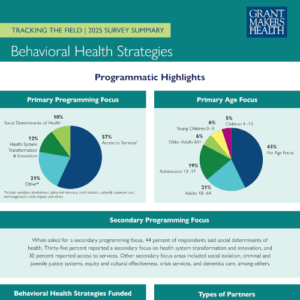
Behavioral Health Strategies
GIH conducted a survey in late 2024 on funder engagement in behavioral health. This fact sheet, based on a sample of 139 health funders, summarizes the current trends, gaps, successes and challenges for funders. It also highlights philanthropy’s continued commitment to behavioral health while also signaling concern about the upcoming funding environment.