
Upcoming Events
Past Events
Explore Health Equity and Social Justice Topics
Recent Items - Climate and Environmental Health










Latest Resources

Changing the Vaccine Conversation Before It’s Too Late—What Can Philanthropy Do?
In July 2026, the United States reached a grim milestone when the number of confirmed cases of measles exceeded the total for all of 2025. On August 10, 2026, the White House issued an executive order directing changes to the federal childhood vaccine schedule and categories, and calls for availability of separate measles, mumps, and rubella vaccines. The science has not changed, but the new framework could significantly slow down the delivery of protective immunizations from these serious diseases.

Community Focused Strategies to Improve Health in West Baltimore
For far too long, residents of west Baltimore have faced continuous uphill battles to access basic amenities, services, jobs, and quality of life. Racism, redlining, eminent domain, disinvestment, school closures, poverty, violent crime, chronic health conditions, failed affordable housing, and the outmigration of businesses and residents have left behind vacant housing and dilapidated commercial corridors. These challenges result in a 17-year difference in life expectancy between residents of west Baltimore neighborhoods compared to other parts of the city.

The New Hampshire Children’s Health Foundation: September 2026
The New Hampshire Children’s Health Foundation is continuing its 2026 Emergent Need Fund to help nonprofit organizations in New Hampshire respond to emergent needs caused by unforeseen events. These funds are designed to provide rapid support when unexpected circumstances threaten the ability to deliver essential services to children and families.
The Merck Foundation: August 2026
The Call for Proposals is now open! The Merck Foundation has launched a United States initiative called the Community Collaborative for Reimagining HIV Care. Through the Collaborative, the foundation will provide grants to support the development and implementation of innovative, community-centered models of comprehensive care to meet the evolving needs of people living with HIV.

Elevating Community Priorities to Shape Georgia’s Health Policy Agenda
Georgia stands at a pivotal moment that will shape the direction of health policy in our state. With an open governor’s race in 2026, along with other open seats, we’re on the cusp of significant political transition. While new leadership introduces uncertainty, it also creates opportunity. This moment opens the door for nonpartisan, nonprofit, private foundations like our team at Georgia Health Initiative to play a constructive role in elevating community priorities to shape a health policy agenda designed to work for all Georgians.

Strengthening Health Care Access for People with Disabilities: Lessons for Philanthropy
In July, we recognize Disability Pride Month, marking the anniversary of the landmark Americans with Disabilities Act (ADA) and celebrating the contributions and diverse identities of people with disabilities. While the ADA prohibits discrimination on the basis of disability and establishes protections and requirements for employers, state, and local governments, and other areas of public life, many people with disabilities still face barriers.
Reports and Publications
2024 Health Equity Survey: Understanding the Changing Landscape
In 2024, Grantmakers In Health (GIH) surveyed its Funding Partners to understand how their health equity work has evolved. The survey consisted of 40 questions including demographic information, program focus areas, partner engagement, organizational strategy, priority population, successes, and challenges. This report summarizes findings from the Health Equity Survey titled, “Understanding the Changing Landscape.”
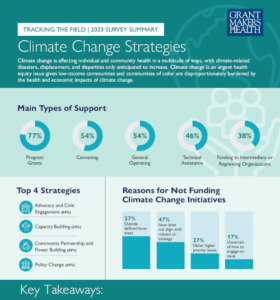
2023 Survey Summary: Climate Change Strategies
This infographic summarizes the responses to a Grantmakers In Health funder survey, conducted in May and June 2023, on how philanthropy is addressing climate change, and the barriers and opportunities that exist to support climate-related efforts.
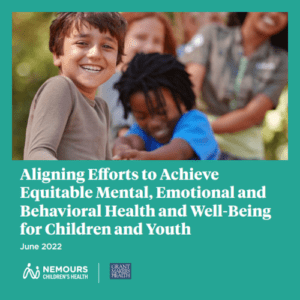
Aligning Efforts to Achieve Equitable Mental, Emotional, and Behavioral Health and Well-Being for Children and Youth
This report issues a call to action for philanthropic organizations and public-sector partners that are ready to move forward in improving mental, emotional, and behavioral health. It describes existing philanthropic and federal initiatives and offers a potential portfolio of aligned strategies for private- and public-sector partners to consider.