
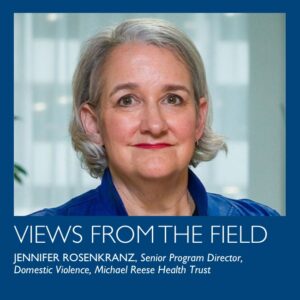

Jennifer Rosenkranz, Senior Program Director, Domestic Violence, Michael Reese Health Trust
Interviewer: Maya Schane, Grantmakers In Health
Grantmakers In Health’s Maya Schane spoke with Jennifer Rosenkranz of the Michael Reese Health Trust in Chicago, Illinois, about the Trust’s recently published research, People Who Cause Harm: Policies, Funding, and Strategies in Cook County.
The research involved a landscape scan of Cook County, Illinois’ policies, funding, and services for people who cause harm with a goal of engaging the stakeholders and providers doing this work as well as survivors and those who receive services to identify barriers, challenges, and strengths of domestic violence prevention programs. The research examined Partner Abuse Intervention Programs (PAIP) in particular, a standard intervention for people who cause harm that is overseen by the Illinois Department of Human Services.
The research showed much of the incredible work being done across Cook County but also highlighted that many of these programs are underfunded and face systemic barriers. Findings highlighted how organizations have difficulties innovating and expanding their programming due to lack of funding; how people who are not involved in criminal courts have few service options; how children who witness violence need more assistance; how there is missing coordination between the service providers, courts, and law enforcement; and that there is need for greater education around healthy relationships.
This interview discusses the research itself as well as what other funders can learn from it. It has been edited for length and clarity.
What attracted Michael Reese Health Trust to studying Partner Abuse Intervention Programs? Prior to conducting this research, were you already engaged in work on domestic violence in Cook County?
We have been engaged in this work for many years. In fact, we have funded domestic violence programs since our very first grant cycle, and we found that despite all the good work that we knew was going on, the incidence of intimate partner violence and the calls to the Illinois Domestic Violence Hotline kept increasing, so we thought that there had to be something more we can do.
We set out to study this, listened to survivors and what they said they wanted, and learned from the people on the ground doing the work every day, and that was how we decided to engage in the partner abuse side of domestic violence. Our board was also supportive of us taking this new direction, allowing us to take a risk and do something different.
For funders who might be unfamiliar with Partner Abuse Intervention Programs, what do you hope they take away from this report, and what are some of the most important findings or messages?
I hope that funders see this as a viable way to prevent domestic violence. I think the vast majority of resources are going to survivor services—and this isn’t a competition between the two—but very few organizations fund interventions for people who cause harm, and the amount of money from state government that goes into these services is dwarfed by services for survivors. I hope that people see that if we really want to end domestic violence, we need to address the behavior of the people who are doing it. There are very few private funders engaged in this work, and we hope to engage additional partners to prevent domestic violence.
This can be a misunderstood area of domestic violence prevention. Can you explain why investing in intervention programs for people who cause harm is an important part of supporting survivors and preventing future violence?
We heard loud and clear that often times survivors don’t want their family to break up; they want the abuse to stop. Even when the partners are no longer together, they often have to co-parent, so they need to have an ongoing relationship.
Survivors also worry about their former partner hurting somebody else, so we heard loud and clear that addressing and working with people who cause harm is survivor-centered. If we’re really going to break the cycle, this is work that must be done.
Despite established links between community violence and intimate partner violence, in the report you discuss how there is a lack of integration between prevention strategies. Can you discuss how you see intimate partner violence interventions fitting within broader community violence intervention strategies?
There are various models of existing programs. Years ago, Michael Reese funded these two areas, community violence and domestic violence, separately. We heard from our grantees that there was a lot of overlap, so we brought organizations together to talk about what needed to be done.
What resulted from that was a model where a community violence organization partners with a domestic violence organization so that there can be cross-referrals. If a street outreach worker who’s working in community violence sees something they know is related to domestic violence, they have a place to call and to refer people, and vice versa. Called the Intersections Project, this is now a national model – there are programs in Chicago; Baltimore, Maryland; and Oakland, California – so thankfully more people are recognizing this intersection.
Since publishing this report, what feedback or reactions have you received from other stakeholders engaged in this work – whether from policymakers, nonprofits, funders, or the public, at the state or local levels?
The feedback has been really positive. We expected that there might be some negative feedback about taking this route to address domestic violence, and that hasn’t been the case. It has gotten press locally, and I have met with other funders and policymakers to talk about the report and discuss how we can move forward the report’s recommendations.
People providing PAIP programs felt like this was an area that no one cared about, and that they were working in the shadows. I think they appreciate an organization focusing on this area, working with them closely, and seeing their needs being met, so it has really had a great impact.
We’ve also seen organizations shift their work as a result of this report. I serve on the city of Chicago’s gender-based violence task force, and the city has committed to increasing funding for programs for people who cause harm, which is a positive outcome.
How did an equity lens shape both the research process and the recommendations? Were there particular communities or perspectives that you felt were especially important to include?
An equity lens grounds all of our work at Michael Reese. In this area specifically, we know that Black residents are disproportionately overrepresented in PAIP data and in survivor reports, and we know that there is also institutional racism that contributes to that. We recommend culturally responsive and community-centered programming, which is part of our work to modernize the PAIP curriculum. It’s also important to expand voluntary programming so that we can prevent over-incarceration of Black and Brown communities and get people help before they come to the court.
Although there’s a research component to this work, the other part of this is that we engaged the communities closest to the work. We surveyed providers of domestic violence services and had focus groups with survivors and people who cause harm. This was another key aspect of the work, so that it was not a foundation coming in and telling people what they need to do, but rather listening and talking to the community and then using the foundation to elevate the findings and work towards the recommendations.
How does Michael Reese Health Trust plan to utilize these results and build on this work? How will the research inform your grantmaking or other strategies moving forward?
It is guiding my work in the domestic violence program entirely now—all of our domestic violence support is focused on this area.
We say that Michael Reese is a funder and a doer, so beyond grantmaking and providing general operating support to organizations that provide PAIP programs, we are also funding innovative work to help strengthen outcomes for these programs. We provide technical assistance and capacity building for providers; for example, I host a learning conference every year for providers so they can hear from experts in the field about how to strengthen programs.
Also, one of the projects we are most excited about is a hotline for people who cause harm. There’s currently the Illinois Domestic Violence Hotline for survivors, but we learned from the research that several hundred people who cause harm each year are also calling that hotline. We are working with a local organization, The Network Advocating Against Domestic Violence, on a hotline for people who cause harm so these individuals can learn about healthy relationships and access services before entering the criminal-legal system.
The last piece is that because Michael Reese is a public foundation, we can advocate. We are listening to PAIP providers about the changes they want to Illinois’ administrative code, which specifies the required elements of PAIP programs. Once those are finalized, we hope to help use our influence and power to help achieve those aims.
What roles can philanthropy play in advancing this work, and what lessons would you share with other health funders interested in engaging on this topic?
Part of it is taking a risk and not shying away from a challenge. There are new ways to look at existing problems, and we need to take some risks and be willing to engage in something that may seem out of the box but is worth exploring and doing.
We are hoping to get more funders engaged in this effort and in understanding that this is a crucial part of preventing and ending the cycle of domestic violence. There is certainly work going on in many local communities related to this, and I am of course happy to talk to anyone who wants to engage in that.