

Upcoming Events
Past Events
Explore Health Equity and Social Justice Topics
Recent Items - Climate and Environmental Health









Latest Resources
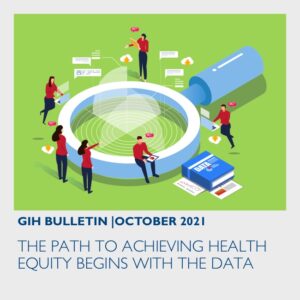
The Path to Achieving Health Equity Begins with The Data
As we work towards a more just and equitable future, we must ensure that we have the data needed to measure the things we are trying to improve. It is no longer acceptable to say we do not know.

New Resources for Investing in Farm to Early Care and Education
Farm to early care and education initiatives work across systems, linking health, education, and agriculture to support young children’s cognitive, physical, and social-emotional development; improve community nutrition; and build sustainable local food systems. The W.K. Kellogg Foundation has released a set of new resources based on the learnings from their five-year, five-state (Georgia, Iowa, North Carolina, Pennsylvania, and Wisconsin) investment in farm to early care and education.

Moving from Intention to Impact: Funding Racial Equity to Win
In a joint report, Moving from Intention to Impact: Funding Racial Equity to Win, PolicyLink and The Bridgespan Group examines commitment to funding for racial equity work in the US. In the last year, donors across the spectrum from foundations to corporations have made unprecedented commitments to advancing racial equity. Two key takeaways from the report to encourage funders to make real impact in racial equity is the need for transparent reporting and being responsive to the needs of movement leaders.
The 2020 DAPP Report – Change Philanthropy
Change Philanthropy has released its 2020 Diversity Among Philanthropic Professionals Report that analyzes the philanthropic workforce and identifies trends and gaps in diversity and inclusion in philanthropy. Over 2,300 individuals, including staff and board members, from 124 foundations participated through an anonymous, self-reported survey. The report covers diversity and representation across multiple areas including race/ethnicity, sexual orientation, gender, and immigration status, and highlights differences by geographical regions in the US.
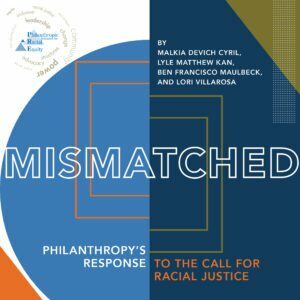
Mismatched: Philanthropy’s Response to the Call for Racial Justice
The Philanthropic Initiative for Racial Equity (PRE) latest report, Mismatched: Philanthropy’s Response to the Call for Racial Justice, is an in-depth and comprehensive analysis of racial equity and racial justice funding. The analysis found that while overall funding and the number of funders supporting racial equity and racial justice work increased over the past decade, it is still a small proportion compared to overall funding priorities.

The Unseen Provider: COVID-19 Reveals the Hidden Link between Correctional and Community Care
COVID-19 has had disproportionate impact on justice-involved people because health and justice systems maintain discrete siloes due to longstanding policies. These policies create structural barriers to an integrated response to people living at the intersection of these two systems. Focusing resources in this overlooked area provides an excellent opportunity for a return on investment for grantmakers seeking to make impactful change.
Reports and Publications

GIH Bulletin: January/February 2026
One year ago, as we were just one month into the new administration, I wrote that “At a moment when so much has been described as ‘unprecedented,’ and so much of what we value is being attacked, we need to ask ourselves as individuals, organizations, and a field, what do we stand for? What values do we hold, and what will we do and say to defend them?” Today, the answers to these questions are needed more urgently than ever.

GIH Bulletin: November/December 2025
GIH President and CEO, Cara V. James, delivered these remarks on Protecting the Freedom to Give at the closing of the 2025 Health Policy Exchange, in Arlington, Virginia.
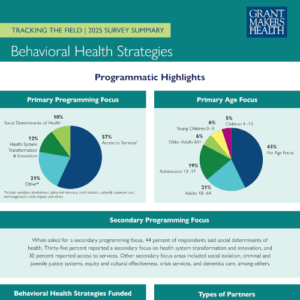
Behavioral Health Strategies
GIH conducted a survey in late 2024 on funder engagement in behavioral health. This fact sheet, based on a sample of 139 health funders, summarizes the current trends, gaps, successes and challenges for funders. It also highlights philanthropy’s continued commitment to behavioral health while also signaling concern about the upcoming funding environment.