
Upcoming Events
Past Events
Explore Health Equity and Social Justice Topics
Recent Items - Climate and Environmental Health

Recent Items - Health Equity
Recent Items - Healthy Eating/Active Living
Kate B. Reynolds Charitable Trust: October 2025
Recent Items - Housing
Marin Community Foundation: October 2024
Horizon Foundation: September 2024
Recent Items - Justice Reform
Recent Items - Social Determinants of Health
North Carolina Healthcare Foundation: January 2026
Marin Community Foundation: October 2024
Recent Items - Violence Prevention
The Joyce Foundation
Latest Resources
HIV/AIDS and Women of Color: Changing the Conversation
For the past decade, HIV/AIDS-related conditions have been the leading cause of death for African-American women ages 25-34 in the United States (CDC 1999). Over the past two decades, our local foundation has seen this national epidemic take root in our local community in Washington, DC, where we now have 10 times the rate of HIV/AIDS per capita compared to the rest of the country.
We Must Promote Health Equity in Spite of Current Economic Challenges
When the Whitehall Studies were first published, they identified not only a social gradient that correlated the relationship between social status and life expectancy, but new variables to consider when predicting population health outcomes. These variables included the economic, social, and physical environments in which people live.
Initiatives in Education, Economic Development Present Challenges, Yield Big Rewards
The Rapides Foundation is a health care legacy dating back to 1994. The foundation’s grantmaking focus has always addressed traditional health care and health promotion priorities. We have funded medical training and programs that help people get access to medication and launched programs that helped communities fund walking trails and playgrounds.
Expanding the Circle of Allies
Many of us have been investigating and working to reduce health disparities for decades. And we have seen the trend lines like writing on the wall. An equation of the health decisions we each make, plus the environment in which we make them, has added up to a nation where we are not nearly as healthy as we could be.
Cultivating Health Literacy at the State and National Levels
In 2004 the Institute of Medicine (IOM) released a landmark report on the state of health literacy in the United States. That report, Health Literacy: A Prescription to End Confusion, pulled together a growing body of information indicating that health literacy deficits are both common – present in nearly half of the U.S. population – and damaging to individual health and well-being.
Improving the Health of Vulnerable Children with Medical-Legal Partnerships
ubstandard housing, polluted neighborhoods, and inadequate nutrition are just a few of the “nonmedical” problems that can compromise children’s health status and developmental trajectory. The most visible result of these threats can be a frustrating, expensive, and heartbreakingly preventable trip to the doctor’s office or local emergency room.
Reports and Publications
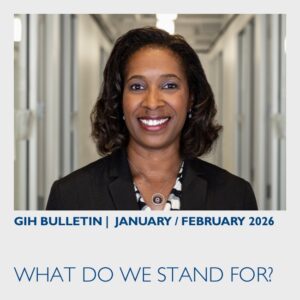
GIH Bulletin: January/February 2026
One year ago, as we were just one month into the new administration, I wrote that “At a moment when so much has been described as ‘unprecedented,’ and so much of what we value is being attacked, we need to ask ourselves as individuals, organizations, and a field, what do we stand for? What values do we hold, and what will we do and say to defend them?” Today, the answers to these questions are needed more urgently than ever.

GIH Bulletin: November/December 2025
GIH President and CEO, Cara V. James, delivered these remarks on Protecting the Freedom to Give at the closing of the 2025 Health Policy Exchange, in Arlington, Virginia.
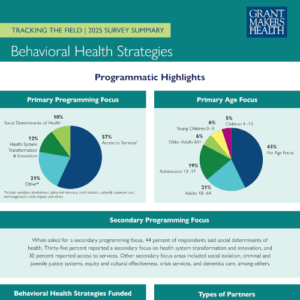
Behavioral Health Strategies
GIH conducted a survey in late 2024 on funder engagement in behavioral health. This fact sheet, based on a sample of 139 health funders, summarizes the current trends, gaps, successes and challenges for funders. It also highlights philanthropy’s continued commitment to behavioral health while also signaling concern about the upcoming funding environment.
Strengthen your knowledge, skills, and capacity.
GIH focuses our programming around five areas that are critical to achieving better health for all.
We invite you to explore the resources available on our focus areas pages, browse content in more specific issue areas, and to connect with GIH staff to discuss how we can partner and support your work.