

Explore Community Engagement and Empowerment Topics




Latest Resources

Community Focused Strategies to Improve Health in West Baltimore
For far too long, residents of west Baltimore have faced continuous uphill battles to access basic amenities, services, jobs, and quality of life. Racism, redlining, eminent domain, disinvestment, school closures, poverty, violent crime, chronic health conditions, failed affordable housing, and the outmigration of businesses and residents have left behind vacant housing and dilapidated commercial corridors. These challenges result in a 17-year difference in life expectancy between residents of west Baltimore neighborhoods compared to other parts of the city.

Hogg Foundation for Mental Health: September 2026
The Hogg Foundation for Mental Health is seeking two young adult leaders to join its National Advisory Council. The council advises the foundation on its work and includes members with expertise in psychiatry, community health, peer support, social work, sociology, philanthropy, public policy, and law, as well as people with lived experience of mental health conditions.

The Voters Health Care Reaches
August marks Civic Health Month, a time to showcase the link between voting and health. It arrives this year against a difficult backdrop. The enhanced Affordable Care Act (ACA) subsidies that helped millions afford coverage expired at the end of 2025, and federal cuts to Medicaid are reshaping who can get care and how. The ACA was among the hardest-won health equity victories in a century, and its erosion is a reminder that policy gains are never permanent. They are defended, or lost, depending on who shows up to vote.

Elevating Community Priorities to Shape Georgia’s Health Policy Agenda
Georgia stands at a pivotal moment that will shape the direction of health policy in our state. With an open governor’s race in 2026, along with other open seats, we’re on the cusp of significant political transition. While new leadership introduces uncertainty, it also creates opportunity. This moment opens the door for nonpartisan, nonprofit, private foundations like our team at Georgia Health Initiative to play a constructive role in elevating community priorities to shape a health policy agenda designed to work for all Georgians.
UniHealth Foundation: July 2026
UniHealth Foundation recently launched its Healthy Neighbors Small Grants Program. The new initiative will fund nonprofits focused on enhancing community health and wellness in Pasadena, Altadena, Sierra Madre, and South Pasadena, California. Grant awards will range from $5,000 to $10,000, with decisions announced in late fall 2026.

Dogwood Health Trust: July 2026
Dogwood Health Trust shared a new disaster response playbook that captures lessons learned from its experience responding to Hurricane Helene in 2024. The playbook and downloadable readiness and response checklist offer practical guidance for how organizations can help stabilize communities in the immediate aftermath of a disaster and lay the groundwork for long-term recovery.
Reports and Publications
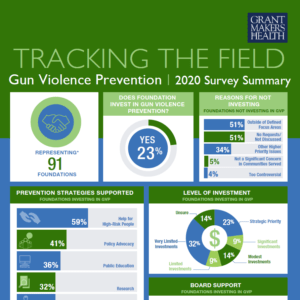
Gun Violence Prevention Infographic
Gun violence is a public health crisis in the United States, with approximately 120,000 Americans injured or killed by guns each year. GIH surveyed our Funding Partners in September 2020 to explore investments in gun violence prevention. The survey results have been compiled into a one-page summary infographic.
GIH Bulletin: November/December 2020
GIH is continuing to organize several post-election calls for health funders, as we have done in previous years. Join us on November 30 at 1:00 p.m. Eastern for Post-Election Discussion: Moving Forward on Health Care to gain key insights into the prospects for increasing health care access, advancing health equity, and improving the delivery system. In addition, check out these resources from our Philanthropy Support Partners…
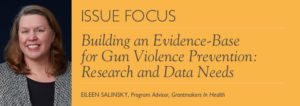
Building an Evidence-Base for Gun Violence Prevention: Research and Data Needs
Gun violence prevention research is woefully underfunded, receiving significantly less research funding and scientific attention compared with other leading causes of death. Using a methodology that calculated expected levels of research investment based on mortality rates, one study estimated that between 2004 and 2015 gun violence received just 1.6 percent of the federal research support projected and had 4.5 percent of the volume of publications anticipated.