

Upcoming Events
Past Events
Explore Health Equity and Social Justice Topics
Recent Items - Climate and Environmental Health










Latest Resources

The Gilead Foundation: Advancing Health Equity Through Education Equity in the U.S.
While the COVID pandemic and most recent racial reckoning galvanized the traditional health philanthropy community, many corporate funders made their first foray into supporting racial and social justice efforts as well as health equity. Corporate social responsibility efforts were, and continue to be, scrutinized as merely cosmetic public relations efforts with no real long-term, institutional commitments to driving meaningful change in Black and Brown communities that have long been historically, intentionally marginalized.

Health Philanthropy’s Equity Blind Spot: Syringe Services Programs
Syringe services programs (SSPs) have existed, mostly under the radar, in the United States since the early days of the response to the HIV epidemic. Illegal then, and still illegal in many jurisdictions across the country today, sterile syringe access is a bedrock of harm reduction.

Strengthening Social Connection and Opportunities in Rural Communities
This brief describes an unfolding learning journey intended to strengthen social connection, resident voice, and agency to address inequities in rural health and well-being. Along the way, we have come to realize the important lessons for each of our institutions and ways in which we are better off for having taken this approach to our work.

Rhode Island’s Health Equity Zones: Rethinking Community Investing to Create Measurable, Sustainable Gains in Health Equity
In 2015 the Rhode Island Department of Health (RIDOH) launched a project called the Health Equity Zones (HEZ) initiative, with the goal of creating a new public health approach. Rather than prioritizing specific health outcomes, Rhode Island’s HEZ initiative was designed to shift investments upstream to improve the social, environmental, and economic determinants of health by intentionally investing in community infrastructure and resident empowerment. The HEZ initiative has grown over the past seven years to become an internationally recognized model for operationalizing health equity, and during that time we have learned a lot about the role of community investments and how our approach needs to be rethought if we are truly going to invest in health equity.

Centering Racial Justice to Address Climate Change: Learning What it Takes
In 2018, the Kresge Foundation launched the Climate Change, Health, and Equity (CCHE) initiative as a 5-year, $22 million commitment to accelerate action on climate change and climate-related inequities in health. Since its inception, the CCHE network has worked in distinct, yet aligned strategies that focus on health institutions, practitioner and professional societies, and community-based organizations. The priority was to bring together diverse grant-funded partners at different points along their equity journey, with initiative partners providing evaluation, technical assistance, and support to sustain the network.
Reports and Publications

GIH Bulletin: January/February 2026
One year ago, as we were just one month into the new administration, I wrote that “At a moment when so much has been described as ‘unprecedented,’ and so much of what we value is being attacked, we need to ask ourselves as individuals, organizations, and a field, what do we stand for? What values do we hold, and what will we do and say to defend them?” Today, the answers to these questions are needed more urgently than ever.

GIH Bulletin: November/December 2025
GIH President and CEO, Cara V. James, delivered these remarks on Protecting the Freedom to Give at the closing of the 2025 Health Policy Exchange, in Arlington, Virginia.
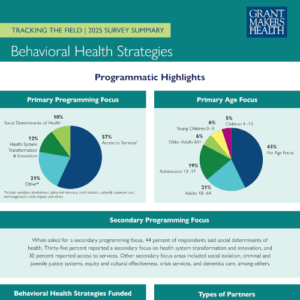
Behavioral Health Strategies
GIH conducted a survey in late 2024 on funder engagement in behavioral health. This fact sheet, based on a sample of 139 health funders, summarizes the current trends, gaps, successes and challenges for funders. It also highlights philanthropy’s continued commitment to behavioral health while also signaling concern about the upcoming funding environment.