

Upcoming Events
Past Events
Explore Health Equity and Social Justice Topics
Recent Items - Climate and Environmental Health










Latest Resources
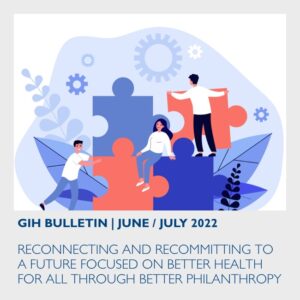
Reconnecting and Recommitting to a Future Focused on Better Health for All through Better Philanthropy
Much has changed since Grantmakers In Health (GIH) last convened in 2019. Over the past three years, more than 1 million Americans have lost their lives due to COVID-19. Large cracks are apparent in our public health infrastructure, health care systems, and safety net programs. In addition, pervasive inequities across all facets of society have increased. The country is divided, and this division continues to hamper our ability to address one of the greatest health challenges our modern world has ever faced.

Reflecting on the Intersections Initiative
For organizations like the St. Joseph Community Partnership Fund (the Fund) and Prevention Institute (PI), GIH conferences have served as a critical space to bring together advocates across sectors and spark new ideas to address complex health issues. Inspired by a PI-led session on upstream prevention and health equity at GIH’s March 2016 annual conference, the Fund noted the promising landscape for a grantmaking initiative that could focus on root causes of poor health and dismantling systems of inequity, and a partnership was born.

Will We Hear the Voices of the LGBTQ Community?
Across the United States we are seeing a coordinated campaign to restrict lesbian, gay, bisexual, transgender, and queer (LGBTQ) rights and limit access to affirming, lifesaving health care. According to the Equality Federation, nearly 400 anti-LGBTQ bills were introduced across the country in 2021, and over 240 bills have already been filed in 2022. These policies directly impact the health and safety of members of the LGBTQ community. Recent data from The Trevor Project show that 66 percent of LGBTQ youth, including 85 percent of transgender and/or nonbinary youth, report that recent debates around state laws to restrict the rights of transgender people have negatively affected their mental health.

It’s Time to Converge on Narrative Change for Racial Justice and Health Equity
Philanthropy is increasingly embracing narrative change as a tool for building public and political will to advance equitable policies and structural change. Yet philanthropic narrative investments to advance racial justice and health equity are still relatively new and disparate. The work is often siloed, lessons and insights are not often shared across efforts, and there is also a wide range of definitions of narratives, perspectives, and approaches on how to shift them.

Investing in Asian American, Native Hawaiian, and Pacific Islander Communities through Strategic Philanthropic Partnerships
May is Asian American Pacific Islander heritage month, celebrating the fastest-growing racial group in the United States. Recent priorities for grantmakers have focused on racial equity, health and well-being, and immigrant rights. Yet, investments for Asian American, Native Hawaiian, and Pacific Islanders have been under-resourced and deprioritized, receiving only 0.26 percent of philanthropic dollars and 0.17 percent of research funding from the National Institutes of Health.

Beyond the Headlines: Towards a New Narrative for Health Philanthropy in Haiti
Contrary to the narrative that all philanthropic investments have been ineffective in Haiti, Partners In Health, Build Health International, and Health Equity International have had immense positive impacts on the health sector in Haiti over the last decade. With sustained funding from the W.K. Kellogg Foundation, these nongovernmental organizations are committed to tackling systemic inequities embedded in the health care system.
Reports and Publications

GIH Bulletin: January/February 2026
One year ago, as we were just one month into the new administration, I wrote that “At a moment when so much has been described as ‘unprecedented,’ and so much of what we value is being attacked, we need to ask ourselves as individuals, organizations, and a field, what do we stand for? What values do we hold, and what will we do and say to defend them?” Today, the answers to these questions are needed more urgently than ever.
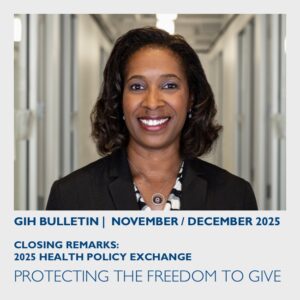
GIH Bulletin: November/December 2025
GIH President and CEO, Cara V. James, delivered these remarks on Protecting the Freedom to Give at the closing of the 2025 Health Policy Exchange, in Arlington, Virginia.
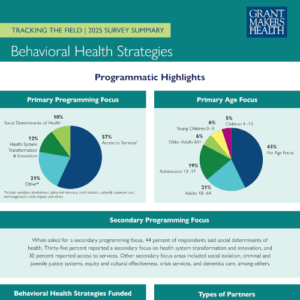
Behavioral Health Strategies
GIH conducted a survey in late 2024 on funder engagement in behavioral health. This fact sheet, based on a sample of 139 health funders, summarizes the current trends, gaps, successes and challenges for funders. It also highlights philanthropy’s continued commitment to behavioral health while also signaling concern about the upcoming funding environment.