

Upcoming Events
Past Events
Explore Health Equity and Social Justice Topics
Recent Items - Climate and Environmental Health









Latest Resources

Rethink, Reorient, Reimagine Health and Housing
The pandemic has blatantly exposed the longstanding inequities in America due to institutional and systemic racism that people of color have experienced for far too long. It has brought to
light the need to urgently rethink and reorient our role in reimagi
ng the affordable housing
sector — one that brings health in reach for all.

Rural Food Insecurity: COVID-19 and Beyond
According to Feeding America, one in ten people and one in six children face hunger in our state (Feeding America 2020). As a foundation focused on the social and economic barriers to health, food insecurity has always been important to us

Education Is Our Passport to A More Just and Equitable Future
The pandemic and ensuing social unrest have led to myriad conversations focused on how to use this moment to create a more equitable health system, rebuild our public health infrastructure, and reimagine police practices. I would encourage us to also consider this moment an opportunity to rethink our educational system, given the strong relationship between education, income, wealth, and health.

Educating Health Care Teams by the Zip Code
In 2016, the Robert Wood Johnson Foundation, Josiah Macy Jr. Foundation, Gordon and Betty Moore Foundation, and John A. Hartford Foundation envisioned a national program to support advanced practice nurse faculty members to create sustained and vibrant academic-community partnerships with the goal of improving population health in their own communities and zip codes.

Investing in Rural Communities to Achieve Health Equity
Some years ago, in reference to Georgia’s economy, the claim was made of the existence of two Georgias: one, the vibrant metropolitan areas of the state; the other, rural Georgia – described as its poor economic cousin. Today, this Two Georgias distinction applies to the growing disparities in health and health care between the metropolitan areas and rural communities, home to nearly 2 million Georgians.
Reports and Publications

GIH Bulletin: January/February 2026
One year ago, as we were just one month into the new administration, I wrote that “At a moment when so much has been described as ‘unprecedented,’ and so much of what we value is being attacked, we need to ask ourselves as individuals, organizations, and a field, what do we stand for? What values do we hold, and what will we do and say to defend them?” Today, the answers to these questions are needed more urgently than ever.

GIH Bulletin: November/December 2025
GIH President and CEO, Cara V. James, delivered these remarks on Protecting the Freedom to Give at the closing of the 2025 Health Policy Exchange, in Arlington, Virginia.
Behavioral Health Strategies
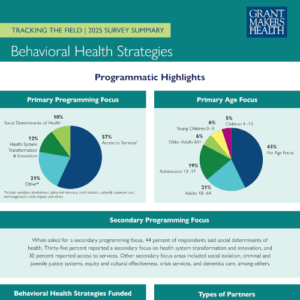
GIH conducted a survey in late 2024 on funder engagement in behavioral health. This fact sheet, based on a sample of 139 health funders, summarizes the current trends, gaps, successes and challenges for funders. It also highlights philanthropy’s continued commitment to behavioral health while also signaling concern about the upcoming funding environment.