

Upcoming Events
Past Events
Explore Health Equity and Social Justice Topics
Recent Items - Climate and Environmental Health










Latest Resources

Healthy Food Hits the Road: Making Good Food Available (and Affordable) in New England’s Food Deserts
As health care costs continue to rise, it is critical that players from every sector—public, private, and nonprofit—work collaboratively on solutions that address the health needs of low-income people and invest in preventative health measures.

Philanthropy Talks to Philanthropy
The annual conference showed again this year why it is the premier opportunity for health funders to talk to their peers about challenges, lessons learned, and the path forward.

Reducing the Risk of Exposure to Lead in Drinking Water
Ensuring access to sufficient, safe drinking water has been an essential function of water utilities, public health, and health care professionals around the world for more than a century. The public health community is often on the front lines, responding to elevated blood lead levels—and can speak to the need for prevention.

The Power of Collaboration for Environmental Health and Justice
Eboni Cochran knows when there has been a chemical release from one of the manufacturing facilities near her home in west Louisville, Kentucky. Not because of a warning siren, but because she smells it, then feels the symptoms almost immediately: sinus pain, headache, trouble breathing.
Healthy Water, Healthy People
When it comes to our health, we tend to take water for granted. But as we have been reminded recently, failures within our fragile water systems can quickly become public health disasters. What is worse is that the people who are hit hardest typically live in our most vulnerable communities.
Reports and Publications

GIH Bulletin: January/February 2026
One year ago, as we were just one month into the new administration, I wrote that “At a moment when so much has been described as ‘unprecedented,’ and so much of what we value is being attacked, we need to ask ourselves as individuals, organizations, and a field, what do we stand for? What values do we hold, and what will we do and say to defend them?” Today, the answers to these questions are needed more urgently than ever.
GIH Bulletin: November/December 2025
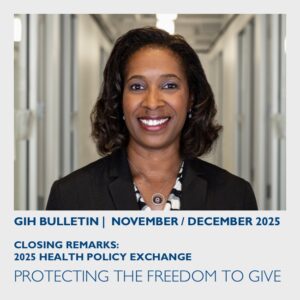
GIH President and CEO, Cara V. James, delivered these remarks on Protecting the Freedom to Give at the closing of the 2025 Health Policy Exchange, in Arlington, Virginia.
Behavioral Health Strategies
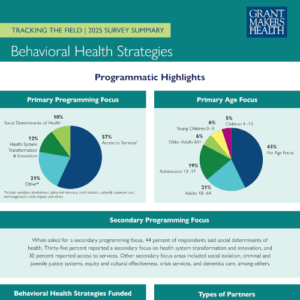
GIH conducted a survey in late 2024 on funder engagement in behavioral health. This fact sheet, based on a sample of 139 health funders, summarizes the current trends, gaps, successes and challenges for funders. It also highlights philanthropy’s continued commitment to behavioral health while also signaling concern about the upcoming funding environment.