

Upcoming Events
Past Events
Explore Health Equity and Social Justice Topics
Recent Items - Climate and Environmental Health








Latest Resources

Postpartum Care Systems: Strategically Collaborating to Advance and Align Solutions Across Sectors
As state policymakers began extending continuous eligibility for postpartum Medicaid coverage from the 60 days following birth to the 12 months following birth in 2022, a small workgroup of
funders connected to explore what philanthropy’s role could be in strengthening maternal health outcomes
and how we might support effective implementation of the extension

Q&A: How the Chicago South Side Birth Center is Championing a Better Approach to Maternal Health
Grantmakers In Health (GIH) recently spoke with Jeanine Valrie Logan, Founder + Lead Steward of the Chicago South Side Birth Center, and Shruti Jayaraman, Chief Investments Officer of Chicago Beyond, to learn how the Chicago South Side Birth Center and Chicago Beyond are working together to improve maternal health outcomes for mothers in one of Chicago’s most underserved communities. This interview has been edited for style and clarity.

Investing in Inclusion: How Health Philanthropy Can Prioritize the Needs and Perspectives of Individuals with Disabilities
One in five children in the United States has a special health care need requiring more than routine health services, and one in four adults report having a disability. As 70 million adults and 14.5 million children in the United States have a disability, the population impacted by issues in the aging out process and in the health care system more broadly is far from insignificant. Despite these numbers, disability-related grants represent just 2 percent of total philanthropic giving and are primarily directed towards services and supports that seek to fix or cure disabilities and perpetuate the ableist assumption that people with disabilities are unable to make decisions about their own care.

Merck Foundation: December 2024
Merck Foundation has launched a new initiative – the Collaborative for Equity in Cardiac Care to advance equitable access to high-quality, culturally responsive cardiac care for people living with heart conditions in underserved United States communities. The foundation is committing $17 million over five years to support the development and implementation of innovative, comprehensive programs for cardiac health care across the country as well as promote cross-sectoral collaborations to address barriers to care associated with social drivers of health.

Marin Community Foundation: October 2024
Episcopal Health Foundation’s (EHF) annual poll shows continuing health care affordability and access crisis in Texas. EHF’s poll found that 64 percent of Texans said they skipped or postponed some sort of health care because of the cost. That includes things like check-ups, treatments, tests, filling prescriptions, and dental care. That percentage is slightly down from the 68 percent who said they skipped care last year – the highest percentage in the six-year history of EHF’s poll.

Illinois Children’s Healthcare Foundation’s Persistent Journey toward Equity
Since 2019, the Illinois Children’s Healthcare Foundation (ILCHF) has embarked upon a journey of perspective transformation—challenging ourselves to know, think, and believe differently so we will decide, engage, and act more equitably. Through consistent commitment and action, our Board of Directors, leadership, and staff have moved equity, diversity, and inclusion (EDI) work beyond “box checking” activities, institutionalizing long-term, individual, organizational, community, and cultural changes.
Reports and Publications

GIH Bulletin: January/February 2026
One year ago, as we were just one month into the new administration, I wrote that “At a moment when so much has been described as ‘unprecedented,’ and so much of what we value is being attacked, we need to ask ourselves as individuals, organizations, and a field, what do we stand for? What values do we hold, and what will we do and say to defend them?” Today, the answers to these questions are needed more urgently than ever.

GIH Bulletin: November/December 2025
GIH President and CEO, Cara V. James, delivered these remarks on Protecting the Freedom to Give at the closing of the 2025 Health Policy Exchange, in Arlington, Virginia.
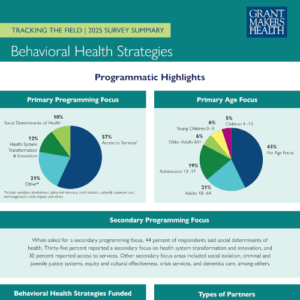
Behavioral Health Strategies
GIH conducted a survey in late 2024 on funder engagement in behavioral health. This fact sheet, based on a sample of 139 health funders, summarizes the current trends, gaps, successes and challenges for funders. It also highlights philanthropy’s continued commitment to behavioral health while also signaling concern about the upcoming funding environment.