
Contribute to the Philanthropic Growth and Impact Fund
Explore Philanthropic Growth and Impact Topics




Latest Resources

Preconference – Welcome to the 2024 GIH Conference on Health Philanthropy!
The 2024 Grantmakers In Health Conference on Health Philanthropy, Bold Results Through Courageous Action, launched in Portland, Oregon today, Monday, June 3, 2024, with three engaging pre-conference sessions.

Interact for Health
“When we asked our community what we should prioritize ahead of launching a new strategic plan, the response around mental health was overwhelming, especially for youth. This work is urgent and necessary, and the trends of the past few years are a call to all of us to listen to the young people in our lives and center their needs. I’m especially excited that we have co-created a 25-person Youth Action Council as part of our collaborative work on youth mental health in the region. We know that: ‘those closest to the problems are closest to solutions’ and the Youth Action Council is one way we are living out that value.”

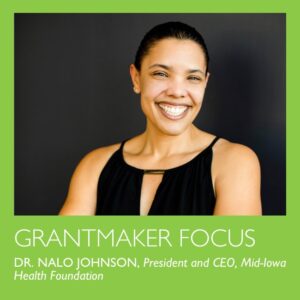
Mid-Iowa Health Foundation
“Utilizing a public health lens, we understand that data is critical to drive decisionmaking. Thus, we seek to invest in data-driven and community-informed initiatives to inform decisionmakers regarding policy and resource investment decisions to positively impact community health.”

Joan Alker of the Georgetown Center for Children and Families to Be Honored with the Andy Hyman Award for Advocacy
Joan Alker, Executive Director and a cofounder of the Georgetown Center for Children and Families (CCF) in Washington, DC, will receive Grantmakers In Health’s 2024 Andy Hyman Award for Advocacy.

Billie Hall of the Sunflower Foundation to Be Honored with the 2024 Terrance Keenan Leadership Award in Health Philanthropy
Billie Hall, President and Chief Executive Officer of the Sunflower Foundation in Kansas, will receive Grantmakers In Health’s 2024 Terrance Keenan Leadership Award in Health Philanthropy.
Reports and Publications
Collaboration Across Government and Philanthropy
This Georgetown University Center for Public and Nonprofit Leadership report uses data from a recent Grantmakers In Health survey to examine how philanthropy is partnering with government to fill critical gaps.
Grantmakers In Health Funder Collaboration Survey Report
At a time of deep cuts to health and social services, disappearing public health data, rising health care costs, and resurgent infectious diseases, philanthropy faces an urgent challenge: protecting vulnerable communities and sustaining hard-won health gains. Meeting this moment demands meaningful community engagement, strong coordination among funders, and partnerships that extend beyond the philanthropic sector. Yet despite the importance of these relationships, little is known about how health funders work together. To help fill this gap, GIH conducted research in 2025 to examine collaboration among health funders, highlight successes and challenges, and identify opportunities to strengthen collective impact.
Advancing the Public’s Health: Current Philanthropic Approaches and Priorities for the Future
This GIH report is grounded in discussions with a diverse set of philanthropic and public health leaders about the current state of the field. It aims to assess how foundations view public health and their guiding frameworks, as well as to identify lessons learned and priorities for strengthening the public health ecosystem.

Trustee Resources
Explore this page to browse resources, publications, and events related to foundation trustees.