Contribute to the Philanthropic Growth and Impact Fund
Explore Philanthropic Growth and Impact Topics



Latest Resources
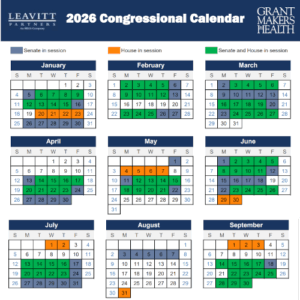
2026 Congressional Calendar
Developed in collaboration with Leavitt Partners, this calendar tracks when each house of congress will be in session in 2026.
Grantmakers In Health’s Partnership with Sustainable Agriculture and Food Systems Funders Highlighted in Inside Philanthropy Article
Due to cuts to the Supplemental Nutrition Assistance Program (SNAP) in H.R.1, along with the program’s suspension during the longest government shutdown in American history, Grantmakers in Health (GIH) is partnering with Sustainable Agriculture and Food Systems Funders (SAFSF) on a funder working group to coordinate philanthropy’s response. This partnership, along with SAFSF’s broader work, was highlighted in a November 13, 2025 Inside Philanthropy article. In the piece, Clare Fox, SAFSF’s…

Roles for Philanthropy as Medicaid Changes Take Effect
For those of us who have worked toward health equity, who have spent the past few years building toward incremental gains and pushing for larger change, the events of this year can feel like one big backslide. At times, it’s overwhelming. Yet this is not the time to get bogged down by the size of the challenge or by analysis paralysis. From where I sit, I see five roles that philanthropy can play in the rollout of changes to Medicaid.

Acting with Urgency: Stupski Foundation Accelerates Its Spend-Down Grantmaking
In this interview, Grantmakers In Health’s Maya Schane spoke with Dan Tuttle and Sulma Gandhi of the Stupski Foundation about the foundation’s spend-down strategy and acceleration of grantmaking in 2025 in response to federal policy changes.

Practicing What We Preach: Three Tips for Putting Equity at the Heart of a Successful Application Process
Every step of the grant application process
— from initial outreach to final award notification — provides opportunities for funders to either reinforce inequities or dismantle them. The grant application process is often the first barrier that organizations encounter when seeking funding. If designed without an intentional focus on equity, the application process can advantage well-resourced organizations, while disadvantaging equally or better qualified organizations that have fewer resources.
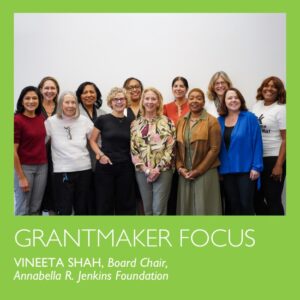
Annabella R. Jenkins Foundation
“Health equity is not achieved by philanthropy alone. Guided by the vision of our all-female volunteer Board, the Jenkins Foundation is proud to collaborate with community partners and grantees by investing in relationships, resilience, and equitable access to care across the Greater Richmond, Virginia region. A recent example is our partnership in Boost 200, a workforce development initiative led by the Virginia Health Care Foundation. Through shared learning and collective investment with local funders, we have helped expand licensure opportunities for behavioral health counselors—strengthening our region’s pipeline of mental health professionals and improving access to care for our community.”
Reports and Publications
Collaboration Across Government and Philanthropy
This Georgetown University Center for Public and Nonprofit Leadership report uses data from a recent Grantmakers In Health survey to examine how philanthropy is partnering with government to fill critical gaps.
Grantmakers In Health Funder Collaboration Survey Report
At a time of deep cuts to health and social services, disappearing public health data, rising health care costs, and resurgent infectious diseases, philanthropy faces an urgent challenge: protecting vulnerable communities and sustaining hard-won health gains. Meeting this moment demands meaningful community engagement, strong coordination among funders, and partnerships that extend beyond the philanthropic sector. Yet despite the importance of these relationships, little is known about how health funders work together. To help fill this gap, GIH conducted research in 2025 to examine collaboration among health funders, highlight successes and challenges, and identify opportunities to strengthen collective impact.
Advancing the Public’s Health: Current Philanthropic Approaches and Priorities for the Future
This GIH report is grounded in discussions with a diverse set of philanthropic and public health leaders about the current state of the field. It aims to assess how foundations view public health and their guiding frameworks, as well as to identify lessons learned and priorities for strengthening the public health ecosystem.

Trustee Resources
Explore this page to browse resources, publications, and events related to foundation trustees.