Explore Access and Quality Topics





Latest Resources

Protecting Children’s Access to Health Care in Schools: The Impact of Medicaid Cuts on School Health Services
“Due to the remote area we serve, our students have little to no access to medical services otherthan those provided in schools.”—Superintendent from a rural school district in Michigan. Schools are essential places for children to access health services. An estimated 40 percent ofschool-aged children have at least one chronic health condition (National Survey of Children’sHealth, 2019). Among low-income children with special health careneeds, approximately 87percent do not receive necessary care, primarily due to financial costs and limited access (Childand Adolescent Health Measurement Initiative, 2022). Providing health care at school, where children spend most of their days, is crucial to addressing these concerns.
Kate B. Reynolds Charitable Trust: October 2025
Three new fact sheets inform funders about how recent federal budget cuts will impact health care access, food assistance, and the health of immigrant families. The fact sheets detail what is being cut, when the cuts will take effect, and what to do next.

Responding to a Rural Hospital Closure: The Importance of a Phased, Multi-Pronged Approach
It has been over a year since the August 31, 2024, closure of a beloved community hospital in Ayer, Massachusetts following the bankruptcy of the private equity-backed Steward Health Care system. The impacts of the Nashoba Valley Medical Center closure continue to reverberate across this rural working-class region, adding to a growing sense of abandonment and frustration that has accumulated over waves of health care service cuts.

Designing Inclusive and Equity-Centered Health System Improvement Projects—Lessons from Three Initiatives
Disparities in access to health care persist for individuals with low incomes and Black, Hispanic/Latinx and Native American/Native Alaskan individuals and are particularly acute in behavioral health. Behavioral health care utilization rates among Black, Hispanic, and Asian adults are less than half those of White adults. These disparities exist because of barriers in access such as limited provider networks, poor language access, a lack of culturally-aligned services, and technological barriers to telehealth. Working with health providers to create inclusive and accessible services is essential to building more equitable access to behavioral health care, and to healthier and happier families and communities.

To Improve Youth Mental Health, Funders Must Center Youth Voices
As youth mental health challenges continue to grow nationwide, a new initiative in Greater Cincinnati believes transformational change begins when youth are empowered to lead.
Georgia Health Initiative: July 2025
The Georgia Health Initiative released a new report titled “The Public Health Emergency Medicaid Unwinding: Georgia’s Redeterminations Experience,” which explores promising practices and lessons learned during the unwinding of Georgia’s Medicaid coverage. It also highlights ways these findings can support ongoing efforts to strengthen health coverage access in Georgia.
Publications and Reports

GIH Bulletin: January/February 2026
One year ago, as we were just one month into the new administration, I wrote that “At a moment when so much has been described as ‘unprecedented,’ and so much of what we value is being attacked, we need to ask ourselves as individuals, organizations, and a field, what do we stand for? What values do we hold, and what will we do and say to defend them?” Today, the answers to these questions are needed more urgently than ever.
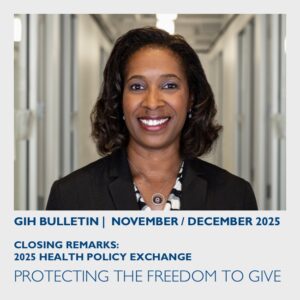
GIH Bulletin: November/December 2025
GIH President and CEO, Cara V. James, delivered these remarks on Protecting the Freedom to Give at the closing of the 2025 Health Policy Exchange, in Arlington, Virginia.
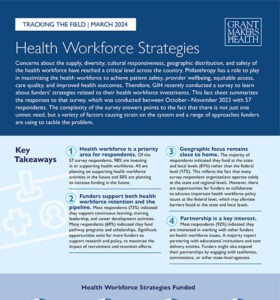
2024 Survey Summary: Health Workforce Strategies
Concerns about the supply, diversity, cultural responsiveness, geographic distribution, and safety of the health workforce have reached a critical level across the country. Philanthropy has a role to play in maximizing the health workforce to achieve patient safety, provider well-being, equitable access, care quality, and improved health outcomes. Therefore, GIH recently conducted a survey to learn about funders’ strategies related to their health workforce investments.