

Upcoming Events
Past Events
Explore Health Equity and Social Justice Topics
Recent Items - Climate and Environmental Health










Latest Resources

Enough is Enough: It is Time to Get Serious about Eliminating Racial Disparities
Our country has experienced significant upheaval over the last 90 days that raised the collective awareness of inequities in health, work, education, and policing. These changes have led to increased calls for action and offer a pivotal moment to enact meaningful steps towards achieving health equity. We must not squander this opportunity.
Reopening Is an Opportunity to Rethink and Rebuild
As we reopen our communities and think about long-term recovery plans, we should also consider how to redesign our systems to achieve better health for everyone. Philanthropy has a vital role to play in this process.

The Urgent Need for Nature During and After COVID-19
Mounting research, combined with our personal and professional experience, suggest that improving equity in access to greenspace may help combat health inequities. Access to safe, nearby nature must be prioritized as critical public health infrastructure and not just an amenity for a few.

Hiding in Plain Sight: Care Challenges for Older Adults Living with HIV
Unless you fund an AIDS-serving organization or have a personal connection, this may surprise you, but HIV/AIDS has quietly undergone a metamorphosis, and it is time for health funders to take a fresh look.
Achieving Health Equity is Possible, and Philanthropy Can Help Lead the Way
Philanthropy has a critical role to play in ensuring that health disparities are acknowledged and addressed during this crisis and throughout the recovery process. Health foundations are uniquely positioned to respond to COVID-19 and can deploy a wide range of resources in their communities.
Reports and Publications

GIH Bulletin: January/February 2026
One year ago, as we were just one month into the new administration, I wrote that “At a moment when so much has been described as ‘unprecedented,’ and so much of what we value is being attacked, we need to ask ourselves as individuals, organizations, and a field, what do we stand for? What values do we hold, and what will we do and say to defend them?” Today, the answers to these questions are needed more urgently than ever.

GIH Bulletin: November/December 2025
GIH President and CEO, Cara V. James, delivered these remarks on Protecting the Freedom to Give at the closing of the 2025 Health Policy Exchange, in Arlington, Virginia.
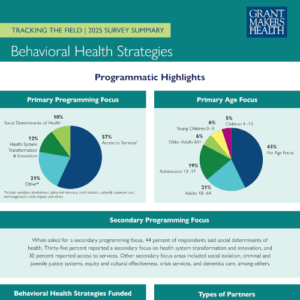
Behavioral Health Strategies
GIH conducted a survey in late 2024 on funder engagement in behavioral health. This fact sheet, based on a sample of 139 health funders, summarizes the current trends, gaps, successes and challenges for funders. It also highlights philanthropy’s continued commitment to behavioral health while also signaling concern about the upcoming funding environment.