

Upcoming Events
Past Events
Explore Health Equity and Social Justice Topics
Recent Items - Climate and Environmental Health







Latest Resources

The Burroughs Wellcome Fund: October 2026
The Burroughs Wellcome Fund (BWF) has announced the next cycle of its Next Generation Pregnancy Initiative (NGP), significantly expanding its investment in researchers working to deepen understanding of pregnancy and address some of the field’s most persistent challenges.

Health Foundation of South Florida: October 2026
Through Black Health Summit In Action, the foundation carries the insights and priorities from the stage into direct community investment, supporting solutions in maternal and infant health, Black men’s health, housing, and community safety, while amplifying the voices most directly affected. This work responds to what residents and grassroots leaders have long shared: health equity requires more than clinical care. It demands collaboration, trust, and investment in communities themselves.

Changing the Vaccine Conversation Before It’s Too Late—What Can Philanthropy Do?
In July 2026, the United States reached a grim milestone when the number of confirmed cases of measles exceeded the total for all of 2025. On August 10, 2026, the White House issued an executive order directing changes to the federal childhood vaccine schedule and categories, and calls for availability of separate measles, mumps, and rubella vaccines. The science has not changed, but the new framework could significantly slow down the delivery of protective immunizations from these serious diseases.
Reports and Publications

GIH Bulletin: January/February 2026
One year ago, as we were just one month into the new administration, I wrote that “At a moment when so much has been described as ‘unprecedented,’ and so much of what we value is being attacked, we need to ask ourselves as individuals, organizations, and a field, what do we stand for? What values do we hold, and what will we do and say to defend them?” Today, the answers to these questions are needed more urgently than ever.
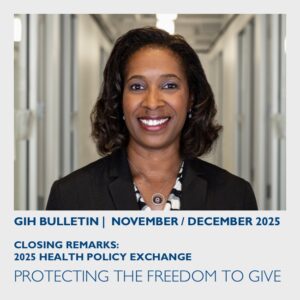
GIH Bulletin: November/December 2025
GIH President and CEO, Cara V. James, delivered these remarks on Protecting the Freedom to Give at the closing of the 2025 Health Policy Exchange, in Arlington, Virginia.
Behavioral Health Strategies
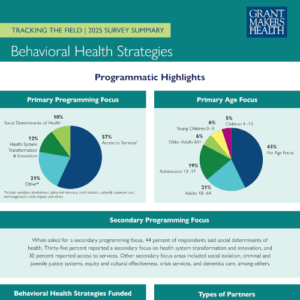
GIH conducted a survey in late 2024 on funder engagement in behavioral health. This fact sheet, based on a sample of 139 health funders, summarizes the current trends, gaps, successes and challenges for funders. It also highlights philanthropy’s continued commitment to behavioral health while also signaling concern about the upcoming funding environment.