
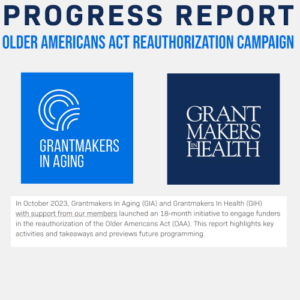
GIH Advocacy for the Reauthorization of the Older Americans Act (OAA)
The OAA provides critical services that address the social drivers of health for older adults. Grantmakers In Health (GIH) and Grantmakers In Aging (GIA) are partnering to engage funders in advancing the reauthorization of this important piece of legislation.
Explore Population Health Topics





Latest Resources

The Keys to Successful Collaboration Between a State-based Health Foundation and a National Funder Collaborative
Discussions about firearms in the US are often focused on urban gun violence and mass shootings. But firearm injury and death is a public health crisis that touches every community—urban and rural, red states and blue—and it intersects with issues many health funders care about: mental health, suicide prevention, and health equity.
39 Funders Collaborate on Comment Letter in Support of Health Professionals
The U.S. Department of Education recently published a proposed rule that would narrow the definition of which graduate programs qualify as “professional degrees” for federal student loan purposes, affecting how much students in certain health fields may borrow. Finalizing this rule will result in reduced access to care (especially in rural and other underserved communities), by making graduate education less affordable, disrupting health workforce pipelines, and creating obstacles for students to enter essential health and human-services professions.
What Do We Stand For?
One year ago, as we were just one month into the new administration, I wrote that “At a moment when so much has been described as ‘unprecedented,’ and so much of what we value is being attacked, we need to ask ourselves as individuals, organizations, and a field, what do we stand for? What values do we hold, and what will we do and say to defend them?” Today, the answers to these questions are needed more urgently than ever.

Reimagining Rural Health and Well-being
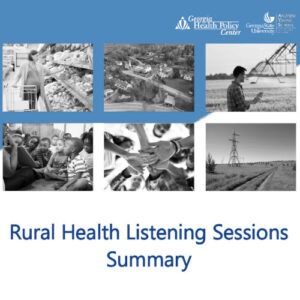
To inform positive change, Grantmakers in Health (GIH) and the National Rural Health Association (NRHA) are partnering to reimagine a unified vision for health and well-being in rural America. The Georgia Health Policy Center (GHPC) was engaged to conduct a landscape analysis and facilitate listening sessions with rural health stakeholders at the local, state, and national levels.
GIH President and CEO Cara V. James Joined The Rural Impact Podcast for a Conversation about the Intersections of Policy and Philanthropy
On December 4, 2025, Cara V. James, President and CEO of Grantmakers In Health (GIH), was featured in an episode of The Rural Impact podcast. She joined Michelle Rathman, host of The Rural Impact and strategic communications advisor in health care policy, for a conversation on the intersections of policy and philanthropy, challenges with rural health funding, and more. “Policies that are impacting rural communities are…
Grantmakers In Health’s Partnership with Sustainable Agriculture and Food Systems Funders Highlighted in Inside Philanthropy Article
Due to cuts to the Supplemental Nutrition Assistance Program (SNAP) in H.R.1, along with the program’s suspension during the longest government shutdown in American history, Grantmakers in Health (GIH) is partnering with Sustainable Agriculture and Food Systems Funders (SAFSF) on a funder working group to coordinate philanthropy’s response. This partnership, along with SAFSF’s broader work, was highlighted in a November 13, 2025 Inside Philanthropy article. In the piece, Clare Fox, SAFSF’s…
Publications and Reports
On the Front Lines of Public Health
Foundations are well positioned to collaborate with federal, state, and local health departments to create change within the public health system. They can also support and guide partnerships that embrace a variety of community stakeholders and draw on the strengths of each. This Issue Focus looks at strategies and examples for establishing such partnerships.
Supporting Local Efforts to Improve Health Care Access
The number of Americans without access to health care has continued to climb due to rising medical costs,ongoing declines in employer-sponsored coverage,and recent cuts in public programs. With no national solution in sight, many cities and counties across the country have designed local initiatives to provide coverage and care for their uninsured residents. This Issue Focus looks at approaches grantmakers are taking to address these issues.
Implementing the Medicare Prescription Drug Benefit
On January 1, 2006, Medicare prescription drug coverage became available to the program’s 43 million beneficiaries. To receive the coverage, however, beneficiaries must actively opt in to Medicare Part D by selecting a prescription drug plan (PDP).
Connect With Funder Peers on Population Health
Interested in exchanging strategies, information, and questions with your funder peers? Sign up for GIH E-Forums.