

Upcoming Events
Past Events
Explore Health Equity and Social Justice Topics
Recent Items - Climate and Environmental Health












Latest Resources

Broken Triangle: A Framework for Reparative Philanthropic Relationships
Traditional philanthropic practices have often created imbalanced power dynamics and barriers for Black-led, Black-serving organizations. When the REACH Healthcare Foundation performed a portfolio review in 2018 that revealed this same exclusion within the foundation’s grantmaking investments, REACH committed to reshaping their funding approach, which aims to repair previously neglected —and in some cases, damaged —relationships.
Act Now to Protect Philanthropy, Medicaid, and SNAP
Right now, Congress is finalizing a massive budget reconciliation bill that threatens philanthropy’s freedom to give and endangers the health and well-being of many millions of Americans. We are reaching out today to raise awareness of three critical developments in the ongoing budget reconciliation process and to encourage you to act.
Health and Well-Being Threatened in The First 100 Days
Statement from GIH President and CEO Cara V. James on First 100 Days
Cara V. James Speaks Up on Federal Disruption with Inside Philanthropy
Grantmakers In Health (GIH) President and CEO Cara V. James was interviewed for an Inside Philanthropy article published on April 30, 2025. The piece outlines philanthropy’s reactions to the sweeping cuts to public health infrastructure in the United States, the consequences of these cuts, and the importance of remaining committed to our values.

Philanthropy, Stewarding a Just America
In a time of intensive action to dismantle policies and practices that protect the well-being of all Americans, where chaos is the principal strategy to overthrow the will of and care for the American people, philanthropy must remain rooted in what is legally and morally right.

The Value of Convening Grantees to Navigate Uncertainty Together
In moments of chaos, it’s natural for nonprofits to feel uncertain—unsure of what’s next and how to move forward. But uncertainty can also be a powerful catalyst for connection and action. During the COVID-19 pandemic, The Healthy Food Community of Practice doubled down on its efforts to bring nonprofits together and helped them build lasting relationships, collaborate in new ways, and innovate around shared challenges.
Reports and Publications

GIH Bulletin: January/February 2026
One year ago, as we were just one month into the new administration, I wrote that “At a moment when so much has been described as ‘unprecedented,’ and so much of what we value is being attacked, we need to ask ourselves as individuals, organizations, and a field, what do we stand for? What values do we hold, and what will we do and say to defend them?” Today, the answers to these questions are needed more urgently than ever.
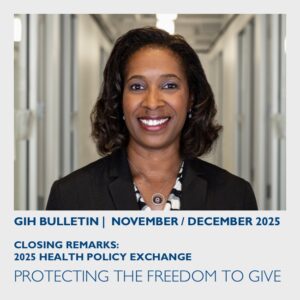
GIH Bulletin: November/December 2025
GIH President and CEO, Cara V. James, delivered these remarks on Protecting the Freedom to Give at the closing of the 2025 Health Policy Exchange, in Arlington, Virginia.
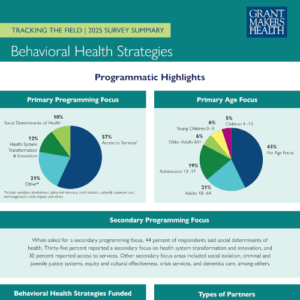
Behavioral Health Strategies
GIH conducted a survey in late 2024 on funder engagement in behavioral health. This fact sheet, based on a sample of 139 health funders, summarizes the current trends, gaps, successes and challenges for funders. It also highlights philanthropy’s continued commitment to behavioral health while also signaling concern about the upcoming funding environment.