
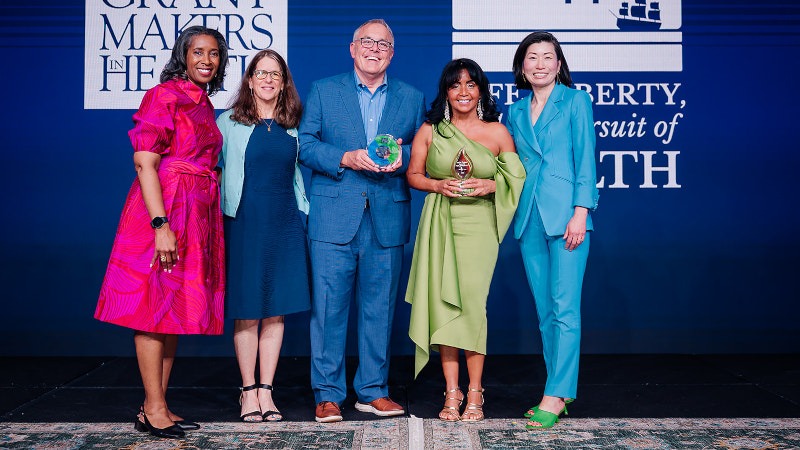
“Healthy communities are built in food lines, in tenant meetings, in schools, in kitchens, in churches, in organizing spaces, and in a moment when someone says, ‘I see you, I hear you, I can help you.’” –Gladys Vega, President and CEO at La Colaborativa and recipient of GIH’s 2026 Andy Hyman Award for Advocacy
From breakout sessions to quick takes and wellness activities to two inspiring plenary sessions, every corner during day two of the Grantmakers In Health (GIH) Annual Conference on Health Philanthropy, Life, Liberty, and the Pursuit of Health was filled with conversation and connection. The day’s agenda focused on how funders can find and use their voices to stand up in this moment of change, including doubling down on their values; taking bigger, bolder risks alongside grantees; and seeking partnerships spanning the private and public sectors.
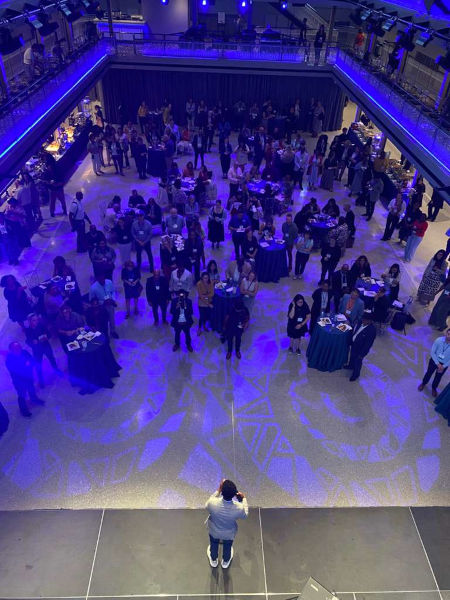
The Morgan State Musical Theater Program, one of the country’s rising HBCU theater programs, surprised attendees at the close of the “Getting in Formation: Organizing for the Future” plenary, transitioning them from a day of critical discussions into an evening of celebration, learning, connection, and growth. Ten talented performers brought the power of creative storytelling to the ballroom stage with an excerpt from their original production Echoes of Motown, which explores the intersections of music, justice, resistance, and Black cultural legacy. Art and creativity continued at the reception at the historic M&T Bank Exchange at the France‑Merrick Performing Arts Center, a vibrant community hub that embodies the belief that live theatre is for everyone.
Spotlight on Plenaries
Mark Constantine, Senior Vice President of Community Investment for Dogwood Health Trust, was honored with the 2026 Terrance Keenan Leadership Award, which recognizes a grantmaker whose work is distinguished by leadership, innovation, achievement, creativity, and boldness.
Throughout his distinguished career, Constantine has authored two books; served in philanthropic leadership focused on program-related investment and affordable housing; and held consulting roles supporting foundations and national nonprofit organizations on governance, strategy, and learning.
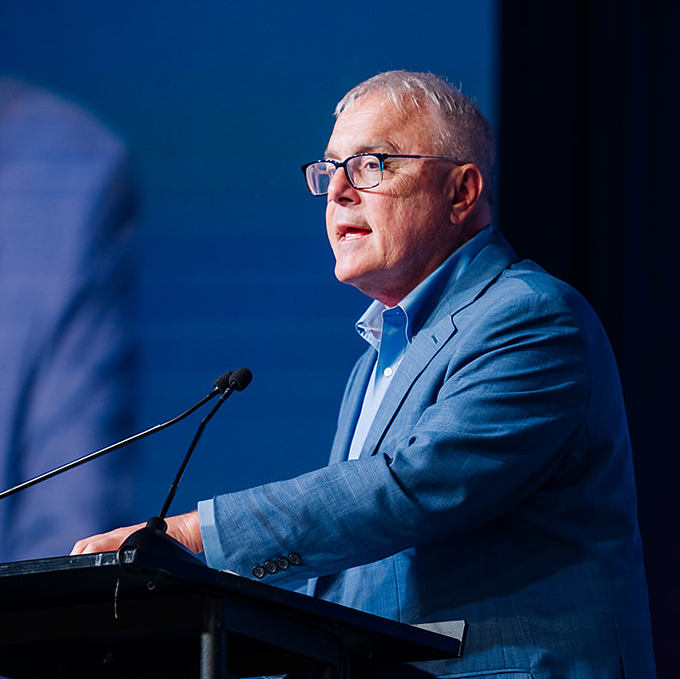
In accepting the award, Constantine reflected on the life of Terrance Keenan and the important lessons that can be drawn from his accomplishments in the field and applied to today’s challenging times. In particular, Constantine elevated the critical importance of:
- Working collectively for the common good: No institution succeeds because of one leader; it is because of people willing to show up for each other time and time again. Sustained social change requires collaborative work, and while it is often messy, it is particularly necessary in this moment.
- Knowing your history is an act of respect: When entering a community, it is vital to seek understanding and call upon the trusted historians in the community. Doing so connects the past to the present and shows respect for what has come before. “Social movements,” as Constantine noted, “are not well served by amnesia.”
- Investing in leadership relentlessly: Lasting change requires leadership, and it is one of our greatest responsibilities to invest in the next generation of philanthropy and community change. Be intentional about cultivating community within our own field and helping the next generation understand they don’t need to carry the challenges alone.
- Loving well and deeply: Love is what sustains us when progress is slow. Love is what allows us to play the long game. Love deeply because doing so will sustain us through uncertain and difficult times.
Constantine closed his remarks by thanking his colleagues for how they show up for one another, how much they care, and how they carry this work forward.
Gladys Vega, President and CEO of La Colaborativa was honored with the Andy Hyman Award for Advocacy, which recognizes a nonprofit or public sector champion who embodies a commitment to principled action, leadership to advance social change, and dedication to making progress in policy and practice despite challenging political environments.
Vega has dedicated more than three decades of service to the city of Chelsea, Massachusetts, where she’s lived since the age of nine and where she leads as President and CEO of La Colaborativa, an organization she joined in 1990 as its receptionist.
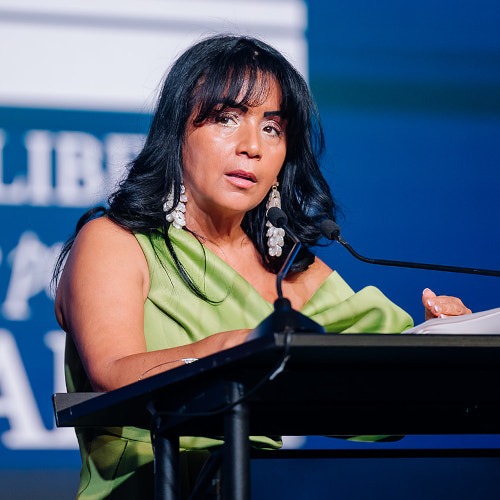
She is a groundbreaking community organizer and advocate who works relentlessly and fearlessly to ensure the Chelsea immigrant community has a voice in determining how its needs and concerns are addressed.
Following receipt of the award, Vega shared how her nine-year-old self, having grown up around poverty and addiction, would never have believed it possible to be on stage accepting a national award for her work in advocacy.
In her remarks, Vega recounted the dark days of the COVID-19 pandemic and its impact on her community, her organization, and herself. She shared how the pandemic changed how she viewed health care and the multiple factors that impact one’s health, like housing, food, love, dignity, and respect. During the pandemic, her organization began receiving and providing food for the first time, initially on her own porch then in her organization’s reconfigured office space; and ultimately in an old warehouse which her team spruced up with “much love and hope.” Today, her organization distributes six million pounds of food each year and provides a range of services spanning consumer protection, wrap-around services, emergency response, and more as the largest Latina-led organization in Massachusetts.
Vega left the audience with several key lessons from her experiences supporting her community:
- Community organizations have deep trust in their communities which helps save lives. Before people trust their doctors, they trust community organizations like La Colaborativa, and they are vital to the strength and resilience of communities.
- We must stop treating community organizations like pilot projects. Community organizations are public health infrastructure. They are not adjacent to health care; they are health care.
- It’s important for funders to be present in communities and to see the work being done and the impact it has.
- Funders must evolve the ways they do business. As they did during the pandemic, funders must reconsider their models and trust community wisdom because it can save lives.
Vega closed her comments by saying that the award she received is for every resident who has stood in line for food with dignity, all the volunteers who have delivered food until midnight, all the organizers who have ever knocked on doors, and for the funders who have trusted grassroots leadership.
Getting in Formation: Organizing for the Future
Attacks on democracy threaten to upend society, not just for the next election cycle, but for decades to come. Efforts to undermine the rule of law and voting rights are having a profound and direct effect on the health of our communities, especially among the most marginalized. In this powerful, pointed, and provocative plenary session, Joe Goldman, President of the Democracy Fund moderated a discussion with panelists Deepak Bhargava, President of the Freedom Together Foundation, and DaMareo Cooper, Executive Director at the Center for Popular Democracy, exploring foundational understandings in organizing, the risks of inaction, as well as the role and obligation of philanthropy to rise to the challenges of the present moment.
Goldman opened the session by sharing that authoritarians have broken through in the United States and are looking to consolidate power. If that power is consolidated, the effects could span generations, underscoring the gravity of the present moment and the need for a path forward. He suggested that the path must include leveraging the guardrails of democracy, having an affirmative story to work toward, and organizing. The call to organize to build a better future became an early focal point of the panel conversation.
Understanding What Good Organizing Looks Like
Near the start of the session, Goldman posed a key question: “What do we mean when we say organizing?” Cooper answered first, calling out the differences between organizing, social services, self-help resources, education providers, and advocacy. He talked about how organizing isn’t about people needing an advocate but rather building a network of people who can advocate for themselves. Similar to capacity building within an organization, good organizing is capacity building for a community. It is not about how many doors were knocked on, but how many of those people took action; and it is better measured by how many people participated in winning a policy change and by the leadership pipeline for bringing people into the work.
In response to the same question, Bhargava pointed to Minnesota, where immigrants have been detained, a crisis of hunger has taken place, people have been afraid to leave their homes, and citizens have been killed. He noted that what stopped that situation was not lawsuits or Congressional action, or even state elected officials interceding. What made the difference was that thousands of people stood up in mass protest, videotaping abuses, linking to people around the country in a coordinated way, and executing a general strike. Those actions didn’t come out of nowhere, they were the result of years of organizing efforts that helped people channel their energy and actions effectively.
The Risk of Inaction
Goldman encouraged the panelists to look ahead, explore the flip side, and imagine what inaction in this moment would look like. Bhargava offered that in five years, the price of inaction today would be a lack of free and fair elections; free speech would continue to shrink while the price of activism would increase; and there would be no prospect of making progress on the things that are at the heart of our foundations. Inaction presents a game-over situation. Cooper added that we are in a moment of rebirth and that this is an immense opportunity, particularly because there is a huge base of people waiting for inspiration—many of whom did not participate in the last election. We need to ask what kind of world we want to live in because we have an immense opportunity to shape it.
The Role and Obligation of Philanthropy
For funders looking to make a change and do something different, Bhargava encouraged philanthropy to do the following:
- Ask yourself a key question. Go sit in a quiet place and ask yourself how you want to show up in this moment in history. In 20 years, when you look back and need to answer what you were doing in this moment, will you be able to say that you really were doing all that you could?
- Have an honest conversation. Connect with your key audiences, including your boards, and be willing to say that under these conditions, doing 98 percent of what we’ve been doing may not be the right thing. Be willing to change approaches.
- Come up with a plan. Create a plan that pushes you out of your comfort zone. If you are not uncomfortable, you are probably doing something wrong.
Cooper emphasized that those in the room were born to be in this position right now and discussed how those on the frontlines of community organizing are willing to risk their livelihoods to address what is happening in their communities. He shared, “These next weeks and months are truly going to decide the next ten years. Your kids and grandkids … the reality they walk into will be shaped by what you do now.” The concern is that foundations are leaving the movement at this moment. The people are there on the frontlines willing to do the work, but the money is not there.
When Goldman specifically asked about the obligation philanthropy has in this moment, Bhargava said there have been many conversations about the risks. He shared that we need to be mindful, as much as possible, to extend a shield of protection to our grantees. Additionally, we should not be afraid to use our social capital to challenge others to be better, ask how they are responding and what their responsibility is to use their public voice, and consider whether we are using our own voices on behalf of our grantees. We are often the ones who can take on more risk, yet too often it is the people with the least who end up risking the most. The session concluded on a message of hope with Bhargava reflecting that this country is much better than its government. If we believe in the agency of everyday people, we need to extend trust and provide them with resources.
Lessons from Building a Community-Based Mental Health Model in Baltimore and Detroit
This standing-room-only session explored Detroit’s Leadership for Mental Health Project alongside work from Baltimore’s Center for Urban Families.
Phyllis Meadows, Senior Fellow for Detroit at The Kresge Foundation, started by surveying the room and nearly everyone in attendance shared that they currently fund mental health programs. Meadows then shared a story about the origin of Detroit’s Leadership for Mental Health Project, which included looking for national models of other programs around the country that were doing similar work.
One organization, the Center for Urban Families in Baltimore, was doing exactly what they hoped Detroit organizations would do and happened to be a Kresge grantee funded for several years by one of Meadows’ colleagues. “They were doing the model exactly as we hoped it would unfold in Detroit,” said Meadows. As the project grew, the team wanted to stay true to three key tenets: continuing to learn, make mistakes, and work as partners with grantees.
The session then shifted to remarks from the session’s three panelists. K.C. Snapp, Chief Operating Officer at DABO & A Seat at My Sister’s Table, expanded on the work of DABO and noted, “systems should not just look good on paper; they should look good on people.” Their model is not one-size-fits-all but is heavily relationship-based in order to rebuild trust in institutions.
Ambra Redrick, CEO of Teen Hype, works at three intentional levels: one-on-one with young people to build their assets and agency, with schools and communities to build a continuum of care for young people, and at the macro-level to disrupt anything that is disturbing the Detroit youth ecosystem.
Catherine Pitchford, Director of Programs at the Center for Urban Families, provided an introduction that highlighted the importance of seeing and supporting the whole person. The organization regularly asked questions of the team, members, and partners they wanted to work with to ensure they had the same core values. “It was important that we captured partners who were really invested in our growth over time. It was even more important that our funder understood the need for that growth, too.”
A recurring theme throughout the conversation was the importance of choosing the right partners. Multiple panelists referred to the process of “dating” potential partners to find the right connections and ensure a reliable and effective referral process. As a result of this, together with their referral and funding partners:
- Leadership for Mental Health has received $1.1M in funding;
- 83 percent of grantees were actively screened and referred in 2025;
- 1,107 clients were screened in 2025;
- 22 percent were referred to mental health services; and
- 4 of 6 grantees have begun closing the loop.
The session ended with a question about financial sustainability, to which Meadows offered a reframe. Many individual grants are not financially sustainable over the long-term, and funding ends. Instead of thinking solely of financial sustainability for projects, Meadows urged attendees to consider the sustainability of the impact they are making. Can it remain even after the money is gone?
Thanks to these leaders, both cities are advancing community-based approaches that expand access to mental health care for vulnerable residents. This session was supported by the Arthur M. Blank Family Foundation.
Forks in the Road, Firings, Lawsuits, and Rehiring: Who’s Left at HHS?
The mission of the US Department of Health and Human Services (HHS) is to enhance the health and well-being of all Americans. Darci Graves, Founder & Principal at Darci l. Graves & Co and formerly of the Centers for Medicare and Medicaid Services, moderated a session on how significant disruption to the federal workforce has put that mission at risk. Sara Mogulescu, President of the Volcker Alliance, launched with some alarming data: the federal workforce is the smallest it has been since the 1960s and thousands of people have left HHS agencies—the Food and Drug Administration (FDA), Centers for Disease Control and Prevention (CDC), National Institutes of Health (NIH), and Centers for Medicare & Medicaid Services (CMS)—over the last year.
These numbers only tell part of the story. The United States has lost both immense institutional knowledge and the on-ramps for early-career talent. Michael Warren, Chief Medical and Health Officer at March of Dimes, noted that much of the reductions in force happened swiftly and without warning or reason. Long-term staff had no time to offboard, which damaged institutional infrastructure, systems, and processes.
Greta Massetti, Professor and Chair at the School of Public Health at Georgia State University, shared that the field of noncommunicable diseases was the hardest hit. Experts on the frontlines of specific issues, from diabetes to pediatric traumatic brain injury, were let go, and their depth of expertise is not easy to find or replace.
Panelists called these workforce reductions at HHS a true “generational loss” and mentioned several immediate effects, including:
- Confusion for those who remain at agencies;
- Fear of speaking truth to power;
- Anxiety about talking to community partners or even speaking to other agencies;
- Organizational inefficiencies with entire branches being removed;
- Lack of critical public health content; and
- Lack of data analysis and disease surveillance.
As expected, the effects don’t just sit at the federal level—they have real consequences for state and local officials who cannot deliver programs due to the loss of federal funding, partnerships, and guidance. In turn, a vacuum of data analysis and expertise has left state and local public health officials without the time, attention, and care required for emergent health issues.
Graves asked, “What should be rebuilt versus reimagined?” Panelists suggested several ways HHS—and public service more broadly—can be rethought now to enhance the health and well-being of all Americans. Mogulescu suggested, “We build what’s next, not what was.” This requires understanding the implications of current changes, capturing institutional knowledge, and gathering evidence to build a new baseline. Panelists agreed that rebuilding trust, being smarter about new technologies like AI, and building a government that better represents the people it serves are all essential.
They also shared that funders now play a more critical role than ever before. Urgent ways funders can help now include:
- Supporting long-term solutions rather than just patching the necessary holes;
- Funding critical public health infrastructure and data that have been lost, but without losing the foresight to fund innovation;
- Fostering private-public partnerships;
- Showing up as a trusted community member and being true to the organization’s North Star; and
- Investing in the next generation of talent with internships, fellowships, and convenings.
There are many challenges ahead while rebuilding, and funders will play a critical role every step of the way.
Measuring Grant Impact Through Peer Insights
Randl Dent, Program Officer at the ABIM Foundation, led a late-morning quick take titled Measuring Grant Impact Through Peer Insights.To begin, Dentinvited attendees to respond to the question: what words come to mind when you think about assessing grantee impact? The resulting word cloud emphasized hope, stories, data, frustration, capacity, lived experience, trust, and more.
The session explored how funders assess and communicate the impact of their grants to their boards and the public. The impact analysis process, led by ABIM Foundation, included several steps:
- Draft a project charter,
- Craft an interview guide,
- Interview 10 foundations,
- Develop a two-part coding system, and
- Share with the board.
The majority of the session focused on the interview insights from the 10 foundation conversations. One key insight included the importance of a strategic framework and coding system to guide function decisions and impact measurements. Another theme was on measuring impact with humility and acknowledging the inherent tradeoffs—including focusing on contribution versus attribution and the fact that change and impact take time. Finally, Dent emphasized the importance of providing support beyond funding, such as providing effective partnership, offering non-monetary support to grantees like educational or coaching opportunities, and supporting capacity building.
Interview insights on grantee impact showed a steady shift away from traditional reporting toward relationship-based reporting, such as regular check-ins where foundation staff would take progress notes to reduce grantee burden. In terms of measuring impact, there was an emphasis on flexibility in measurement rather than a one-size-fits-all approach to data assessment.
A final set of insights focused on showcasing impact. Interviewees highlighted the importance of storytelling as a tool for impact, with one interviewee noting “you’ll always learn more from an in-person site visit than from a written progress report.” Board engagement and sharing stories with the public also provided important ways to highlight the work grantees are doing on the ground.
Building on these learnings, the ABIM Foundation created its own impact coding system to analyze outputs and outcomes from its Building Trust: Advancing Health Equity grant program—a framework that offers a model for understanding and communicating impact in meaningful ways. Dent shared that the coding system focused on “making quantitative sense of our qualitative data.” The hope is that meaningful engagement between grantees and community organizations will lead to increased trust and understanding. Overall, the Building Trust: Advancing Health Equity grants have led to improvements in knowledge, behavior, and care delivery, as well as long-term changes such as integration into curricula and securing additional funding.
Together: Public-Private Support for B’more for Healthy Babies
Stronger Together: Public-Private Support for B’more for Healthy Babies (BHB) explored a long-standing partnership led by the Baltimore City Health Department in collaboration with communities, nonprofits, health providers, and foundations to support the health and wellbeing of Baltimore’s young children and their families. Launched in 2009, the BHB program includes care coordination through a centralized intake system used by 150 local health providers, as well as large-scale communications campaigns that drive behavior change.
Over the last two decades of BHB, Baltimore City’s infant mortality rate has decreased by 39 percent and the Black-white disparity in infant mortality has decreased by 48 percent, with the program helping avert 469 infant deaths. Dr. Joshua Michael, Executive Director of the Sherman Family Foundation, mentioned that when the Foundation was initially introduced to the program, they did not identify as health funders but more as education funders. However, when they saw the program’s community-based and public outcomes, they felt there was no comparable investment in their portfolio. Michelle Taylor, Health Commissioner of the Baltimore City Government, drove this point home: 469 infant deaths averted are equivalent to the number of children in 21 kindergarten classrooms, demonstrating the depth of impact not only for caregivers and families, but for society as a whole.
Both speakers credited the importance of sustainable funding and intentional partnership for the program’s longevity. Taylor and Michael shared several insights to help other health funders achieve public-private partnerships:
- Be proactive and start early: Wherever you are from and whoever you’re funding, know that social services like Medicaid billing are only a partial solution. Baltimore realized this early on and took action.
- Consider the timing of funding: Private funding may only be available for a limited period. When private funding is leveraged in unique, strategic, and well-placed ways to complement public funding, it can have a sustainable impact.
- Have the conversation: The key to public-private partnerships is sitting down with government officials to determine what falls within their purview. Michael mentioned an early conversation he had to understand what the public could fund and what it could not. It helped him make more specific funding requests, such as staffing needs, and translate more clearly across public and private budgets.
- Use specific data and language to inspire: When you have concrete data showing population-level impact, other funders are more likely to come to the table. BHB has seen significant success in attracting individual and family foundations, backed by tangible data on lives saved.
- Recognize strong partnerships as a program achievement: Sustaining a public-private partnership for 17 years, with many different mayors and health commissioners, is worth celebrating. Focusing on partnership success can bring new people to the work, retain those already invested, and keep the focus on the issue.
The ongoing efforts to sustain this public-private funding over 17 years have led to a partnership where everyone is stronger together.
Amplifying Foundation Voice: Strategies for Speaking Out
Viewed as credible and trustworthy messengers, foundations can elevate issues, amplify community voices, educate policymakers, and spark action. Foundations are also uniquely positioned to publicly speak out about critical issues facing their communities and the nation. During Amplifying Foundation Voices: Strategies for Speaking Out, panelists explored the ways foundations act as a trusted entity in the community and can navigate disruption with intention and care.
Beth Tritter, Partner for Social Impact at FGS Global, and Chrystal Okonta, Director for Health at FGS Global, opened up the session with a five-question survey for the audience to assess the state of the communication function within each organization. Many in the room noted that in the past 12 months, their organization has made a public statement on a policy or issue they wouldn’t have addressed two years ago. Others shared that in the last six months, they have had difficult conversations with grantees or staff about shifting funding priorities or strategy. Attendees also noted that the single biggest communication challenge they are facing right now is deciding when to speak out and when to stay quiet.
All communications need to emanate from values, but Tritter noted, “proactive responses can be especially tough, because some people ask: ‘If we don’t have to say anything, why should we?’”
Before crafting a proactive response, Tritter provided several questions to ask yourself, including: would speaking out be a reflection of your organization’s core values? Does speaking out feel urgent and necessary given those core values? If the answer is yes to both of these, then consider a proactive response.
After these questions have been answered, conduct a risk assessment to understand what the risks and significance of speaking out are. Map the ways that speaking out proactively will have an impact on the situation or your key audiences and—just as importantly—assess the risks of staying silent. Tritter provided a risk framework (available in the GIH agenda app) to help with this assessment and introduced an interactive, real-world scenario to bring these tools to life.
Okonta then provided an overview of reactive responses, which are considered in situations that are more urgent. The first step is to assess the breadth of the issue and its potential impact; the higher the risk, the more likely you are to consider a reactive response.
- Questions to ask when you are thinking about the reach of your crisis: What is the influence of the source of the crisis? What is the volume of chatter? What is the duration of the publicity or are things dying down? What is the external environment that might affect this issue?
- Questions to ask about the severity of your crisis include: How serious is the topic or story? How seriously will stakeholders react to the crisis, if at all? How is the narrative escalating and are there ongoing, serious developments? How serious is the focus of the criticism?
Okonta provided a risk framework (available in the GIH agenda app) to help with assessing the potential or need for a reactive response.
This highly tactical session equipped health funders with practical tools to communicate with clarity and confidence during periods of significant policy disruption. Ultimately, Tritter shared, “Your reputation is what allows you to do what you do. You’ve all spent years or decades building stellar reputations in your communities. Once it is sullied, it is really hard to get back.” This session was followed by “office hours” with experts from FGS Global.
Protecting Vaccine Access, Confidence, and Equity
Rapid changes in federal vaccine policy have caused confusion among families, providers, and states, leading to a nationwide decline in routine vaccinations. The session Protecting Vaccine Access, Confidence, and Equity encouraged health funders to seek opportunities to increase confidence in and to protect access to vaccines. Per moderator Lauren Smith, Vice President of Strategic Portfolios at the Robert Wood Johnson Foundation, the vaccine conversation lies at the intersection of critical topics in health and philanthropy: trust, data, science, community partnerships, leadership, and public health.
Dr. Matthew Dudley, Director of Epidemiology at Johns Hopkins Institute for Vaccine Safety, launched the session with a summary of how the vaccine system typically works. It is a complex web of stakeholders and steps, from research led by the National Institutes of Health (NIH) to pharmaceutical trials; Food and Drug Administration (FDA) review, Advisory Committee on Immunization Practices (ACIP) recommendations, and Centers for Disease Control and Prevention (CDC) guidance; and finally to vaccine manufacturing. Many of these stakeholders also play a role in communicating about vaccines to providers and the public, as well as in monitoring vaccine efficacy and safety.
Recent changes to these processes have significantly eroded vaccine confidence, as evidenced by declining vaccine demand. To start, Health and Human Services (HHS) appointed new ACIP members, many of whom were notable vaccine skeptics, who voted on changes to the childhood vaccine schedule without scientific evidence. In January 2026, HHS authorized a complete overhaul of the childhood vaccine schedule without following standard protocols, and in direct conflict with many state policies and trusted medical organizations. While a federal judge blocked the change in March 2026, an appeal is pending. This has led to increased confusion among states about policies and coverage, and to a tenuous understanding of which vaccines children and families should receive.
The rapid pace of change and resulting confusion require attention and action from funders. Panelists shared more about the urgency of this moment: Judy Monroe, President and CEO of the CDC Foundation, pointed out that many preventable diseases have returned and are affecting children across the country. Angela Botticella, Managing Director of the Governors Public Health Alliance, focused on infrastructure. For her, vaccine work is a “team sport,” and funders need to work across counties and states to ensure community safety. Shelby Kaemmerer, Program Officer at the Mt. Sinai Health Foundation, noted that the Foundation typically funds only local initiatives but determined that vaccines sit at the intersection of prevention and sound health policy.
Panelists shared examples of funding locally to build national trust in vaccines. Kaemmerer’s Foundation made a catalytic investment in a new organization and campaign, Grandparents for Vaccines, an idea from a local expert to build trust in vaccines that had national promise. Grandparents for Vaccines is already in 32 states and has 5,000 members in less than a year. Similarly, the CDC Foundation, which typically operates at the national level, identified a need during the South Carolina 2025 measles outbreak. Monroe recognized that community and local foundations would have on-the-ground insights that national organizations would not, and reached out directly to local foundations to connect, raise funds, and staff communities with community health workers.
Panelists recommended that funders looking to take similar action around vaccines can:
- Activate elected officials: Elected officials can help convene and identify messengers. Botticella recommended that elected officials return to their campaign roots: knock on doors, find the right messages and messengers, and work with community organizations and advocates.
- Build partnerships with trusted community members: Invest in bidirectional communication to build trusted relationships over time, not just during an emergency.
- Make connections with local experts: Local funders are not always experts in vaccines. Kaemmerer mentioned that the Foundation trusted expert partners to inform their investment in Grandparents for Vaccines. Local or regional funders who feel they lack the scope of knowledge or practice should talk to and lean on regional experts. When experts are identified, connect grantees to them as well, who would also benefit from their experience and knowledge.
- Report what works to support the next generation of communicators, policymakers, and government officials: Consider government officials who are transitioning out—talk about what worked and what didn’t. In the same vein, support officials, from governors to county health officials, who are newly coming into their positions. When the whole system works together, from state to national, it is easier to identify and replicate best practices.
As the United States enters an uncertain respiratory virus (COVID-19, flu, RSV) vaccination season this fall, there is no better time to connect across state lines, invest in local and national initiatives that inform one another, and document the best practices emerging from what will be a major learning moment for public health and philanthropy.
Fun Fact: The Baltimore City Health Department is the oldest continuously operating health department in the United States. It was founded in 1793 in response to the first recorded yellow fever outbreak.
Reporting from the 2026 Annual Conference on Health Philanthropy
Follow all the conference activities on GIH socials and the official GIH Annual Conference app.
Facebook | LinkedIn | Instagram | Conference App