Upcoming Events
Explore Access and Quality Topics











Latest Resources
Sustaining Health Care Improvement Initiatives through Policy
Many foundations now recognize their own responsibility and the opportunity to improve the sustainability of grant projects by taking active roles in advocating for important public and private policy changes. By partnering with grantees and by capitalizing on their unique roles, foundations can work with policymakers to continue successful programs through ongoing policies that sustain transformative efforts.
The Road Less Traveled: Integrative Medicine and U.S. Health
The United States is among the wealthiest nations in the world, but it is far from the healthiest. It is clearly time to re-evaluate and look for innovation and systemic changes in mindsets and health care practice. A deeper understanding and integration of the principles and practices of complementary and alternative health care systems offers some significant opportunities for change.
Nonprofit Competition in the Health Insurance Exchange: Consumer Operated and Oriented Plans
When the Affordable Care Act was passed, Section 1332 established the Consumer Operated and Oriented Plan (CO-OP) program, which offers a consumer-friendly, high-quality nonprofit competitor to provide affordable insurance products to the small employers and individuals that will be served by the health insurance exchanges.
Coming Soon? The Ongoing Effort to Promote Better Depression Services in Primary Care
Depression is one of the most common disabling and debilitating health conditions in the United States and internationally. To ensure better depression care for older patients, The John A. Hartford Foundation has advocated for the Improving Mood–Promoting Access to Collaborative Treatment (IMPACT) model as the standard approach to the delivery of mental health services in primary care.
Integrating Health Services for People with Co-Occurring Mental Health and Substance Use Disorders
Care for people with co-occurring conditions remains terribly fragmented. Three separate systems exist—health, mental health, and substance use services— to care for each individual problem, each one with its own set of norms, culture, regulations, reimbursement process, and accountability.
Dental Hub and Spoke Project Links Kansans in Underserved Areas to Dental Care
Kansas, like many states with a vast rural geography, has substantial areas with little or no access to oral health services. Studies of the Kansas dental workforce show 93 of 105 counties do not have enough dentists to serve their population.
Publications and Reports
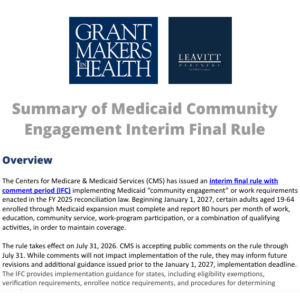
Rural Health Transformation Program: Opportunities for Philanthropy
This GIH issue brief is a high-level analysis of major themes as identified from initiatives and strategies in state applications, reflecting the primary foci of each state’s Rural Health Transformation (RHT) program. Based on this analysis, we offer several recommendations for grantmaker investment and action in support of RHT initiatives and, ultimately, improving the health and well-being of rural communities.
Understanding Vaccine Access in a Shifting Landscape
This Grantmakers In Health (GIH) Issue Focus provides an overview of the current vaccine policy landscape and describes how health funders can respond to threats to vaccine access.

GIH Bulletin: January/February 2026
One year ago, as we were just one month into the new administration, I wrote that “At a moment when so much has been described as ‘unprecedented,’ and so much of what we value is being attacked, we need to ask ourselves as individuals, organizations, and a field, what do we stand for? What values do we hold, and what will we do and say to defend them?” Today, the answers to these questions are needed more urgently than ever.