
Latest Resources

Blue Cross Blue Shield of Massachusetts Foundation: January 2026
Blue Cross Blue Shield of Massachusetts Foundation released a chart pack which provides an overview of the public coverage programs in Massachusetts, explains the key Medicaid and Marketplace provisions in H.R.1, and elevates what is known about how these provisions will impact the coverage landscape and the health care delivery system in Massachusetts.
The Commonwealth Fund: August 2024
The 2024 State Scorecard on Women’s Reproductive Health has been released based on the most recent data to assess how well the health care system is working for women in every U.S. state. It measures performance by 32 different metrics across three areas: health outcomes; health care quality and prevention; and coverage, access, and affordability.
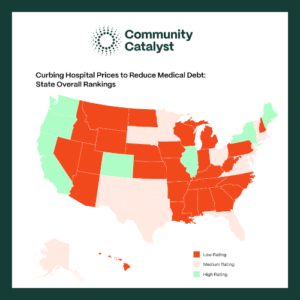
A Compendium of State Policies to Curb Hospital Prices and Reduce Medical Debt
Health care in the United States is the most expensive in the world by far and the reason is simple – health care providers keep increasing the prices of services. Hospitals, which represent the largest component of health care spending, have an outsized influence on medical debt in their communities through their policies and behavior.

As More Americans Gain Health Care Coverage, Advocates Fight for Higher-Quality Insurance
People’s Action and our allies fought hard to win health care for millions through the Affordable Care Act and Medicaid expansion. 91 percent of Americans now have health insurance, even though there is still work to do to ensure everyone can get coverage, particularly immigrants and those living in holdout non-expansion states.
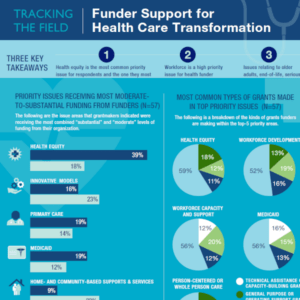
Funder Support for Health Care Transformation
This infographic summarizes the responses to a Grantmakers In Health funder poll, conducted October 2022, on how philanthropy is supporting health care transformation efforts, especially those concerned with improving quality of life, coordinating complex care, and taking patient preferences into account.

Reflecting on the Intersections Initiative
For organizations like the St. Joseph Community Partnership Fund (the Fund) and Prevention Institute (PI), GIH conferences have served as a critical space to bring together advocates across sectors and spark new ideas to address complex health issues. Inspired by a PI-led session on upstream prevention and health equity at GIH’s March 2016 annual conference, the Fund noted the promising landscape for a grantmaking initiative that could focus on root causes of poor health and dismantling systems of inequity, and a partnership was born.

Beyond the Headlines: Towards a New Narrative for Health Philanthropy in Haiti
Contrary to the narrative that all philanthropic investments have been ineffective in Haiti, Partners In Health, Build Health International, and Health Equity International have had immense positive impacts on the health sector in Haiti over the last decade. With sustained funding from the W.K. Kellogg Foundation, these nongovernmental organizations are committed to tackling systemic inequities embedded in the health care system.
AHRQ Releases Annual Update on U.S. Healthcare Quality, Disparities
The Agency for Healthcare Research and Quality has released its National Healthcare Quality and Disparities Report, which details the state of healthcare quality and disparities in the United States. The report identifies improvements in HIV and colon cancer care, nursing home care, and medication prescribing to older adults. The report also indicates that more work needs to be done to address disparities in important areas. Among the findings, dental and oral health care services have not substantially improved, particularly for people with low income or who live in rural areas.
Reimagining A Quality Information System For US Health Care
Recommendations include: a national data infrastructure that operates independent of practice setting; aligned multipayer incentives that support needed infrastructure investments; longitudinal patient-reported outcome measures captured both in-clinic and through mobile technologies; a series of robust regional demonstration projects to broaden stakeholder understanding and technical capability; and a governance mechanism that assures both simplification and alignment of methods.
Connect With Funder Peers on Quality
Interested in exchanging strategies, information, and questions with your funder peers? Sign up for GIH E-Forums.